Shareable links for wellness apps can turn every class, trainer profile, or wellness program into a mini-landing page that markets your product automatically. Instead of forcing users through long app-install funnels, deep links allow anyone to open the exact content instantly.
By moving to Flutter Web with deep links, you can give each of your classes a unique URL. And anyone clicking it will be able to get straight to the content (either in-app or in the browser).
The result? The user’s phone is the final step in the funnel, not a stumbling block. This shift turns passive users into active promoters – every click becomes a potential sign-up. This article reveals how it works in practice and why it’s a must-have feature for you.
The Problem
Without shareable links, wellness apps trap content. A trainer or user cannot simply paste a link to a workout into WhatsApp or Instagram. They have to encourage friends to install the app. From the friend’s perspective, the journey looks like this:
- Find the app in the store.
- Install it and wait.
- Register, confirm email, and maybe add payment details.
- Manually search for the studio, the trainer, and the exact class.
- Hope it is not already full.
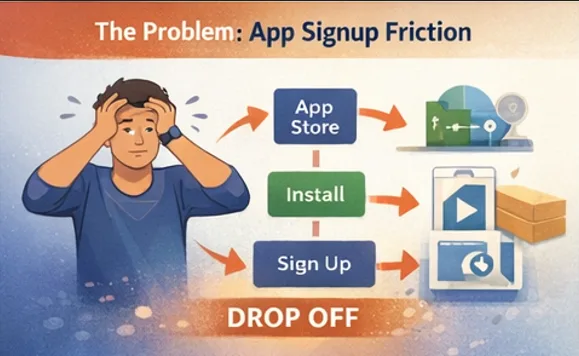
Every extra step kills conversion. In practice, most people drop somewhere between the store page and the search field, which means the original user’s enthusiasm never converts into a booking.
Deep links can make the difference.
This is exactly why shareable links for wellness apps are becoming a critical growth feature for modern wellness platforms.
How Shareable Links for Wellness Apps Work with Flutter Web
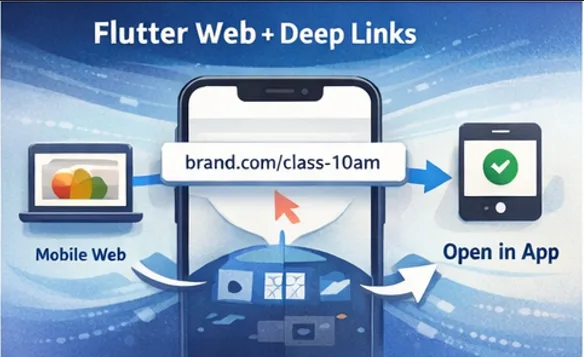
Flutter allows building a single codebase for web and mobile. By adding Flutter Web, every app page (e.g. a specific workout or master class) can be published on the open web, each with its own URL. Deep linking then ties the URL to the app content. In practice:
- Unique URLs for each content page. Every program, coach profile, or recipe gets a dedicated link.
- Instant access via browser. Clicking that link opens the page in a browser immediately – no waiting for app installation.
- Seamless app fallback. If the app is installed, the link can open it to the exact screen via Universal Links/App Links. If not, it stays on mobile web.
- Shared codebase. Flutter’s architecture means the same Dart code controls routing on all platforms. With little extra effort, developers set up named routes or Router API to respond to paths. Google even provides a Deep Linking Validator to ensure links work across iOS/Android.
The key is that deep links turn every user interaction shareable by design.
With Flutter Web, developers can implement shareable links for wellness apps that work across web and mobile environments.
What the User Journey Looks Like with Shareable Links
Imagine a typical scenario for a studio network or wellness app:
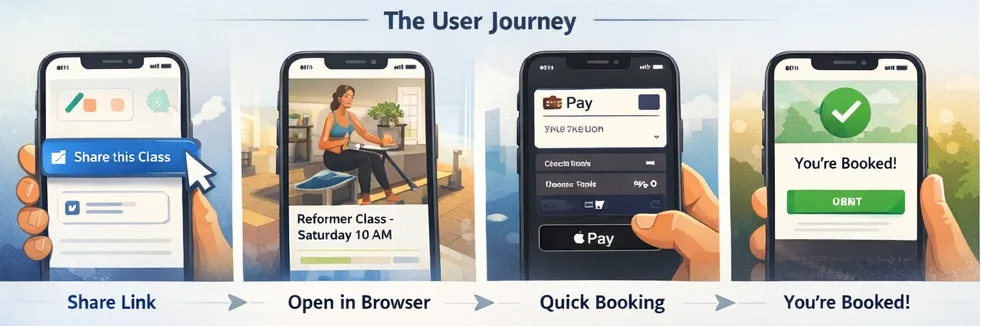
- A loyal client books a Saturday reformer class with their favorite instructor.
- At checkout, they see a “Share this class with a friend” button.
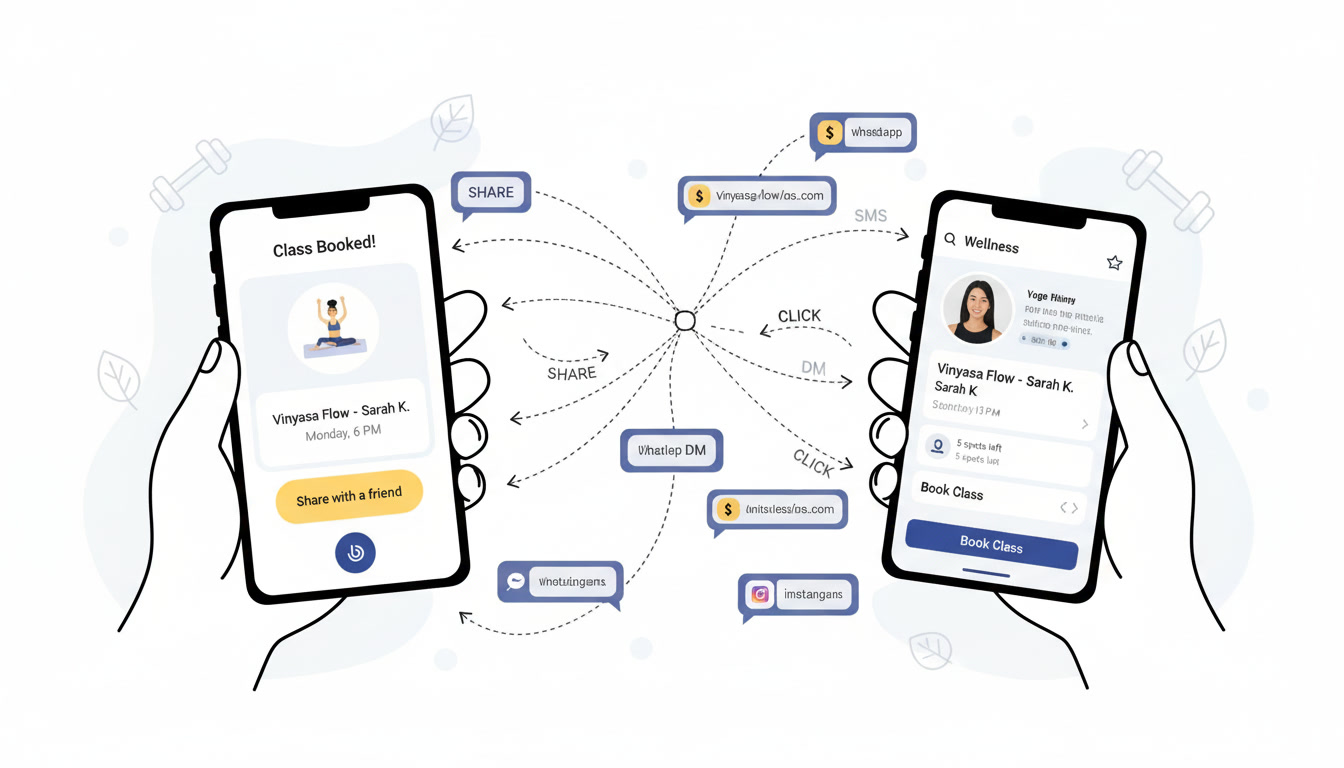
- Tapping it generates a unique link like brand.com/class/reformer-sat-10-00 and offers WhatsApp/Telegram/Messenger sharing.
- The friend taps the link on their phone:
- If they do not have the app, the link opens instantly in the browser, on a mobile-first Flutter Web page that shows exactly that class, instructor, time, and available spots.
- If they already have the app, the link can deep‑link directly into the native screen for the same class, pre‑filled and ready to book.
- With Apple/Google Pay or a simple guest checkout, booking takes a couple of taps.
From the friend’s perspective, the whole flow, from “Tom sent me a link” to “I’m booked for Saturday”, can take less than 20 seconds.
Business Impact: Links Instead of Ad Spend
Technically, deep links are just URLs. Economically, they bring lots of measurable business advantages:
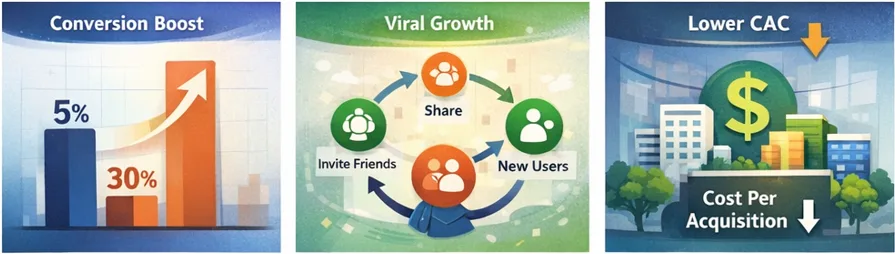
- Dramatically higher conversion rates. Deep links reduce friction. Marketing studies show click-to-install conversion rates skyrocketing with deep links – 30%+ vs ~5% in generic funnels. Google Ads even cites up to 2× conversion lift from deep linking to specific content.
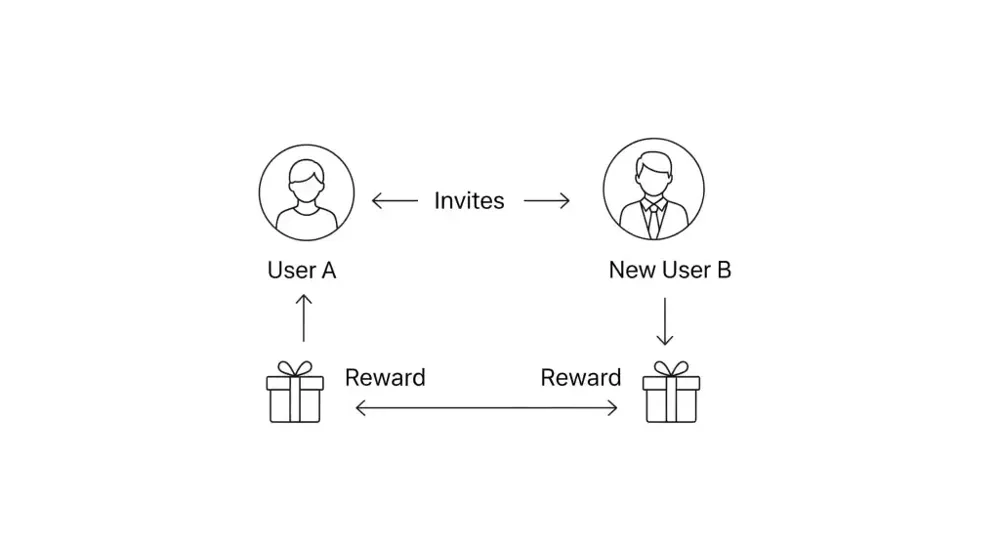
- Explosive viral loops. When users can instantly share content, referral loops kick in. Referral incentives where you invite friends and everyone gets a bonus create self-sustaining growth. If each user invites even a few friends with a personalized link, the viral coefficient (new users per user) can exceed 1. That means each campaign of invites more than replaces itself.
Indeed, FitConnect, a fitness app, grew installs by 326% via social sharing and saw 60% of new users come from social referrals – all without huge ad spend.
Why Deep Links Improve Conversion
- Lower customer acquisition cost (CAC) through organic growth. Every share is free marketing. Our analysis shows that even conservative virality cuts CAC dramatically. For example, if baseline CAC is $10, adding shareable invites (viral coefficient ~0.5) can yield CAC ~$6. More aggressively, if each user brings >1 friend (viral coefficient>1), CAC effectively becomes near zero.
- Enhanced retention and engagement. When users land directly on content they care about, they engage more. Deep linking leads to longer sessions and higher activity. In wellness, seeing your friend’s progress or recommended workout instantly in-app drives stronger habits – exactly the core product value.
| App vs Web+Deep Links | ||
| Native App (no deep links) | Flutter Web + Deep Links | |
| Friction to share | High: User must find/copy a long code or ask friend to install and search manually. Multiple manual steps. | Low: One tap to copy/share URL or share button. No app needed to view. |
| Time-to-signup | Minutes: Friend downloads app (30–60s), registers (1+ minute) before seeing content. | Seconds: Click link → instant content load. Signup prompt appears at content (all in one flow). |
| Conversion rate | Low (≈5%): Generic journey (app store ad → install → signup) converts poorly. | High (≈30%): Deep-linked invites can triple conversion. (E.g. from 5%→30%.) |
| Viral coefficient | Minimal (~0.1–0.2): Few users actually complete invite flow. k<1, no self-sustaining growth. | High (~0.6–1.0+): Encouraging share and easy join can push k near or above 1. Each user brings ~0.6–1 new user. |
Real-life Examples
When an app makes every workout, challenge, or trainer profile instantly accessible through a simple link, something powerful happens: users stop being passive consumers and start acting as distribution channels.
The following examples show how shareability can replace massive advertising budgets and turn community into acquisition.
| YukaThe French wellness app Yuka grew to 73 million users mainly through organic sharing. The company spent $0 on ads, relying on users sharing it with friends and family. According to Yuka’s founders, “the main reason for our growth is word of mouth” – satisfied users tell 10–20 people about the app. |
| StravaAfter workouts, Strava, the fitness app, auto-generates a colorful summary image of your run or ride and prompts you to share it on social media. Each share includes a link back to Strava’s site/app, effectively turning social posts into user acquisition ads. |
| FitConnectIn a recent campaign, FitConnect (a fitness/social app) shifted from paid ads to user-generated social content. They ran Instagram/TikTok challenges and saw a 326% increase in installs, with 60% of new users from social referrals. The lesson: shareable content (like “30-day push-up challenge”) acted as a potent invite. A wellness app with shareable routines could replicate this without heavy paid budgets. |
Although the mechanics may differ (social posts, rewards, push notifications), all these examples illustrate how shareability trumps traditional marketing.
Where to Start with Shareability in Your Wellness Product
For a studio chain, wellness SaaS, or consumer app, a practical roadmap might look like this:
- Map your “high-intent” screens. Trainer profiles, individual classes, onboarding offers, challenge pages, and supplement bundles are prime candidates for deep links.
- Design URLs like marketing assets. Use human‑readable, SEO‑friendly paths (/coach/helen-strength, /challenge/14-day-reset) so links look trustworthy and understandable when shared in chats or stories.
- Implement Flutter Web deep linking. Configure Flutter’s path-based URL strategy and navigation to ensure each key screen has a stable, shareable URL, following the official deep-linking patterns.
- Layer on referral mechanics. Add referral parameters to those URLs and attach simple, meaningful rewards. Start with one or two clear use cases (e.g., “invite a friend to this class” or “share this program”) and iterate based on real data.
- Promote sharing as a feature, not a footnote. Communicate to users that they can invite friends directly into a specific class or program, not just “share the app.” Make it visible in onboarding, emails, and in‑product prompts.
Conclusion: Shareability Is Infrastructure, Not a Feature
Shareable deep links built with Flutter Web turn your product into a living marketing engine.
Instead of pushing users through a generic app-store funnel, you let them send a direct path to value.
In the long term, shareable links for wellness apps transform users into your most effective marketing channel.
At Dreambit, we build scalable digital infrastructure for wellness brands. We help studio networks, fitness startups, and health platforms:
- Implement Flutter Web with production-ready deep linking
- Design frictionless booking and onboarding flows
- Architect referral mechanics that drive measurable growth
Reduce CAC while increasing LTV.