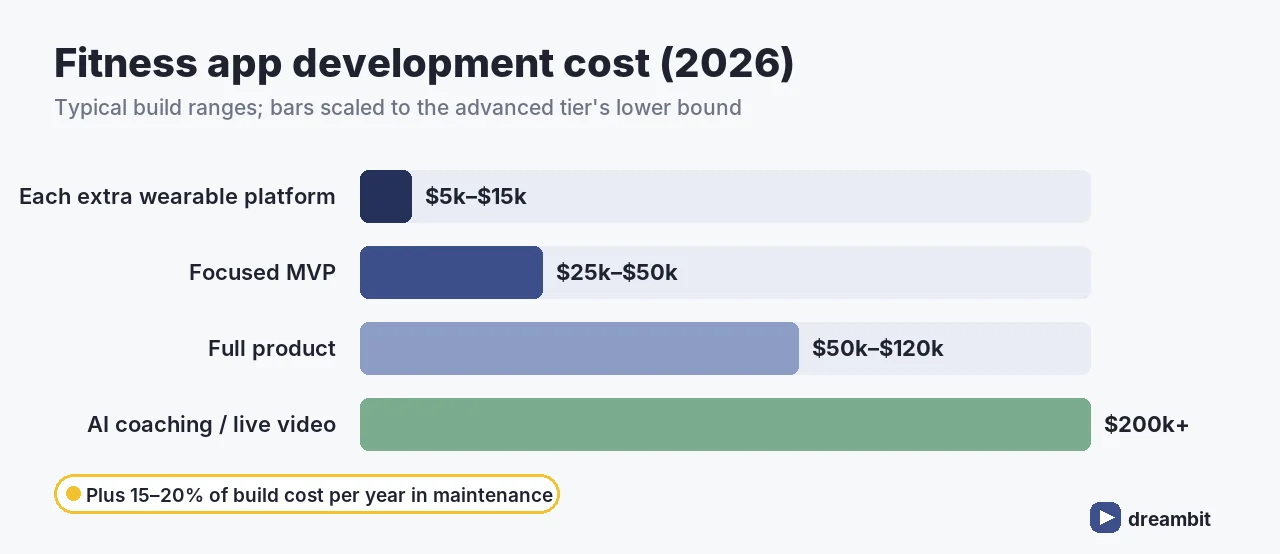
Fitness app development in 2026 typically costs $25,000–$50,000 for a focused MVP, $50,000–$120,000 for a product with wearable integrations and subscription billing, and $200,000+ for AI coaching or live-video platforms. The build is the easy part, though. Fitness is a subscription business, and what decides whether an app survives is how many users start a trial, how many of those pay, and how many are still training in month three.
Wellness is the industry where Dreambit has done the most work. Over 14 years and 150+ products (5M+ downloads, 4.9★ across 114 reviews), we’ve built meal-planning and macro-tracking apps, studio booking platforms, churn-prediction and cancellation flows for subscription wellness brands. This guide covers the app types, the features that matter, what wearables really involve, the subscription numbers to plan around, and what it all costs.
Types of fitness and wellness apps
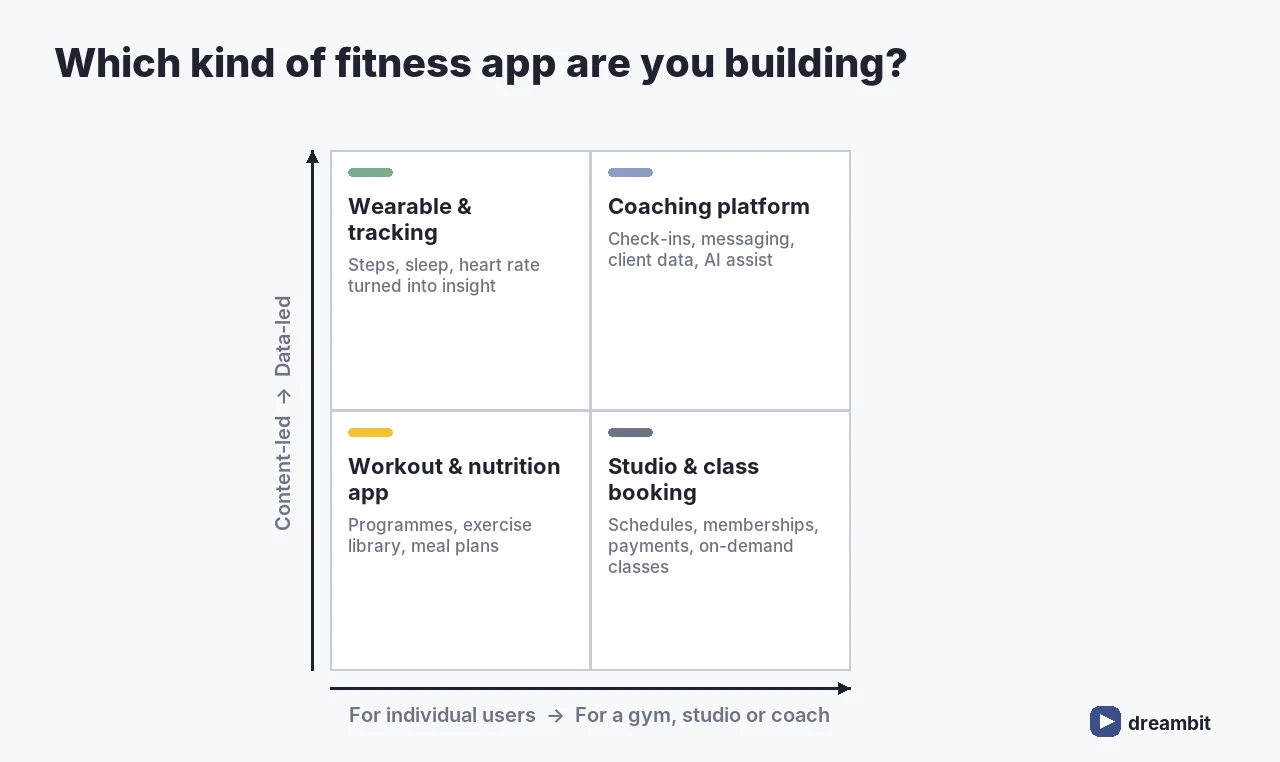
“Fitness app” covers several different products with different economics:
- Workout and training apps: guided programmes, exercise libraries, progress tracking. Content and programming quality are the product.
- Nutrition and meal-planning apps: food logging, macro tracking, recipes and plans. Data entry friction is the enemy. We wrote about building one in a wellness app for clean, simple eats.
- Studio, gym and class-booking apps: schedules, memberships, payments and check-in for a business and its members. Reliability beats novelty. See why your yoga studio booking software is holding you back.
- Wearable companions and activity trackers: steps, heart rate, sleep and recovery pulled from devices and turned into insight.
- Coaching platforms: one-to-one or group coaching with messaging, check-ins and, increasingly, AI assistance.
Most successful products combine two of these, typically training plus nutrition, or booking plus on-demand content. Trying to be all five at launch is how fitness MVPs end up as $200,000 projects.
Core features of a fitness app
The non-negotiable core, whatever the type:
- Onboarding that personalises: goals, level and schedule in a few taps, used immediately to shape the first session. We covered the pattern in progressive onboarding UX.
- The core loop: a workout player, a food log or a booking flow that works fast, works offline and never loses data.
- Progress tracking: streaks, personal bests, charts. People stay for visible progress.
- Reminders and nudges: timely, relevant and easy to tune. Pushy notifications get the app deleted.
- Subscriptions and paywall: trials, plans, restore purchases, and an honest cancellation flow.
- Health data integration: Apple Health and Android Health Connect for steps, workouts and heart rate.
- Privacy controls: clear consent, data export and deletion. Health data is sensitive data.
Wearables and health data: what integration really involves
Wearable support is the feature founders ask for first and underestimate most. On iOS, apps read and write health data through Apple HealthKit. On Android, the platform standard is Health Connect. Google is retiring the older Google Fit APIs, so new Android work should target Health Connect from day one, and existing Fit integrations need a migration plan.
Beyond the two platform hubs, each direct device integration (Garmin, Oura, Whoop, Polar and so on) has its own API, authentication, rate limits and data model. Budget roughly $5,000–$15,000 for each additional wearable platform beyond the first, and remember each one is a dependency to maintain.
The hard part of wearable data isn’t reading it. It’s reconciling it. The same run can arrive from the watch, the phone and a third-party app with different distances, timestamps and heart-rate curves. Deciding which source wins, and showing users a number they trust, is where fitness apps earn or lose credibility.
The subscription numbers that decide success
Almost every fitness app monetises through subscriptions, so it’s worth knowing what normal looks like before you build.
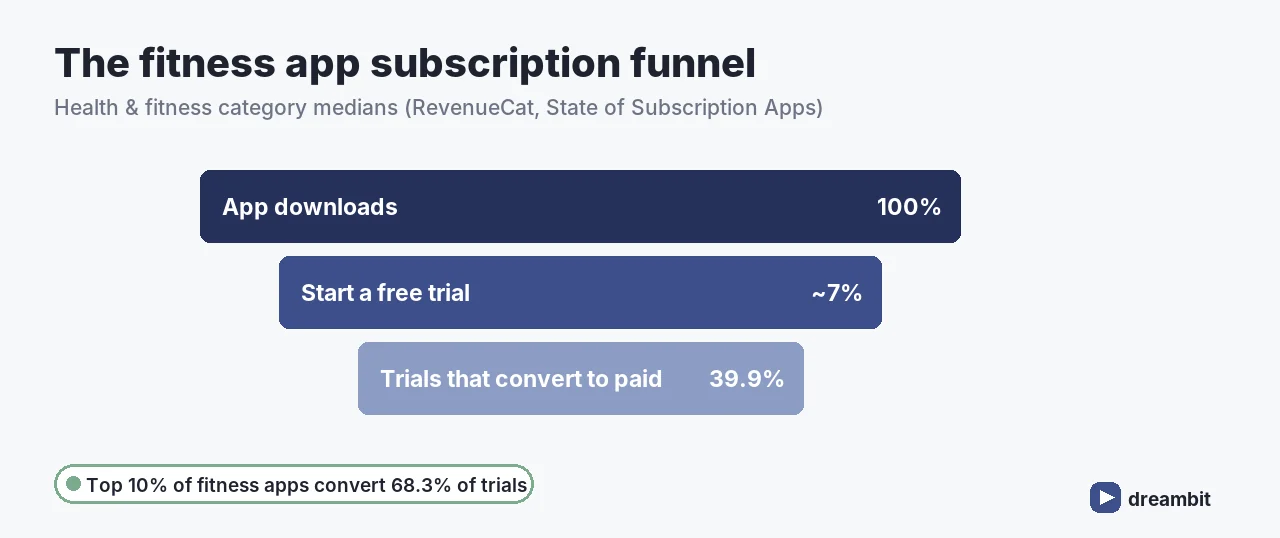
In the health and fitness category, a median of about 7% of downloads start a free trial, and a median of 39.9% of trials convert to a paid subscription. The top 10% of apps convert 68.3% of trials. Longer trials also convert better: across categories, trials of 17 days or more convert markedly better than short ones (RevenueCat, State of Subscription Apps).
Two practical consequences follow. First, your paywall and trial design is a product feature, not a pricing afterthought. It deserves the same design and testing effort as the workout player. Second, health and fitness has one of the highest lifetime values of any app category, which is why it’s worth investing in retention rather than just acquisition. Most successful apps price between roughly $10 and $20 a month, with a discounted annual plan.
Retention: the real product
Downloads are cheap and motivation is temporary. Fitness apps live or die in the weeks after New Year’s resolutions fade. What we’ve seen work:
- Adaptive plans: workouts that adjust to missed sessions and progress outperform static content libraries.
- Small wins early: a first workout or logged meal within minutes of install, not after a long setup.
- Streaks with forgiveness: streaks motivate, but a single missed day shouldn’t reset months of progress.
- Social and sharing: lightweight sharing of achievements is free distribution. See how links replace marketing budgets for wellness brands.
- Churn prediction: spot disengagement before cancellation and intervene. We explain our approach in how we predict user churn.
- An honest cancellation flow: pause options and downgrade paths save subscribers without dark patterns, as in our cancellation flow case study.
Where AI genuinely helps in fitness apps
AI is the most requested feature in fitness briefs right now, and the most often misapplied. The uses that earn their running cost:
- Adaptive programming: adjusting volume, intensity and rest from logged performance and missed sessions. This is the single biggest retention lever, and much of it can be rules plus light modelling rather than a large language model.
- Photo-based food logging: estimating a meal from a picture removes the friction that kills nutrition apps. It needs an easy way to correct the estimate, because users notice wrong numbers fast.
- Coaching chat grounded in the user’s own data: answering “why was this week harder?” from their actual training history, not generic advice. That’s a retrieval problem, covered in AI chatbot development.
- Form feedback from the camera: pose estimation for squats or yoga poses is now feasible on-device, but it needs careful testing across body types, lighting and angles before it’s trustworthy.
What doesn’t earn its keep: a generic chatbot bolted onto the home screen. Every AI feature adds a monthly API bill and an accuracy risk, so start with the one that removes your users’ biggest point of friction.
How much does fitness app development cost?
- Focused MVP: $25,000–$50,000. One core loop (workouts or nutrition or booking), onboarding, progress tracking, subscriptions, Apple Health or Health Connect.
- Full product: $50,000–$120,000. Both platforms, wearable integrations, personalised plans, social features, admin and content tools, analytics.
- Advanced platform: $200,000+. AI coaching, live or on-demand video streaming, multi-location studio management, deep device ecosystems.
- Each extra wearable platform: roughly $5,000–$15,000 on top.
After launch, expect 15–20% of the build cost per year for maintenance, plus cloud, video and AI API costs that scale with active users. For the general picture across app types, see our guide to mobile app development cost.
Many wellness businesses can also cut the bill substantially by choosing the right platform approach. We’ve written about how wellness brands can save 40% of their app budget and when mobile-first web beats native for wellness businesses.
Privacy and health data
Fitness data reveals a lot: heart rate, weight, sleep, menstrual cycles, location. Treat it accordingly:
- Ask for health permissions only when the feature needs them, and explain why.
- Follow Apple’s and Google’s health-data policies exactly. Both stores review health apps strictly.
- Encrypt health data in transit and at rest, and never pass it to advertising SDKs.
- Offer export and deletion that actually work, as GDPR requires in Europe.
- If the app is used by clinicians or makes medical claims, you’re in healthcare territory. See healthcare app development for what changes.
Our fitness app development process
- Discovery (1–2 weeks): audience, core loop, monetisation model and which devices actually matter to your users.
- Prototype the core loop: test the workout player or food log with real users before building anything else.
- Design the paywall and onboarding together: they’re one funnel.
- Build cross-platform: one Flutter codebase for iOS and Android, with native HealthKit and Health Connect bridges.
- Instrument everything: trial starts, conversions, workouts per week and churn signals from day one, using Firebase analytics as described in how Firebase works for app analytics.
- Launch, measure, iterate: the first 90 days of retention data tell you what to build next.
Common fitness app development mistakes
- Building every app type at once. Pick one core loop and make it excellent.
- Treating the paywall as an afterthought. Trial design moves revenue more than most features do.
- Underestimating wearables. Each device is an integration to build and to maintain.
- Static content libraries. Adaptive plans keep people training. Video catalogues alone don’t.
- Punishing streaks. Losing a 90-day streak to one sick day is a reason to quit.
- Careless health data. One privacy incident undoes years of brand trust.
Key Takeaways
- Fitness app development costs $25k–$50k for an MVP, $50k–$120k for a full product, and $200k+ for AI or live-video platforms.
- Pick one core loop (training, nutrition or booking) and make it excellent before expanding.
- Use HealthKit on iOS and Health Connect on Android. Google Fit APIs are being retired.
- Each extra wearable platform adds roughly $5k–$15k plus ongoing maintenance.
- Health and fitness medians: about 7% of downloads start a trial, and 39.9% of trials convert (top 10%: 68.3%).
- Retention is the product: adaptive plans, early wins, forgiving streaks, churn prediction and honest cancellation.
- Treat health data as sensitive data: minimal permissions, encryption, no ad SDKs, working deletion.
Frequently Asked Questions
A focused fitness app MVP with one core loop, onboarding, progress tracking, subscriptions and Apple Health or Health Connect typically costs $25,000–$50,000. A full product on both platforms with wearable integrations, personalised plans, social features and admin tools runs $50,000–$120,000. AI coaching, live-video streaming or multi-location studio platforms start around $200,000. Each extra wearable platform adds roughly $5,000–$15,000.
A focused MVP usually takes 3–4 months from discovery to store release, and a full product with wearables and subscriptions 5–8 months. Wearable integrations, video infrastructure and store review of health-data permissions are the usual timeline risks, so prototype the core loop early and integrate devices before the final sprints.
Start with the platform hubs: Apple HealthKit on iOS and Health Connect on Android, which together cover data from most devices your users already own. Google is retiring the older Google Fit APIs, so new Android work should target Health Connect. Add direct integrations with specific devices such as Garmin, Oura or Whoop only when your audience clearly uses them, since each one is a separate API to build and maintain.
In the health and fitness category, a median of roughly 7% of downloads start a free trial and a median of 39.9% of those trials convert to a paid subscription, according to RevenueCat’s State of Subscription Apps. The top 10% of apps convert 68.3% of trials. Longer trials tend to convert better, and most successful fitness apps price at roughly $10–$20 a month with a discounted annual plan.
The most effective tactics are adaptive plans that adjust to missed sessions and progress, small wins within minutes of install, streaks that forgive an occasional missed day, lightweight social sharing, churn prediction that triggers help before a user cancels, and an honest cancellation flow with pause and downgrade options. Static content libraries on their own rarely sustain engagement.
Yes, in practice it should be treated as sensitive health data. Heart rate, weight, sleep, cycles and location can reveal a great deal about a person. Request permissions only when needed, follow Apple’s and Google’s health-data policies, encrypt data in transit and at rest, never share it with advertising SDKs, and provide working export and deletion. If the app makes medical claims or is used by clinicians, healthcare regulations may apply.