AI chatbot development in 2026 means one of three very different projects: configuring a SaaS widget, building a RAG chatbot grounded in your own documents, or building an agent that acts inside your systems. A standard business RAG chatbot costs $12,000–$25,000; a mid-complexity custom build with CRM integration, multi-turn conversation and analytics lands at $75,000–$120,000 over 8–14 weeks; enterprise platforms run to $250,000+. The number that decides whether any of it was worth it is deflection rate — the share of questions answered without a human.
Dreambit has shipped 150+ products over 14 years (5M+ downloads, 4.9★ across 114 reviews) and builds AI into client products under a spec-first, evaluation-driven discipline — the same one described in how we build with AI. This guide is the unromantic version: what you’re actually buying, what it costs to run, and the failure modes nobody demos.
What AI chatbot development actually covers
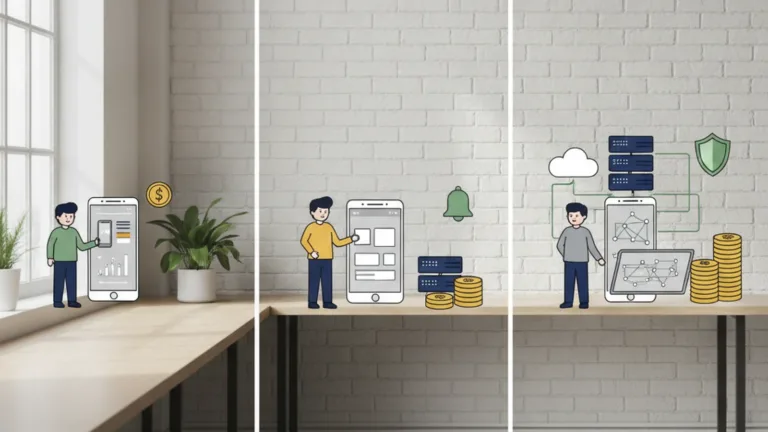
The word “chatbot” hides a 20× cost range. Three tiers, in ascending order of effort:
- SaaS widget — a hosted platform you configure and point at a website or help centre. $19–$500 a month, live in days. Good for FAQ deflection on public content.
- Custom RAG chatbot — retrieval-augmented generation over your knowledge: documents, tickets, product data, policies. Answers cite sources. This is where most serious projects land.
- Agent — it doesn’t just answer, it acts: books, refunds, updates records, calls your APIs. A different risk profile and a different budget, covered in AI agent development.
Getting this classification right in week one is the highest-leverage decision in the whole project. Most companies asking for an “AI assistant” need tier two.
When a chatbot is the right tool
A RAG chatbot earns its budget when four things are true:
- The answers already exist in writing — documentation, policies, specs, a ticket history. If they live only in people’s heads, you have a documentation project first.
- Question volume is high and repetitive — the same forty questions, thousands of times.
- Being wrong is recoverable — a user can escalate, and no irreversible action is taken on a bad answer.
- Someone owns the content — because the bot’s quality is your content’s quality, permanently.
Where it isn’t the answer: highly regulated advice without human review, questions that require live calculation across systems (that’s an agent or a plain integration), and organisations whose documentation is contradictory — the chatbot will faithfully surface the contradiction to your customers. Saying that out loud before a contract is signed is part of the job — the same argument we made in our take on AI.
How a RAG chatbot actually works
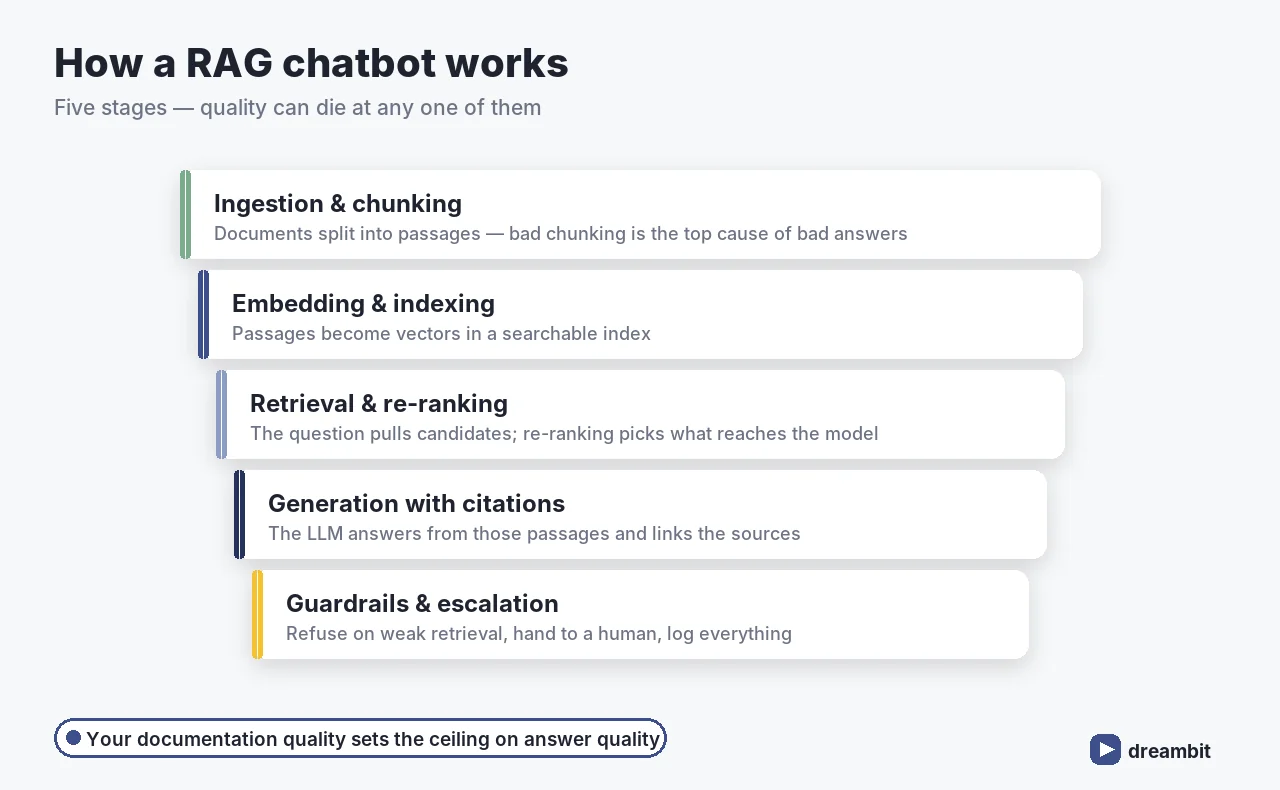
Under the marketing, retrieval-augmented generation is a pipeline, and every stage is somewhere the quality can die:
- Ingestion & chunking — your documents are split into passages. Bad chunking is the single most common cause of bad answers.
- Embedding & indexing — passages become vectors in a searchable index.
- Retrieval & re-ranking — the question pulls candidate passages; re-ranking decides what actually goes to the model.
- Generation with citations — the LLM answers from those passages and links them.
- Guardrails & escalation — refuse when retrieval is weak, hand to a human, log everything.
The technique dates to the original retrieval-augmented generation paper, but the engineering that matters in production is unglamorous: chunk boundaries, metadata filters, re-ranking, and knowing when to say “I don’t know”.
How much does AI chatbot development cost in 2026?
Realistic build ranges, assuming a competent team and an existing knowledge base:
- SaaS platform, configured — $0–$500/month, plus a few days of setup. No engineering.
- Standard RAG chatbot — $12,000–$25,000: ingestion, chunking, embeddings, vector store, retrieval and re-ranking, LLM integration, chat UI, deployment.
- Mid-complexity custom build — $75,000–$120,000 over 8–14 weeks: knowledge-base integration, multi-turn memory, CRM connectivity, analytics, evaluation harness.
- Enterprise platform — $150,000–$250,000+: fine-tuning, multi-language, compliance, SSO, multi-channel, human-handoff tooling.
The spread between a $15,000 chatbot and a $120,000 one is almost never the model. It’s integrations, evaluation infrastructure and the state of your content. Two clients with identical requirements can differ 5× in price because one has clean, current documentation and the other has six years of contradictory PDFs.
The same drivers apply across custom work generally — see the cost of custom software development in 2026.
The monthly bill
A chatbot is not a one-off purchase. Running costs typically sit at $1,000–$15,000 a month depending on volume and architecture: LLM tokens, embedding refreshes when content changes, vector database hosting, monitoring, and the human time to review conversations and fix bad answers.
Two levers keep it sane: retrieve fewer, better passages instead of stuffing context, and route simple intents to a cheaper model. Both are engineering decisions with a direct line to the invoice.
What good looks like: deflection and accuracy
Vendors quote wild numbers, so here are the ranges worth planning against.
Rule-based bots deflect roughly 15–25% of tickets and hybrid NLU bots 42–58%, while a well-tuned RAG chatbot on clean documentation reaches 70–80%. The median AI chatbot handles about 41% of Tier-1 contacts without a human. Grounding is what makes the difference: it cuts hallucination from a reported 5–15% down to 2–4%, and teams deploying RAG report 40–60% better response accuracy than a standalone LLM (industry benchmarks, 2026).
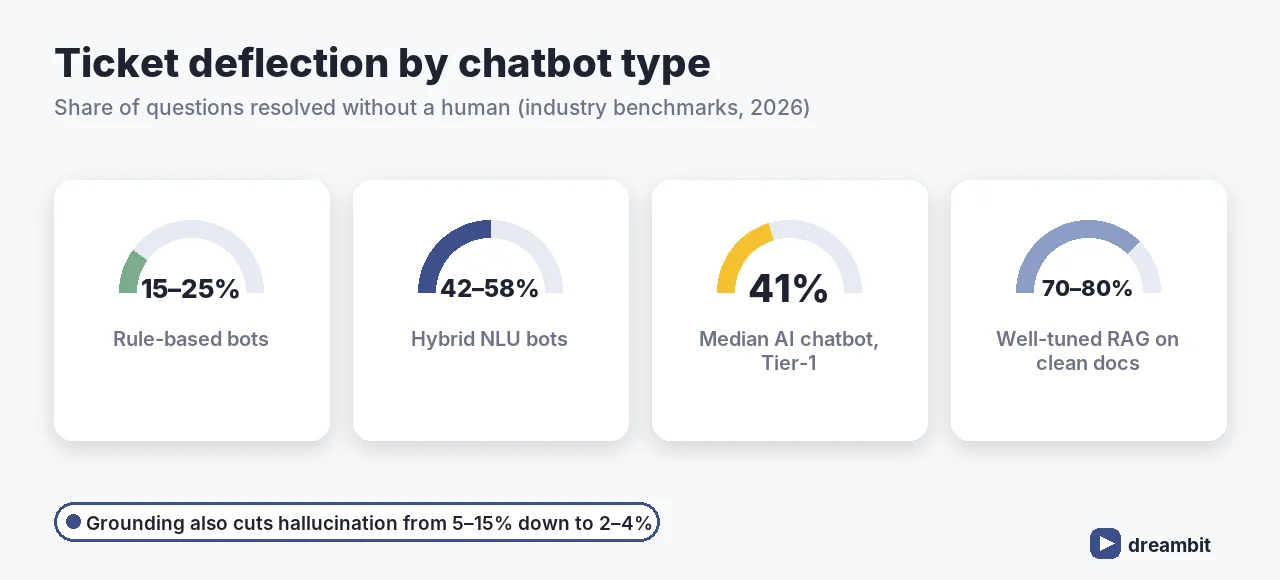
Support deflection is also where AI pays off fastest in consumer products — order status, returns and delivery questions in e-commerce apps are almost entirely answerable from existing content. Read the benchmark carefully, though: the 70–80% figure is conditional on clean documentation. A chatbot deployed onto messy content lands closer to the rule-based end of that range, having cost ten times as much.
Your content is the product
This is the part clients least expect and most need to hear. A RAG chatbot is a mirror: it reflects your documentation back at your customers, faster and more confidently than your website ever did. Outdated pricing, a policy that contradicts the terms page, two different refund windows in two different documents — the bot will find them and repeat them.
So the first sprint of a serious chatbot project is usually content triage: what’s canonical, what’s dead, who owns each section, and how updates reach the index. Budget for it. It’s cheaper than the alternative, which is discovering it in production.
SaaS platform or custom build?
An honest comparison, because plenty of businesses should not be commissioning custom software for this at all:
Pick a SaaS platform when your content is public, your questions are simple, you need it live this month, and you don’t need it inside your systems. Pick a custom build when answers depend on private or per-customer data, when you need real integrations, when compliance dictates where data lives, or when the chatbot is part of your product rather than a support add-on. Starting on SaaS and migrating later is a legitimate strategy — the same staged logic as any MVP approach.
Accuracy, hallucination and trust
You cannot eliminate hallucination; you can make it rare, visible and cheap. What works in production:
- Cite every answer. Sources let users verify and give your team a debugging trail.
- Refuse on weak retrieval. If nothing relevant came back, say so and escalate — a confident wrong answer costs more than a handoff.
- Constrain scope. A bot that answers only what it’s grounded in beats one that will discuss anything.
- Run an evaluation set. 50–100 real questions with known-good answers, re-run on every change to prompts, chunking or model.
- Watch the tail. Review the conversations where users rephrased, escalated or gave up — that’s your roadmap.
Evaluation is what separates a demo from a product. Without it you are guessing whether last week’s change helped.
Security and data boundaries
A chatbot over internal knowledge is a new access path to that knowledge, and permissions do not come for free. What we insist on: per-user retrieval filters so the bot can never surface a document the person couldn’t already open; PII redaction before anything is logged or sent to a model; a clear, written answer to “where does our data go and is it used for training”; and full conversation logging for audit. In regulated work — the kind covered in insurance app development — that last point is not optional.
Treat retrieved content as untrusted input, too: a document containing instructions is still a document, not a command.
How we build chatbots
- Content audit (week 1) — what exists, what’s canonical, who owns it.
- Question inventory — the real top 100 questions from tickets and search logs, not the ones people assume.
- Evaluation set before build — 50–100 questions with known-good answers and sources.
- Thin vertical slice — one content domain end to end, measured, before widening.
- Guardrails and handoff — refusal behaviour, escalation path, logging.
- Pilot with real users — an internal team or a segment of traffic first.
- Tune monthly — content fixes, chunking, re-ranking, prompt changes, all re-scored against the eval set.
It’s the same pattern we apply to every AI feature we ship — see what we build with AI for the wider picture.
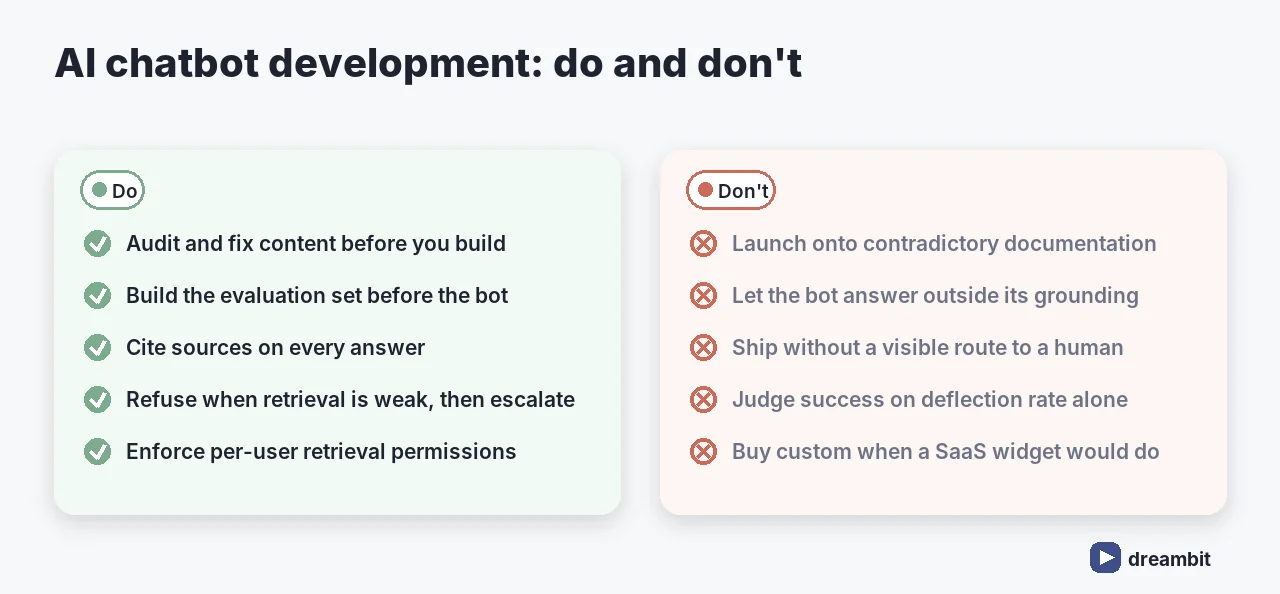
Do and don’t
The patterns that separate the chatbots still running after a year from the ones quietly switched off.
What to measure
Four numbers, reviewed monthly: deflection rate (resolved without a human), answer accuracy against your evaluation set, escalation rate and where it clusters, and cost per conversation. Containment without satisfaction is a trap — a bot that stops people contacting you because it’s useless will look excellent on a deflection dashboard.
Common AI chatbot development mistakes
- Launching on messy content. The bot amplifies whatever your documentation already says.
- No evaluation set. You cannot improve what you cannot score.
- No escalation path. Every bot needs a visible route to a human.
- Answering everything. Scope refusal is a feature, not a limitation.
- Treating launch as the finish line. The first month of real questions is where the product is actually made.
- Buying custom when SaaS would do. If your content is public and your questions are simple, spend the money elsewhere.
Key Takeaways
- AI chatbot development spans SaaS ($19–$500/mo), standard RAG ($12k–$25k), mid-complexity custom ($75k–$120k) and enterprise ($250k+).
- Running costs are $1,000–$15,000 a month — tokens, embeddings, vector store, monitoring, human review.
- Well-tuned RAG on clean documentation deflects 70–80% of tickets; the median bot manages ~41% of Tier-1 contacts.
- Grounding cuts hallucination from 5–15% to 2–4% — citations are a trust feature, not decoration.
- Your documentation quality sets the ceiling on answer quality. Budget a content audit.
- Build the evaluation set before the chatbot, and re-score every change against it.
- Enforce per-user retrieval permissions and PII redaction from day one.
- Measure deflection, accuracy, escalation and cost per conversation — never deflection alone.
Frequently Asked Questions
A configured SaaS chatbot costs $0–$500 a month with no engineering. A standard custom RAG chatbot — ingestion, chunking, embeddings, vector store, retrieval, LLM integration and a chat UI — runs $12,000–$25,000. A mid-complexity build with knowledge-base integration, multi-turn memory, CRM connectivity and analytics is $75,000–$120,000 over 8–14 weeks, and an enterprise platform with fine-tuning, multi-language support and compliance reaches $150,000–$250,000 and above.
RAG stands for retrieval-augmented generation: instead of relying on what the model memorised, the chatbot searches your own documents for relevant passages and answers from them, with citations. It matters because grounding is what makes answers trustworthy — it cuts hallucination from a reported 5–15% down to 2–4% and improves response accuracy by 40–60% against a standalone LLM.
Rule-based bots deflect roughly 15–25% of tickets and hybrid NLU bots 42–58%. A well-tuned RAG chatbot on clean documentation reaches 70–80%, while the median AI chatbot handles about 41% of Tier-1 contacts without a human. The deciding variable is documentation quality, not the model — a bot deployed onto messy content performs near the rule-based end of that range.
Expect $1,000–$15,000 a month depending on volume and architecture. That covers LLM tokens, re-embedding content when it changes, vector database hosting, monitoring, and the human time to review conversations and fix bad answers. Retrieving fewer, better passages and routing simple intents to a cheaper model are the two levers with a direct effect on the bill.
Use a SaaS platform when your content is public, the questions are simple, you need it live this month and it doesn’t need to reach into your systems. Build custom when answers depend on private or per-customer data, when real integrations are required, when compliance dictates where data lives, or when the chatbot is part of your product. Starting on SaaS and migrating later is a legitimate, lower-risk path.
You make hallucination rare, visible and cheap rather than trying to eliminate it. Ground every answer in retrieved passages and cite them, refuse and escalate when retrieval is weak, constrain the bot’s scope to what it is grounded in, and run an evaluation set of 50–100 real questions with known-good answers on every change to prompts, chunking or model. Then review the conversations where users rephrased or gave up.