
Insights9 minute read
Telemedicine App Development: Features, Compliance and Cost
Telemedicine app development in 2026: the three products you're really building, HIPAA and GDPR in practice, FHIR/EHR integration, e-prescribing, video build-vs-buy, and realistic costs and timelines.
 Dmytro Vashchuk
Dreambit
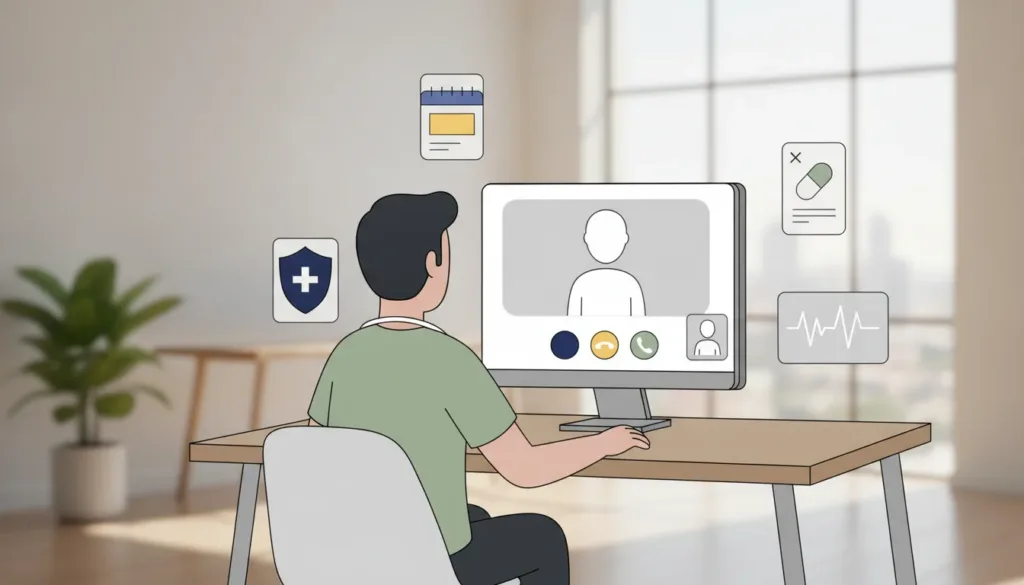
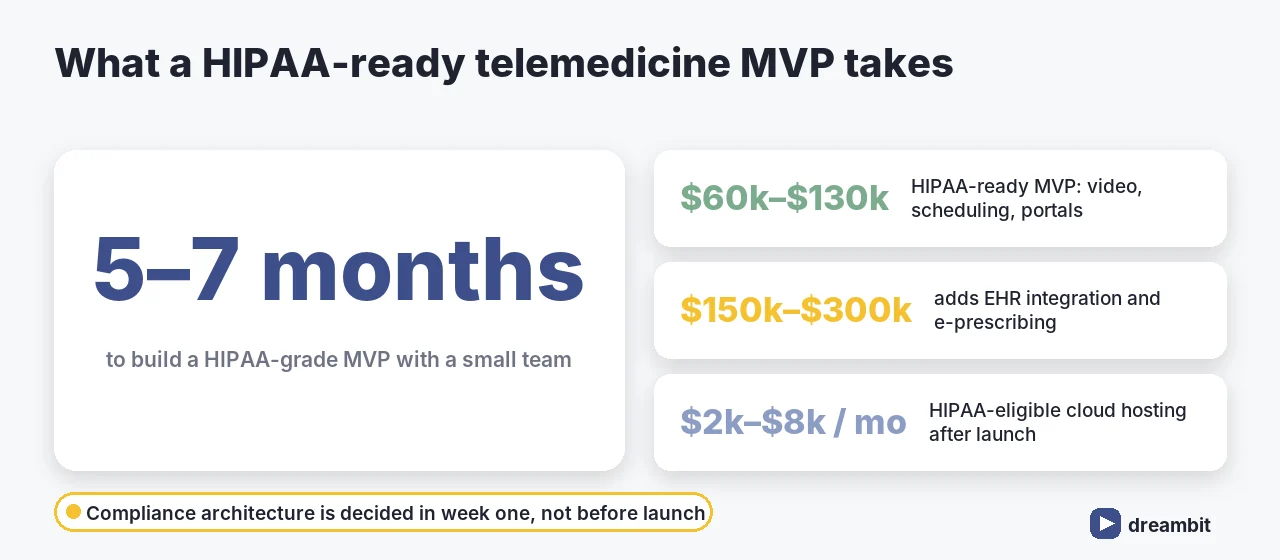
Telemedicine app development in 2026 typically costs $60,000–$130,000 for a HIPAA-ready MVP with video visits, scheduling and patient and clinician portals, and $150,000–$300,000 for a platform with EHR integration and e-prescribing. A HIPAA-grade MVP usually takes 5–7 months. The feature list matters less than you’d think. Cost and timeline are driven by compliance scope and by how deeply the app must integrate with clinical systems.
Dreambit has shipped 150+ products over 14 years (5M+ downloads, 4.9★ across 114 reviews), including healthcare and wellness apps where privacy and reliability are part of the product. This guide covers what a telemedicine platform actually consists of, the compliance work it requires, the integrations that make or break it, and where the budget goes. For the wider sector picture, see our guide to healthcare app development.
A telemedicine app is three products, not one
The most common scoping mistake is to treat a telemedicine app as one app. In practice it’s three connected products with different users and requirements:
- The patient app: booking, intake forms, payments and insurance details, the video visit, prescriptions, records and messaging. It needs to be simple enough for a stressed, unwell, possibly elderly user.
- The clinician app, often a web app: schedule, patient context before the call, the visit itself, clinical notes, e-prescribing and referrals. It needs to be fast, because clinicians judge software in seconds.
- The admin console: provider onboarding and credentials, availability, billing, reporting, audit logs and support tools.
Planning all three from the start, even if only one ships first, avoids the expensive rework of bolting a clinician workflow onto a patient app later.
Choosing a care model: live, asynchronous or remote monitoring
“Telemedicine” covers three care models, and the right mix shapes the whole product:
- Synchronous (live video or audio): the classic virtual visit. It needs scheduling, a waiting room, reliable video and clinician availability. It suits urgent care, mental health and follow-ups.
- Asynchronous (store-and-forward): patients submit questionnaires, photos or readings, and clinicians respond within an agreed window. It’s cheaper to run and fits dermatology, prescription renewals and routine questions.
- Remote patient monitoring: data from devices such as blood-pressure cuffs, glucose meters or wearables flows in continuously, and the system flags readings that need attention. Integration with Apple Health and Android Health Connect, covered in our fitness app development guide, is a common starting point.
Many successful platforms start with one model and add the others later. Asynchronous care is often the cheapest way to prove demand, because it doesn’t require clinicians to be available at fixed times. Whatever you start with, design the data model so a patient’s live visits, messages and readings end up in one record, not three.
Core features of a telemedicine platform
- Scheduling and on-demand queues: booked appointments, walk-in style queues, time zones, reminders and no-show handling.
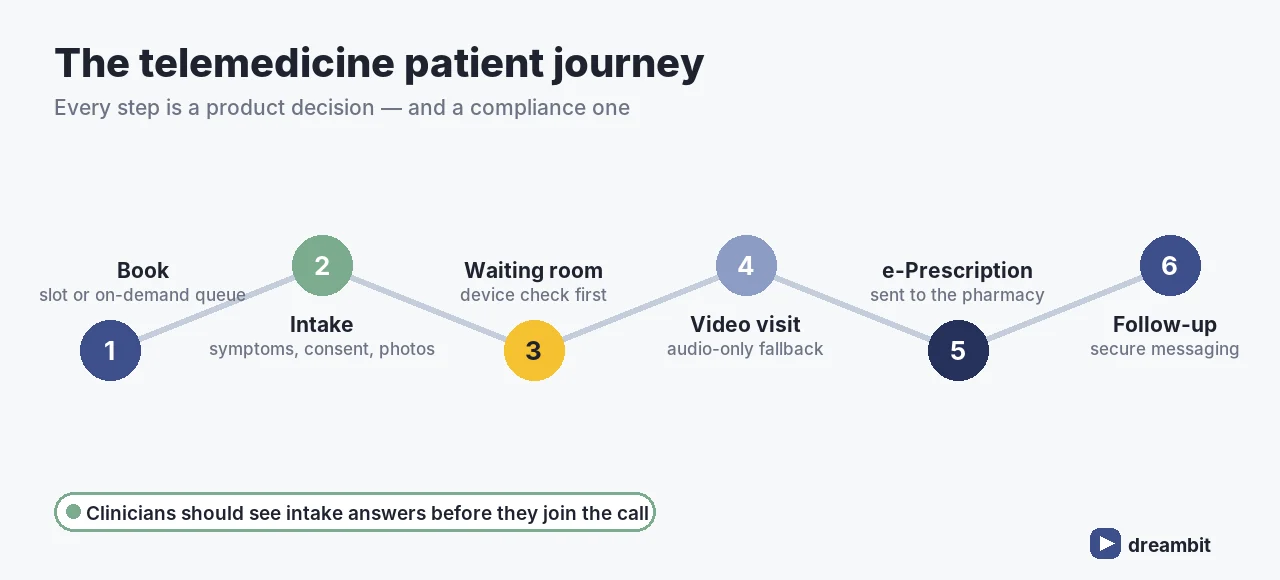
- Video consultations: reliable on poor connections, with a waiting room, screen sharing, and a fallback to audio-only.
- Secure messaging: asynchronous questions, follow-ups and file sharing, with clear expectations about response time.
- Intake and pre-visit forms: symptoms, history, consent and photos, collected before the clinician joins.
- Clinical notes: structured and quick to complete, ideally flowing into the clinic’s EHR.
- E-prescribing: sending prescriptions electronically to pharmacies.
- Payments and insurance: card payments, co-pays, and insurance eligibility where relevant.
- Notifications: reminders, “your clinician is ready” alerts and follow-up prompts, all without exposing health details on a lock screen.
Compliance: HIPAA, GDPR and what they mean in practice
If you serve patients in the US, HIPAA applies. In Europe, GDPR treats health data as a special category requiring explicit safeguards. In practice, compliance means:
- Encryption of health data in transit and at rest, including backups and logs.
- Access control: role-based permissions, multi-factor authentication for clinicians and admins, and automatic session timeouts.
- Audit trails: who viewed or changed which record, and when, retained and reviewable.
- Business associate agreements (BAAs) with every vendor that touches protected health information: hosting, video, messaging, analytics, email.
- Minimal data in notifications and analytics: no diagnoses in push messages, and no health data in ad or analytics SDKs.
- Security testing before launch and on a schedule after it. Our mobile app audit covers what that involves.
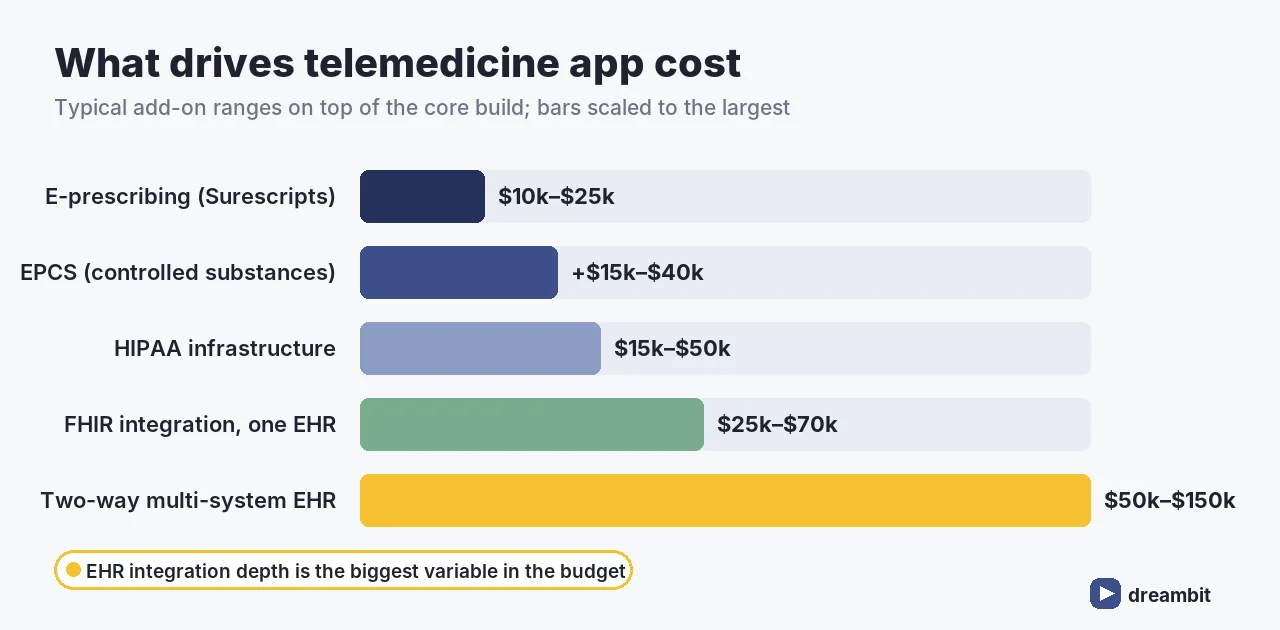
Compliance is a cost line you can’t skip. Industry estimates put HIPAA infrastructure alone at roughly $15,000–$50,000, covering encryption, multi-factor authentication, audit logging and penetration testing, before a single clinical feature is built. That’s also why choosing vendors that will sign a BAA, for video, hosting and messaging, matters more than choosing the cheapest ones.
EHR integration and FHIR
A telemedicine app that doesn’t talk to the clinic’s electronic health record creates double data entry, and clinicians will resent it. Modern integrations use HL7 FHIR, the standard API format for exchanging health data such as patients, appointments, observations and medications.
EHR integration is the largest variable in the budget. A FHIR integration with a single certified EHR commonly runs $25,000–$70,000 and takes 6–12 weeks. A comprehensive two-way integration across several systems can reach $50,000–$150,000. Start with what clinicians actually need from the record during a visit, usually demographics, allergies, medications and recent notes, and grow from there.
E-prescribing
Electronic prescribing usually goes through a certified network such as Surescripts in the US, and typically adds $10,000–$25,000 to the build. Prescribing controlled substances (EPCS) carries extra identity-proofing and two-factor requirements and adds roughly $15,000–$40,000 more. Prescribing rules also vary by country and state, so confirm the regulatory scope with clinical and legal advisers before committing to features.
Video: build vs buy
Almost no telemedicine product should build video infrastructure from scratch. Use an established WebRTC provider that will sign a BAA, and spend your engineering time on the experience around the call:
- A pre-call device and connection check, so problems surface before the clinician joins.
- A virtual waiting room with honest wait-time estimates.
- Automatic quality adaptation, and a graceful fall back to audio when bandwidth drops.
- Reconnection that doesn’t lose the visit when a phone switches from Wi-Fi to mobile data.
Video is billed by usage, often a fraction of a cent per participant-minute, so model it against your expected visit volume early.
How much does telemedicine app development cost?
- HIPAA-ready MVP: $60,000–$130,000. Video visits, scheduling, patient and clinician portals, payments. No EHR integration.
- Mid-tier platform: $150,000–$300,000. Adds EHR integration, e-prescribing, richer clinical notes, admin tooling and analytics.
- Enterprise or on-demand network: $250,000 to $1M+. Multi-specialty provider networks, insurance workflows, multiple EHRs, remote patient monitoring.
After launch, budget for HIPAA-eligible cloud hosting (commonly $2,000–$8,000 a month for a real platform), video usage, e-prescribing subscriptions, security testing and 15–20% of the build cost per year in maintenance. For how these ranges compare with other apps, see mobile app development cost.
Designing for patients and clinicians
Telemedicine UX fails in two predictable places. Patients drop out during sign-up and intake, especially older users and people who feel unwell. Clinicians abandon tools that slow them down between visits. What works:
- Let patients book before they register fully, and collect details progressively. We cover the pattern in progressive onboarding UX.
- Design for accessibility from the start: large text, high contrast and screen-reader support.
- Ask for camera and microphone access only when it’s needed, with a clear explanation. Asking too early costs users, as we showed in app permission requests.
- Give clinicians context in one screen: reason for visit, intake answers and relevant history before they join the call.
- Make notes fast: templates, smart defaults and, increasingly, AI-assisted drafting that the clinician reviews and approves.
Where AI fits in telemedicine
AI is useful in telemedicine when it saves clinician time and stays under clinical review. Common uses include symptom-intake assistants that summarise the patient’s answers for the clinician, ambient note drafting from the consultation, and routing patients to the right service. The rule is the same as anywhere in healthcare: AI drafts, a clinician decides. Answers must be grounded in approved sources, as covered in AI chatbot development. Anything that looks like diagnosis may bring medical-device regulation into scope, so involve regulatory advice early.
Our telemedicine app development process
- Discovery (1–2 weeks): care model, regions, clinician workflow, EHR landscape and compliance scope.
- Compliance architecture first: hosting, vendors with BAAs, data flows and audit logging, decided before features.
- Prototype the visit: test booking, waiting room and video with real clinicians and patients.
- Build in phases: MVP visit flow first, then EHR and e-prescribing, then analytics and AI assistance.
- Security testing and pilot: penetration test, then one clinic or specialty before scaling.
- Operate and improve: monitoring, uptime targets and regular security reviews.
We build most apps in Flutter, so the patient app ships on iOS and Android from one codebase, and the clinician console runs on the web.
Common telemedicine app development mistakes
- Treating compliance as a launch checklist. It’s an architecture decision made in week one.
- Using vendors that won’t sign a BAA. Every service that touches health data needs one.
- Building video in-house. Buy the infrastructure and build the experience.
- Ignoring the clinician app. If clinicians hate it, patients never get a good visit.
- Underestimating EHR integration. It’s usually the biggest and least predictable line in the budget.
- Health data in notifications or analytics. A common and avoidable compliance breach.
Key Takeaways
- Telemedicine app development costs $60k–$130k for a HIPAA-ready MVP and $150k–$300k with EHR integration and e-prescribing.
- A HIPAA-grade MVP typically takes 5–7 months.
- Plan three products: patient app, clinician app and admin console.
- HIPAA infrastructure alone runs roughly $15k–$50k, and every vendor touching health data needs a BAA.
- FHIR integration with one EHR is commonly $25k–$70k, the biggest variable in the budget.
- Buy video infrastructure. Build the waiting room, reconnection and fallback experience around it.
- AI drafts, clinicians decide. Keep AI grounded and under clinical review.
Frequently Asked Questions
How much does telemedicine app development cost?
A HIPAA-ready telemedicine MVP with video visits, scheduling, patient and clinician portals and payments typically costs $60,000–$130,000. A mid-tier platform that adds EHR integration and e-prescribing runs $150,000–$300,000, and enterprise or on-demand provider networks can reach $250,000 to over $1 million. Compliance scope and EHR integration depth drive the number more than the feature list.
How long does it take to build a telemedicine app?
A HIPAA-grade MVP usually takes about 5–7 months with a small team. EHR integration adds roughly 6–12 weeks per certified system, and e-prescribing and security testing add further time. Running a pilot with one clinic or specialty before scaling is strongly recommended.
Does a telemedicine app need to be HIPAA compliant?
If it handles protected health information for patients in the United States, yes. In practice that means encryption in transit and at rest, role-based access and multi-factor authentication, audit trails, business associate agreements with every vendor that touches health data, and keeping health details out of notifications and analytics. In Europe, GDPR imposes comparable safeguards for health data.
What is FHIR and why does it matter for telemedicine?
FHIR (Fast Healthcare Interoperability Resources) is the HL7 standard for exchanging health data through APIs, covering resources such as patients, appointments, observations and medications. It lets a telemedicine app read from and write to a clinic’s electronic health record, avoiding double data entry. A FHIR integration with one certified EHR commonly costs $25,000–$70,000.
Should we build our own video calling for a telemedicine app?
Almost never. Use an established WebRTC video provider that will sign a business associate agreement, and invest your engineering effort in the experience around the call: a pre-call device check, a virtual waiting room, automatic quality adaptation, audio-only fallback and reliable reconnection when the network changes.
Can AI be used in a telemedicine app?
Yes, where it saves clinician time and stays under clinical review: summarising intake answers before the visit, drafting consultation notes for the clinician to approve, and routing patients to the right service. AI should draft and clinicians should decide. Features that look like diagnosis may bring medical-device regulation into scope, so involve regulatory advice early.
Written by
Dmytro Vashchuk
Dmytro Vashchuk is Business Development Manager at Dreambit, helping companies find the right technical partner for their digital product needs. With a strong background in sales and client strategy, he guides prospects from initial conversation through to project kickoff — ensuring a clear fit between client goals and Dreambit capabilities. Dmytro has worked with startups, scale-ups, and enterprise clients across Europe and North America, building long-term relationships rooted in trust and transparency.
Read next
All articles
Tell us about your product
A 30-minute call with a team that has done it. You leave with refactor, rebuild or leave alone, and why.