Mobile app development cost in 2026 ranges from $15,000–$50,000 for a simple app, to $50,000–$150,000 for a medium-complexity product with accounts, an API backend, push notifications and an admin panel, to $150,000–$500,000+ for a complex platform with real-time features, many integrations and compliance requirements. Building for iOS and Android from one cross-platform codebase usually cuts the dual-platform bill by 30–50%. And whatever you spend on the build, plan on 15–20% of it every year to keep the app alive.
Dreambit has shipped 150+ products over 14 years: 5M+ downloads, 4.9★ across 114 reviews, and 60+ apps on Flutter and Firebase alone. This guide prices a mobile app the way we scope one on a real project. It covers what you’re building, what moves the number, what the stores and servers charge after launch, and how to tell an honest estimate from a guess.
How much does mobile app development cost in 2026?
Realistic ranges for a professional team, from discovery to store release:
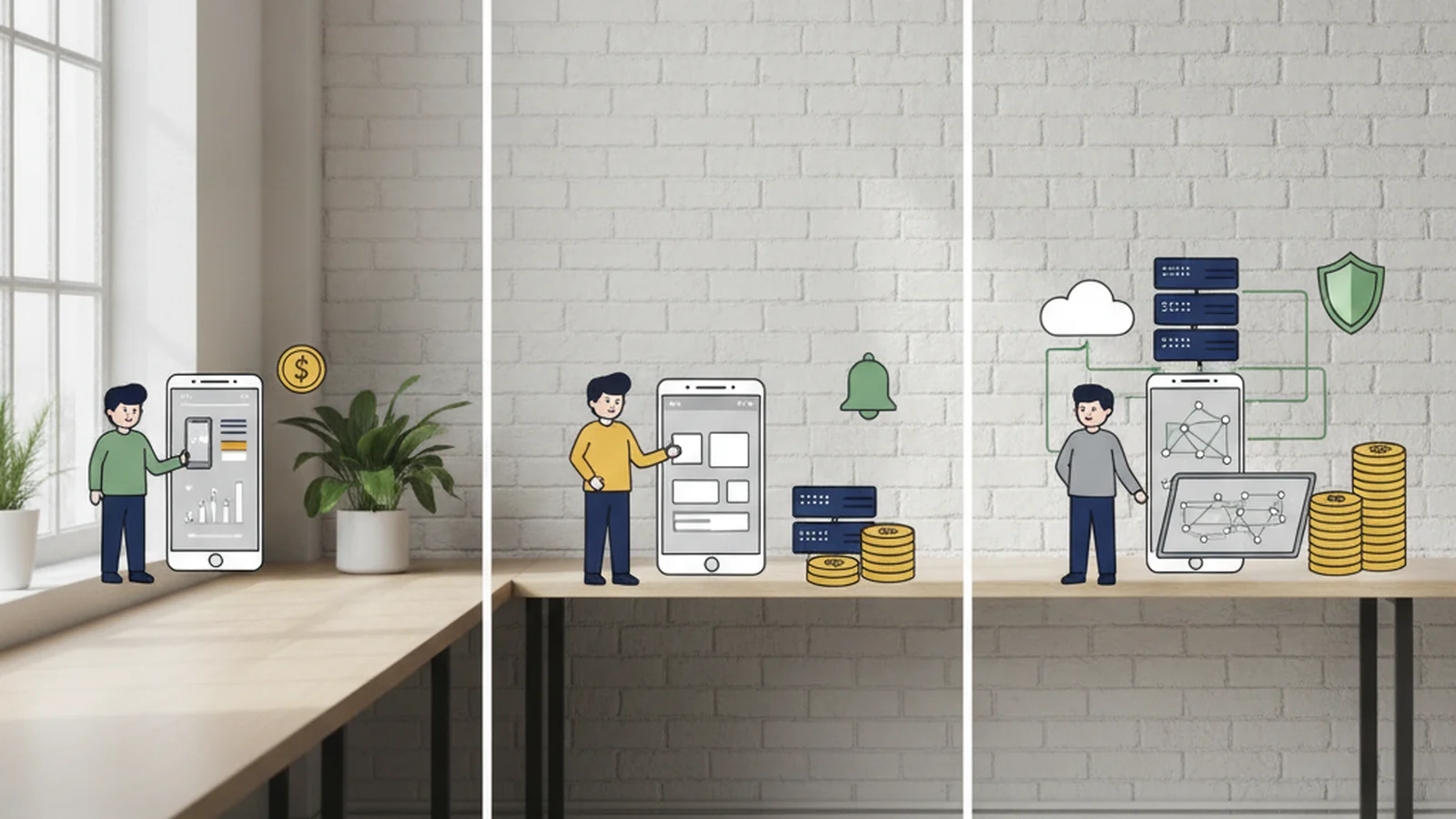
- Simple app: $15,000–$50,000. One platform or a lean cross-platform build, 3–5 core screens, little or no backend. Calculators, content apps, single-purpose utilities, prototypes for investors.
- Medium-complexity app: $50,000–$150,000. User accounts, a REST or GraphQL backend, push notifications, an admin panel, payments or subscriptions, 6–15 screens. Most commercial products land here.
- Complex app: $150,000–$500,000+. Native or cross-platform on both stores, real-time features (chat, live tracking, collaboration), several third-party integrations, heavy backend, and compliance such as HIPAA or PCI.
Treat these as bands, not quotes. Two apps with the same screen count can differ 3× in price, because screens aren’t what you’re really paying for. What’s behind them is.
iOS, Android or both?
Platform choice is the first big lever, and it’s easy to get wrong in both directions.
- iOS only: typically $18,000–$70,000 simple, $70,000–$200,000 medium, $200,000–$700,000 complex. It’s a sensible first platform where your users skew towards iPhone and pay more per user.
- Android only: typically $15,000–$60,000 simple, $60,000–$180,000 medium, $180,000–$600,000 complex. Android’s device variety adds QA effort, but reach is global.
- Both, as two native apps: close to double, because you’re paying for two codebases, two teams’ worth of work and two sets of bugs forever.
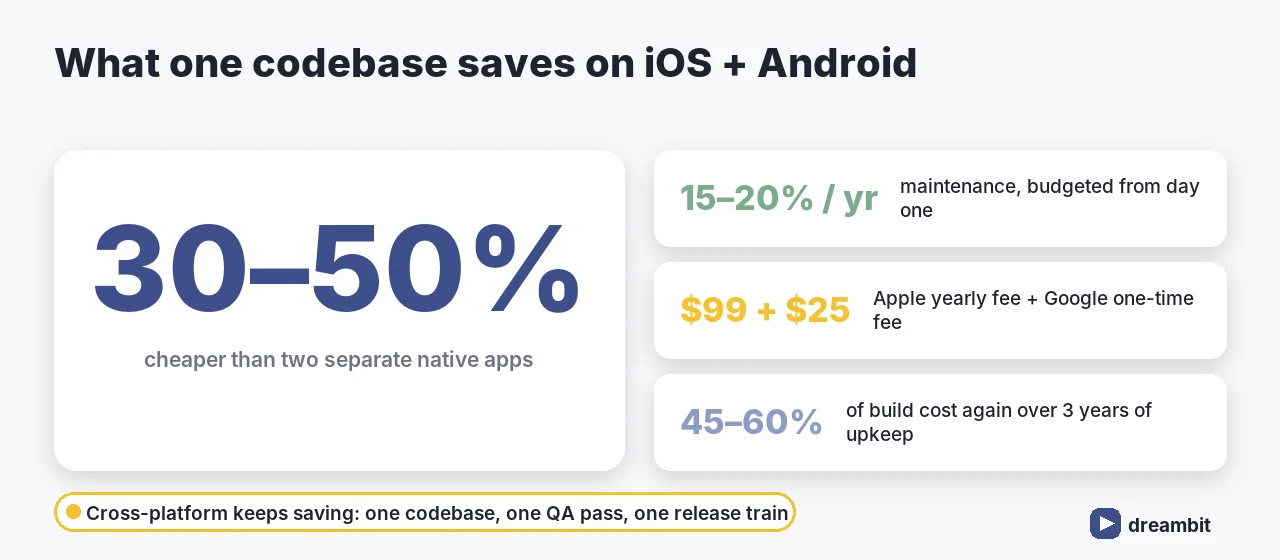
- Both, cross-platform: one Flutter or React Native codebase for both stores, usually 30–50% cheaper than two native builds.
For most business apps, a cross-platform build is the cheapest way onto both stores without giving anything up. Flutter and React Native both cut a dual-platform build by 30–50% against separate native iOS and Android apps, and that saving keeps recurring, because one codebase also means one set of maintenance, one QA pass and one release train (industry benchmarks, 2026).
Where native still earns its premium is deep hardware work, heavy background processing, AR and high-end camera pipelines. We set out the full decision in Flutter vs React Native. If the product doesn’t need a store presence at all, a progressive web app can be cheaper still. That’s covered in web app development cost.
What actually drives mobile app development cost
If you want to predict where your app lands, count these, roughly in order of impact:
- Backend and integrations. Accounts, data sync, payments, CRM, maps, analytics. Every system the app talks to is design, build, error handling and a vendor whose API will change.
- User roles. A customer app with an admin panel is two products. Add a partner, courier or provider side and it’s three.
- Real-time features. Chat, live location and collaborative editing are a category of engineering, not a checkbox.
- Offline support. An app that has to work without signal needs local storage, sync and conflict handling. That’s well worth it for field and travel apps, and we argue the case in why an app that works without Wi-Fi works for your clients.
- Compliance. HIPAA, PCI DSS and GDPR bring audit trails, encryption, data residency and reviews. Healthcare and fintech builds cost more for this reason; see healthcare app development and fintech app development.
- AI features. Chat assistants, recommendations and automation bring retrieval, evaluation and a monthly model bill, as covered in AI chatbot development.
- Design ambition. A clean system-based UI is cheap. Bespoke illustration, motion and custom components are not.
Where the money goes: cost by phase
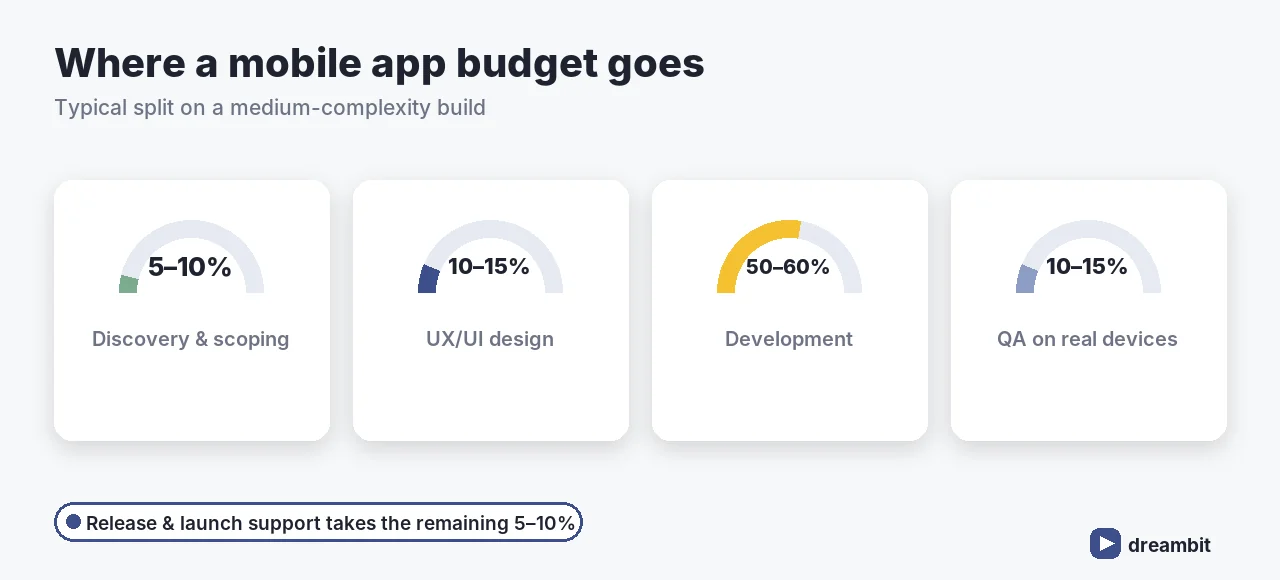
On a typical medium-complexity build, the budget splits roughly like this:
- Discovery and technical scoping: 5–10%. It’s the cheapest place to remove scope, and skipping it is the most expensive thing you can do.
- UX/UI design: 10–15%.
- Development (app plus backend): 50–60%.
- QA on real devices: 10–15%. More on Android, because of device variety. Our approach is in mobile app testing services.
- Release, store submission and launch support: 5–10%.
A quote with almost nothing in discovery and QA hasn’t removed that work. It has moved it into your first months after launch, where it costs more.
Team location and hourly rates
Rates vary more by region than by framework. As a rough 2026 guide for senior mobile developers: North American agencies typically charge $150–$250 an hour, Western Europe roughly $90–$160, and Eastern Europe roughly $70–$120. The same app can therefore cost half as much depending on where it’s built.
The hourly rate is only half the equation, though. A senior team that ships the right thing in 800 hours is cheaper than a junior team billing 1,600 hours for something you then rebuild. When comparing vendors, compare the estimated hours and the seniority behind them, not just the rate. Our guide to hiring mobile app developers covers what to check.
A worked example: what a $100,000 app looks like
To make the ranges concrete, here’s an illustrative medium-complexity app at the middle of the band. It’s not a client project, just the arithmetic applied to a typical brief: a cross-platform booking app for iOS and Android, with customer accounts, a calendar, card payments, push reminders and a simple admin panel for staff.
- Discovery and scoping: about $5,000–$10,000 to agree the flows, integrations and the MVP cut.
- Design: about $10,000–$15,000 for the customer app, the admin panel and a small component library.
- Development: about $50,000–$60,000 across the app, backend, payments integration and admin.
- QA: about $10,000–$15,000 on real iOS and Android devices.
- Release and launch: about $5,000–$10,000 for store submission, staged rollout and launch fixes.
Then the recurring side: roughly $15,000–$20,000 a year in maintenance, a few hundred dollars a month in backend and services at modest scale, and store commission if the app sells subscriptions. Built as two separate native apps instead, the same brief would cost noticeably more, with the gap growing every year you maintain both.
The costs after launch
An app that isn’t maintained stops working. iOS and Android ship major updates every year, SDKs deprecate, and security patches don’t wait. The recurring bill looks like this:
- Maintenance: 15–20% of the build cost per year. A $50,000 app runs roughly $7,500–$10,000 a year, and a $350,000 platform roughly $52,000–$70,000.
- Store fees: the Apple Developer Program is $99 a year and Google Play has a one-time $25 registration. Both stores take a commission on paid apps and in-app purchases, historically 15–30%. Google has cut rates in several markets in 2026, so check current terms for yours.
- Backend and infrastructure: from tens of dollars a month for a small app to $2,000–$10,000 a month once you pass roughly 100,000 monthly active users.
- Third-party services: push, SMS, maps, analytics, crash reporting, auth. Each is small, and together they add up.
The build is the visible part of a mobile app budget. Over three years, maintenance at 15–20% a year adds another 45–60% of the original build cost, before infrastructure, store commission and new features. Teams that budget only for launch run out of money just as users start asking for things.
We go into the detail in mobile app maintenance.
How to reduce mobile app development cost without cutting quality
- Start with an MVP. Ship the one workflow that proves the business, then widen. That’s what an MVP is for.
- Go cross-platform unless you have a reason not to. One codebase is 30–50% cheaper to build and keeps saving through maintenance.
- Use a managed backend for the commodity parts. Auth, storage, push and analytics are solved problems. We use Firebase heavily for exactly this reason; see lessons from 60+ Flutter/Firebase projects.
- Integrate early. The integration left until last is the one that breaks the timeline.
- Decide compliance scope in discovery. Retrofitting it costs far more than designing it in.
- Keep the team stable. Churn costs more than any difference in hourly rate.
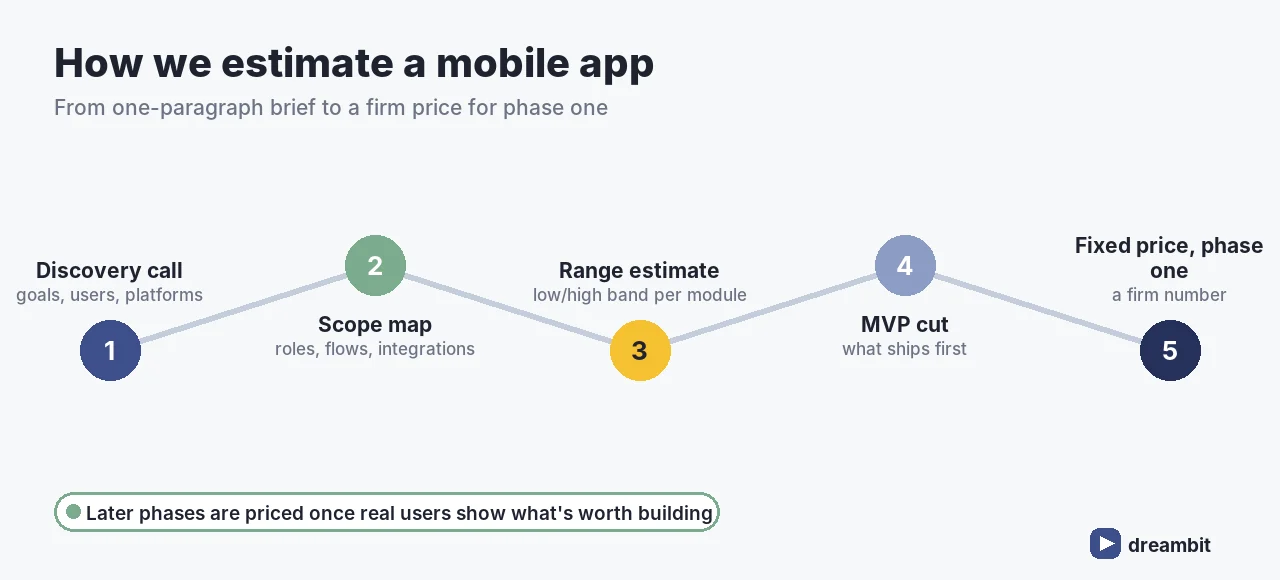
How we estimate a mobile app at Dreambit
We don’t price a mobile app from a one-paragraph brief, because any number we gave would be a guess. Instead:
- Discovery call: goals, users, platforms, constraints, existing systems.
- Scope map: roles, core flows, integrations and compliance, written down and agreed.
- Range estimate: a low/high band per module, with the assumptions stated.
- MVP cut: what ships first, what waits, and what that saves.
- Fixed price for phase one: a firm number for the part we can fully define.
You get certainty on the first release. Every later phase is priced once real users have told you what’s worth building. If you want to see what that process looks like in practice, we’ve described what we do in the first two weeks of a project.
Common mistakes when budgeting a mobile app
- Budgeting the build only. Maintenance alone adds 45–60% of the build cost over three years.
- Building two native apps by default. Unless you need deep hardware access, you’re paying close to double for no user-visible gain.
- Counting screens instead of systems. Integrations and roles drive cost far more than screen count.
- Comparing hourly rates instead of hours. A cheap rate on twice the hours isn’t cheap.
- Skipping discovery to “save time”. It’s 5–10% of the budget and it decides where the other 90% goes.
- Underestimating Android QA. Device variety is real, and testing on two phones isn’t testing.
Key Takeaways
- Mobile app development cost in 2026: simple $15k–$50k, medium $50k–$150k, complex $150k–$500k+.
- A cross-platform build for iOS and Android is typically 30–50% cheaper than two native apps.
- Backend, integrations, roles, real-time features and compliance drive cost far more than screen count.
- A typical budget splits into discovery 5–10%, design 10–15%, development 50–60%, QA 10–15% and release 5–10%.
- Senior rates run about $150–$250/hr in North America, $90–$160 in Western Europe and $70–$120 in Eastern Europe. Compare hours, not just rates.
- Budget 15–20% of build cost per year for maintenance, plus store fees, infrastructure and services.
- Get a firm price for a well-defined phase one, not a guess for the whole roadmap.
Frequently Asked Questions
A simple mobile app typically costs $15,000–$50,000, a medium-complexity app with user accounts, an API backend, push notifications and an admin panel costs $50,000–$150,000, and a complex app with real-time features, many integrations and compliance requirements costs $150,000–$500,000 or more. Integrations, user roles and compliance move the number far more than screen count.
For most business apps, cross-platform is cheaper. One Flutter or React Native codebase for iOS and Android typically costs 30–50% less than building two separate native apps, and the saving continues after launch because there is one codebase to maintain, test and release. Native is still worth its premium for deep hardware access, heavy background processing, AR or high-end camera work.
Plan on 15–20% of the original build cost every year. A $50,000 app runs roughly $7,500–$10,000 a year in maintenance, and a $350,000 platform roughly $52,000–$70,000. On top of that come backend and infrastructure, which run from tens of dollars a month for a small app to $2,000–$10,000 a month past about 100,000 monthly active users, plus third-party services and store commission.
Apple’s developer program costs $99 per year and Google Play has a one-time $25 registration fee. Both stores also take a commission on paid apps and in-app purchases, historically 15–30% depending on revenue and subscription length. Google has reduced rates in several markets in 2026, so check the current terms for the countries you sell in.
Quotes price different assumptions. Two vendors can read the same brief and plan different integrations, roles, QA depth and discovery effort, and hourly rates differ widely by region: senior developers cost roughly $150–$250 an hour in North America, $90–$160 in Western Europe and $70–$120 in Eastern Europe. Compare estimated hours, seniority and what is explicitly in scope, not just the headline number.
Start with an MVP that proves one core workflow, build cross-platform unless you have a hardware reason not to, use a managed backend for commodity parts like authentication, storage and push, integrate third-party systems early, decide compliance scope during discovery, and keep the team stable. Then get a firm price for a well-defined first phase rather than a guess for the whole roadmap.