App icon A/B testing is one of the fastest ways to increase organic installs without rebuilding onboarding or spending more on paid traffic. It’s the first thing users see in the app store and a major factor in whether they click through or scroll past. Yet too often, teams choose an icon based on personal taste or branding alone, treating it as “just a logo.” In reality, the app icon is one of the strongest conversion levers. A compelling icon can grab attention in crowded search results and convince more users to check out your app.
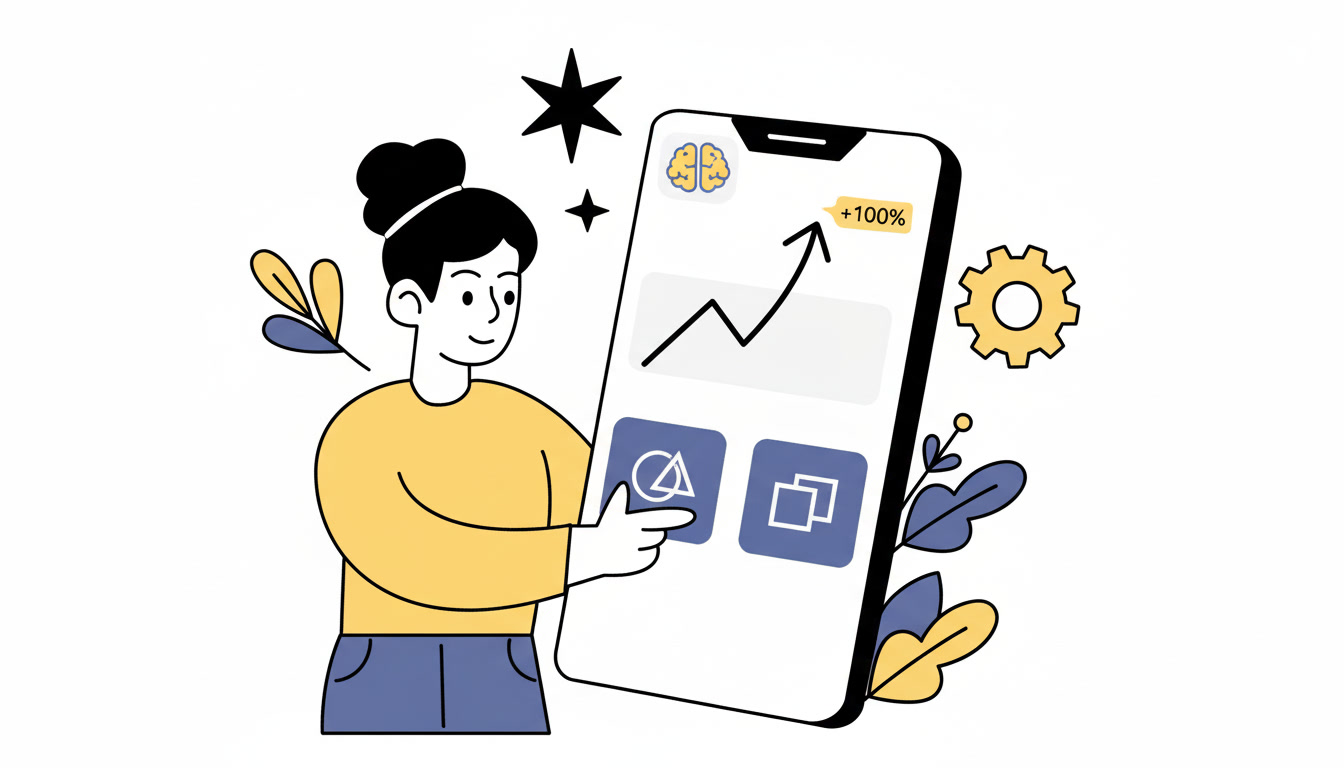
Recently, our team used ChatGPT to generate new icon concepts and ran a simple A/B test in the stores. The result? We doubled our weekly organic installs (+100%) in just one week. In this article, we’ll share how we achieved this explosive improvement.
After generating concepts, we validated them with app icon A/B testing in both stores to measure real install conversion uplift.
The Experiment: New Icons via AI and A/B Testing
To boost our app’s install conversion, we ran a structured experiment in three steps, focusing on the app icon:
| Modern app stores (Google Play and Apple’s App Store) allow developers to run A/B tests on visual assets to see which version attracts more users. The app icon is highlighted above as one of the most impactful elements to test. By testing one element at a time (an icon in our case) and running the experiment for at least 7 days, you can get clear, reliable results. |
Step 1. Generate 10 new icon concepts with AI (GPT-5).
Instead of starting in Figma, we started in GPT‑5.
The goal was not to achieve pixel‑perfect design. The goal was to explore the widest possible range of visual directions that could resonate with our audience — without burning design time.
What GPT‑5 helped with:
- Turning our positioning and audience into clear visual directions.
- Translating generic ideas (“modern”, “trustworthy”) into concrete shapes, colors and metaphors.
- Producing 10 distinct icon concepts instead of 2–3 safe variations.
A simplified version of the prompt we used:
“You are a senior mobile app brand designer.
Our app: [short description, category, main value].
Target users: [who they are, what they care about].
Competitors: [2–3 names].
Task: Propose 10 distinct app icon concepts that would stand out in the App Store/Google Play search results for [key search terms].
For each concept, describe:
– Color palette
– Main shape/symbol
– Style (flat/3D/gradient/minimalist, etc.)
– Emotional message (e.g., ‘security’, ‘speed’, ‘fun’)
– Why it would convert.”
From there, we shortlisted the 5–10 most promising ideas tand turned them into production‑ready icon variants.
The key here was quantity and diversity: by generating many different styles, we increased our chances of discovering a high-performing design that we wouldn’t have thought of on our own.
Step 2. Run an A/B test in the App Store/Google Play
Next, we put these AI-generated icons to the test with real users. Both major platforms offer native A/B testing tools for app listings:
- Google Play: Store Listing Experiments
- App Store: Product Page Optimization / Custom Product Pages
We set up an experiment to compare our current icon against several of the new AI-derived icons. Each user who discovered our app in the store would randomly see one of the icon variants. Crucially, we only tested one element at a time – the icon – while keeping everything else (screenshots, description, etc.) the same, to ensure that any difference in install rates would be due to the icon alone. We also followed best practices by letting the test run for a full week to capture weekday vs. weekend user behavior.
During the experiment, we closely monitored the conversion rate (the percentage of store visitors who clicked “Install”) for each icon version. Rather than guess which icon looked “best,” we let users vote with their clicks.
In fact, ASO experts often recommend generating multiple creative variants and then using A/B testing to see which variant drives the highest conversion – and that’s exactly what we did.
Step 3: Pick the Winner and Roll It Out
After seven days, the A/B test had gathered enough data to declare a clear winner. One of the GPT-5 generated icon concepts significantly outperformed the original icon (and the other variants) in conversion rate. Once we identified this winning icon, we swiftly updated our app listing to use it as the official icon for all users.
Afterwards, we still monitored post‑launch metrics for a few days to confirm the uplift holds:
- Organic impressions → installs
- Overall install volume
- Any changes in uninstall rate.
This metric gave us statistical confidence that this variant wasn’t just randomly better, but truly more appealing to users.
The winner from our app icon A/B testing became the new default icon, and organic installs doubled within a week.
Results: +100% Conversion to Install
The impact of the new icon was dramatic. Our app’s conversion rate from store views to installs doubled, increasing by roughly 100% after adopting the AI-generated winner. In practical terms, this meant we unlocked a doubling of our organic growth without spending a cent on additional marketing. For example, if we were getting about 1,000 organic installs per week before, we started seeing around 2,000 installs per week after the change (with the same traffic levels).
The same product, same audience, and same store visibility started delivering twice as many users, purely because the “book cover” finally matched what users were exactly looking for.
Conclusion: Small Changes, Big Wins
Our experiment underscores a powerful lesson for app marketers and product owners: even a small, simple change can yield huge gains. In our case, changing nothing more than the app’s icon led to a 100% increase in conversions.
The new icon clearly resonated better with our target audience. It communicated our app’s value proposition more effectively at a glance, encouraging more people to click and install.
This experiment also highlights the power of AI and A/B testing. GPT-5’s generative ability allowed us to explore new amazing icons, while the app store’s testing tools told us which of them worked best. By combining AI and A/B testing, we tapped into a winning formula. Now, we run similar AI-assisted A/B tests for other aspects of our product’s marketing and UX.
If you want to increase installs without guessing or overspending, we can help you move real metrics.