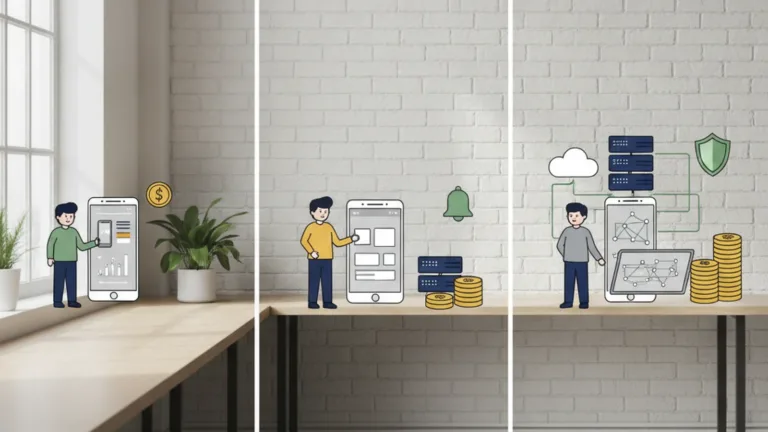
If you are budgeting for custom software development cost in 2026, you’ve probably seen quotes that vary by 2–3x for what appears to be “the same” scope. Meanwhile, you keep hearing that the real cost is not the initial build but everything that comes after.
This article breaks down what you are actually paying for when you hire a dev team, why “cheap” builds often become the most expensive, and how to structure your budget so your product stays financially healthy over its entire lifecycle.
How Much Does Custom Software Development Cost in 2026?
Most projects in 2026 fall into five budget tiers depending on complexity, team size, and how much infrastructure work is involved.
| Product type | Approximate budget | What it usually includes |
|---|---|---|
| Prototype / clickable MVP | $5,000–$15,000 | UX concept, limited screens, basic user flow validation |
| Simple custom app / MVP | $12,000–$40,000 | Core functionality, backend, basic integrations, QA, first release |
| Growth-stage mobile or web product | $40,000–$125,000+ | Scalable architecture, analytics, payments, admin panel, advanced UX |
| Complex SaaS / marketplace / AI platform | $75,000–$250,000+ | Multi-role systems, integrations, automation, AI features, DevOps, security |
| Enterprise-grade system | $150,000+ | Complex workflows, compliance, integrations, high availability, long-term support |
The important point: the development invoice is only one part of the product’s total cost. The real cost includes discovery, architecture, UX, development, QA, integrations, cloud infrastructure, release management, analytics, maintenance, and post-launch optimization.
What Are You Actually Paying For When You Hire a Dev Team?
You are paying for far more than coding hours — the largest cost drivers are architectural decisions, team seniority, and the scope of your platform strategy.
When founders compare custom software development cost, they often focus on hourly rates. That is understandable, but misleading.
The main cost drivers that sit behind any proposal include:
-
Scope and complexity. The more complex your product (real-time features, AI, heavy analytics, multi-tenant permissions, deep integrations), the more hours you are buying across engineering, QA, DevOps, and product. A basic MVP might land in the lower tens of thousands, while complex SaaS or enterprise platforms can easily run into the hundreds of thousands or more.
-
Team location and rate bands. In 2025–26, software development rates range from roughly 25–60 USD/hour for many offshore regions up to 100–300+ USD/hour for premium onshore consultancies, depending on specialization and seniority.
-
Platform strategy. Maintaining separate native iOS, Android, and web codebases significantly increases both build and maintenance costs; cross-platform frameworks like Flutter let one team ship to all platforms from a single codebase, which can meaningfully reduce timelines and ongoing maintenance.
-
Team structure and seniority mix. Hourly rates jump as you move from junior to mid-level to senior and architect roles, but senior people unlock better architecture, faster decisions, and fewer costly reworks later. How you balance that mix has a major impact on the total cost of ownership.
-
Lifecycle, not just launch. Total cost of ownership (TCO) includes the full lifecycle: build, run, maintain, improve, and eventually retire or rebuild the system. For most serious products, your ongoing operating and change costs over several years will exceed what you spent on the initial build.
1. What Does Discovery and Product Shaping Cover?
Good teams start by clarifying business goals, user journeys, and constraints instead of jumping straight to Jira tickets. This includes stakeholder interviews, process mapping, user story workshops, and prioritization. Done well, this phase cuts out wasteful features that would otherwise eat a big chunk of your budget later.
Dreambit works more as a technology partner rather than a pure coding company: we help businesses clarify the product vision and define an MVP that can be shipped in a 2–3 month window. That reduces time-to-market and avoids building features nobody uses.
2. What Does UX/UI Design Contribute to Your Budget?
You’re paying for people who can translate business flows into usable interfaces, states, and interactions that work across devices. This includes wireframes, hi-fi designs, design systems, and interaction patterns. Poor UX is expensive: it leads to abandoned sign-ups, higher support overhead, and slower adoption — costs that rarely show up in the initial quote but hit your P&L later.
For example, in healthcare products Dreambit has worked on, design decisions around flows for appointments were critical to adoption and engagement, not just aesthetics. That has direct revenue and retention implications.
3. Why Do Architecture and Technical Decisions Drive So Much Cost?
You are also paying for someone to choose your tech stack, design system boundaries, and decide how modular, scalable, and testable your codebase will be. These early choices drive:
- How quickly new features can be added.
- How hard it is to swap vendors or grow your team.
- How often you hit scaling or reliability limits that require expensive refactors.
Total cost of ownership frameworks consistently show that architectural shortcuts and accumulated technical debt are some of the biggest hidden cost drivers over a system’s lifetime. Dreambit’s cross-platform focus aims to keep architecture unified, so you are not paying for parallel stacks that drift apart.
4. What Is Included in Development and Integration Work?
This is the actual “writing code” part, covering:
- Implementing features across mobile and web.
- Integrating external APIs (payments, messaging, analytics, identity).
- Handling edge cases, data validation, and error states.
Rates vary significantly by region and firm size. Small to mid-market custom development companies around the world typically charge 90–250 USD/hour in 2026 for mixed teams, while specialized offshore teams in Eastern Europe can deliver strong work at 25–75 USD/hour, depending on seniority and complexity.
5. What Does Quality Assurance and Test Automation Add to Your Budget?
You’re also paying for the invisible work that makes your app actually reliable:
- Manual testing across devices and platforms.
- Automated tests (unit, integration, end-to-end).
- Performance and security checks.
Companies that skimp on QA often “save” in the short term but incur higher bug-fixing costs, downtime, and reputational damage later. In regulated or trust-sensitive domains (healthcare, fintech, dating), that can be catastrophic.
6. Why Do DevOps, Infrastructure, and Observability Matter?
Finally, you are paying for pipelines and infrastructure that keep your product shippable:
- CI/CD pipelines.
- Cloud infrastructure setup (compute, storage, networking).
- Monitoring, logging, and alerting.
TCO analyses highlight that ongoing hosting, monitoring, and operations regularly dwarf one-time setup costs over the lifetime of the system. A solid DevOps foundation means smaller incremental changes are cheaper and less risky to deploy, which matters once you reach the optimization phase.
Why Does “Cheap” Offshore Development Often Cost More in the Long Run?
Cheap builds become expensive because low hourly rates don’t account for architectural shortcuts that compound into technical debt — and that debt eventually consumes a massive share of your ongoing IT budget.
Technical debt is the gap between the system you have and the system you should have built if you had more time, better skills, or fewer shortcuts. It includes tangled architectures, missing tests, outdated dependencies, and “temporary” workarounds that never got fixed.
Fact: According to Software Improvement Group, technical debt can consume up to 40% of an IT department’s budget, and 10–20% of budgets intended for new product development may be redirected to dealing with it instead. Average tech stacks contain 20–40% pure technical debt — meaning nearly half your codebase can be working against you, not for you.
A small feature takes weeks because the codebase is fragile. A payment integration breaks after an API update. The app crashes on specific devices. The admin panel cannot support new business logic. Developers are afraid to touch old modules because one change creates five bugs. Eventually, the company faces a painful choice: keep patching a weak foundation or rebuild the product.
For a startup, technical debt delays growth. For a scaling business, it increases the total cost of ownership. For an enterprise, it can become a serious operational and security risk.
In custom software development, cheap code often becomes expensive code when it lacks:
- clean architecture;
- automated testing;
- documentation;
- security thinking;
- scalable backend structure;
- analytics;
- maintainable integrations;
- senior code review.
Dreambit’s App Quality Audit service is built around this exact issue. The audit evaluates app performance, usability, security, code, architecture, integrations, code quality, and potential technical debt.
That is the smarter way to manage cost: not by ignoring technical debt, but by detecting it early enough to fix it before it becomes a rewrite.
How Does Seniority Mix Affect Your Total Cost of Ownership?
A senior-heavy team costs more per hour but typically reduces total cost of ownership by preventing the architectural mistakes and rework that inflate budgets later.
The hourly price is not the same as the total cost.
A junior-heavy team may look cheaper on paper, but complex products need senior people to make decisions that affect the entire future of the system: architecture, database structure, security model, cloud setup, code standards, integration strategy, and scalability.
A senior-heavy team can often reduce waste because it needs fewer people to make better decisions faster. Senior developers are also more likely to prevent rework, spot risks early, and design the system so that future features are easier to add.
This matters even more in 2026 because AI tools are now part of everyday development. Stack Overflow’s 2025 Developer Survey found that “84% of respondents use or plan to use AI tools in their development process, while 51% of professional developers use them daily.”
But AI does not remove the need for senior oversight. DORA’s 2025 research found that AI can accelerate code generation, but the saved time is often reallocated to auditing and verification. DORA also warns that AI acts as an amplifier: strong teams benefit from it, while teams with fragmented tooling or fragile infrastructure may generate technical debt faster.
In other words, AI can make a good team faster. It can also make a weak architecture messy at scale.
A healthy team structure usually includes:
- a senior tech lead or architect;
- one or more middle/senior developers;
- QA engineer;
- UX/UI designer;
- project/product manager;
- DevOps or cloud specialist when needed.
For early MVPs, a lean team is often enough. For marketplaces, SaaS platforms, fintech products, healthcare apps, AI-powered tools, or systems with many integrations, seniority becomes a cost-control mechanism, not a luxury.
You pay more for senior judgment upfront, so you do not pay more for rework later.
Are You Budgeting for the Post-Launch Phase — or Just the Build?
Most teams budget for launch and almost nothing for what comes after — which is where a large portion of real software costs actually live.
Most sales conversations focus on getting you to launch: features, timelines, and the initial project budget. But the real financial risk often hides in what comes after: the optimization phase.
Why is “launch” not the finish line?
From a TCO perspective, your costs don’t stop when version 1 goes live — they usually start accelerating. After launch, you will:
- Fix real-world bugs and UX friction that only surface with real users.
- Optimize performance as traffic grows.
- Add features to meet customer feedback or competitive pressure.
- Handle platform changes (OS updates, browser changes, third-party API shifts).
Dreambit’s Priority Maintenance Support service includes bug fixes, performance monitoring, compatibility updates, technical support, health checks, emergency support, UI/UX enhancements, and monthly reports.
This is not “extra.” It is part of the software lifecycle.
So, when planning custom software development cost in 2026, companies should not ask only, “How much does it cost to build version one?”
They should ask:
“How much should we reserve to make version one successful?”
A practical rule is to plan a post-launch budget from the beginning. For many products, this means reserving budget for at least three to six months of optimization after release.
How Should You Structure Your Optimization Budget?
Plan your post-launch budget as a line item from day one — not an afterthought — and tie it to measurable outcomes like retention, conversion, and reduced support load.
Instead of treating post-launch work as “we’ll figure it out later,” bake it into your financial model from day one:
-
Assume a meaningful optimization phase. Expect at least several months of follow-on work after launch for a serious product, focused on stability, UX refinements, and the first wave of feature improvements triggered by real usage.
-
Allocate ongoing capacity. Decide whether you want a small, continuous team (e.g., a retained squad that ships improvements every sprint) or periodic “burst” engagements (e.g., 2–3 focused sprints each quarter). The first option is gentler on your roadmap; the second gives more budget flexibility.
-
Track the right metrics. Tie optimization work to measurable outcomes: reduced support tickets, improved conversion, higher retention, lower infrastructure costs, or increased average order value. For example, in e-commerce and service apps, UX improvements after launch have been linked to higher order values and new customer growth in real projects.
In case studies of apps like HealthPoint (healthcare) and HeartMatch (dating), Dreambit’s work did not end with the initial version: ongoing collaboration focused on refining flows, improving reliability, and enhancing engagement features based on live usage. That kind of partnership mindset is what you want to budget for.
What should you ask a vendor about post-launch support?
When you discuss proposals, explicitly ask:
- How do you structure post-launch support and optimization?
- What does the team look like during that phase?
- How do you prioritize improvements based on data rather than opinions?
Vendors who talk confidently about TCO, technical debt management, and post-launch optimization are signaling that they are thinking beyond the initial invoice. This is where transparent communication and a long-term relationship — which Dreambit focuses on — become a real financial asset.
What Does It Take to Manage Custom Software Costs Successfully?
Managing custom software costs successfully means planning not just for the build, but for architecture quality, team seniority, and post-launch optimization from day one.
The difference between projects that deliver value and projects that spiral isn’t budget size — it’s preparation, architecture, and honest expectation-setting from day one.
The cheapest estimate may help you start faster. But the smartest estimate helps you build something that can survive real users, real growth, and real business pressure.
That is the difference between paying for code and investing in a product.
For companies planning a mobile app, SaaS platform, marketplace, AI-powered tool, or digital product ecosystem, the best cost-management strategy is simple:
- Build only what matters first.
- Build it on a strong foundation.
- Measure what users do.
- Improve continuously.
- Choose a development partner who can think beyond launch day.
Dreambit helps companies control total software cost by building scalable, cross-platform products, validating them through measurable releases, auditing quality, and supporting optimization after launch.
Key Takeaways
- Custom software cost ranges widely by complexity — from $5K–$15K for a prototype to $150K+ for enterprise systems. The initial invoice is only part of the picture.
- Hourly rate is not total cost — team seniority, architecture quality, platform strategy, and lifecycle planning all determine your real spend.
- Technical debt is a hidden cost multiplier — poor-quality builds can redirect 10–40% of your ongoing IT budget away from new development into maintenance.
- Senior engineers are a cost-control mechanism, not a luxury — they prevent expensive rework, especially on complex products, and are better positioned to work effectively alongside AI tooling.
- AI accelerates good teams; it amplifies weak architectures — senior oversight remains critical as AI tools become standard in development workflows.
- Post-launch optimization is a budget line, not an afterthought — plan for at least 3–6 months of follow-on investment after launch for any serious product.
- Ask your vendor about TCO from day one — a development partner who talks about technical debt, post-launch support, and lifecycle cost is one who’s thinking about your long-term success, not just the initial contract.