Why Does SaaS Product Development for Web and Mobile Require Architecture First?
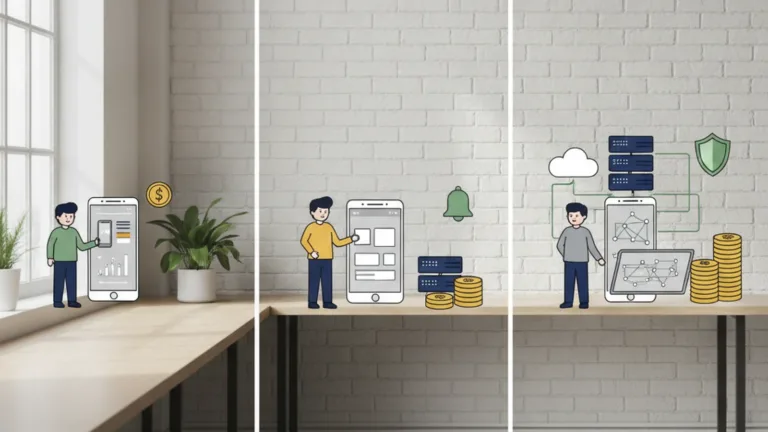
The answer is simple: the decisions you make before writing a single line of code determine whether you’re building one product or three. Successful SaaS products are not built around devices first. They are built around user behavior, business goals, and a technical foundation that can scale across platforms without duplicating every layer of complexity.
Most budget overruns in SaaS development don’t come from a single bad decision. They come from a structural mismatch between how the product was initially framed and how users actually interact with it. A team that starts with “we need a web app and a mobile app” often ends up maintaining two separate codebases, two separate release cycles, and two separate roadmaps — none of which share logic cleanly.
Modern SaaS isn’t a website plus an app. It’s an ecosystem where users get the right interface for the right moment, all connected to the same backend, the same data model, and the same business logic.
Fact: The global SaaS market reached an estimated $390.5 billion in 2025 and is projected to exceed $465 billion by 2026 (Statista; Precedence Research). Despite this growth, most SaaS MVPs cost between $15,000 and $50,000 to build — and the architectural decisions made before writing a single line of code are the single largest driver of whether that budget holds or spirals. (Source: SaaS Development Cost in 2026, Nuclieos)
What Does the Architecture of a Modern SaaS Ecosystem Actually Look Like?
A modern SaaS product built for both web and mobile isn’t two products that share a logo — it’s one layered system that expresses itself differently depending on context. The architecture that makes this possible typically has seven components:
- Core backend and business logic — The authoritative layer. All rules, calculations, and state live here. No client owns logic that belongs to the server.
- API layer — A single integration point for every interface. Web, mobile, and third-party integrations all talk to the same API surface. Consistency here prevents the drift that leads to duplicate endpoints.
- Role-based interfaces — Different users need different views of the same data. A dashboard for an admin isn’t the same as a dashboard for an end user. Interface design follows roles, not platforms.
- Cross-platform front end — Flutter, React Native, or a Progressive Web App strategy depending on product requirements. The decision here has direct cost implications (more on that below).
- Analytics and event tracking — Built in from day one, not bolted on later. You can’t optimize what you haven’t measured. Behavioral events should flow from every client into a unified pipeline.
- Subscription monetization layer — Payments, feature gating, plan management, and lifecycle events. This is its own engineering discipline, not an afterthought.
- DevOps and monitoring — Deployment pipelines, uptime checks, error tracking. The infrastructure decisions made here determine how expensive it is to ship updates across platforms.
When these layers are designed to be shared, adding a new platform surface — say, a tablet UI or a native desktop app — becomes an additive cost, not a rearchitecting effort.
Why Is the “Mobile-First” Approach Often a $100,000 Mistake?
Because most B2B SaaS workflows don’t start on mobile — they live on desktop. Defaulting to mobile-first without analyzing where your users actually spend their productive time can mean spending $40,000–$80,000 building a native mobile app that your core users open twice a week.
Platform duplication is rarely neutral. It becomes a permanent cost structure. You’re not just paying for the initial build — you’re committing to two separate release cycles, two sets of platform-specific bugs, two review queues (App Store and Play Store), and two roadmaps that drift further apart with every feature you ship.
The question to ask before writing any front-end code: where does the value-creating action actually happen? If you’re building a project management tool, the heavy work — creating tasks, reviewing timelines, setting permissions — almost certainly happens at a desk. The mobile app is a companion, not the primary interface. Design it accordingly, and you’ll save a significant portion of your initial budget.
The opposite is also true. If you’re building a field service app, a delivery tracking tool, or anything tied to location and physical context, mobile isn’t just a nice-to-have — it’s the product. The architecture should reflect that from the start.
How Does Flutter Change the Way Teams Approach SaaS Web and Mobile Development?
Flutter fundamentally changes the cost math of building for multiple platforms. Instead of maintaining separate codebases for iOS, Android, and web, a Flutter project compiles to all three from a single source. In practice, this translates to 45–55% cost savings compared to building separate native applications. (Source: Native vs Flutter in 2026, GuruSoftwares)
That’s not just a development speed advantage — it’s a structural budget advantage that compounds over time. A team of three Flutter engineers can do what would previously require five or six engineers across separate iOS, Android, and web stacks. Ongoing maintenance costs drop proportionally: real-world maintenance budgets for Flutter projects run at roughly 10–20% of the original build cost annually, versus significantly higher for teams maintaining parallel native codebases.
Flutter isn’t the right choice for every SaaS product. Products with heavy platform-native requirements — deep OS integrations, ARKit features, complex background processing — may still need native development for specific surfaces. But for the majority of SaaS products focused on data display, forms, dashboards, and workflows, Flutter’s 95% parity with native performance is more than sufficient.
Progressive Web Apps (PWAs) are a complementary strategy worth understanding. A well-built PWA can cover a large portion of mobile use cases without requiring App Store distribution at all — which removes both the 15–30% platform fee and the review cycle friction. MDN’s PWA documentation covers the technical groundwork. For SaaS products where the mobile use case is primarily content consumption or lightweight task completion, a PWA can be the right first step before committing to a full native or Flutter implementation.
What Does Subscription Fatigue Mean for Your Technical Architecture?
Subscription fatigue is real, and it has direct technical implications. When users can cancel in one tap, the architecture that manages their subscription lifecycle needs to be as sophisticated as the product itself.
This means more than just integrating Stripe. A subscription layer built for retention includes:
- Feature gating by plan — Tied to the backend, not the UI. A user who downgrades shouldn’t be able to access premium features because a front-end condition wasn’t updated.
- Churn prediction signals — Login frequency, feature engagement depth, and support ticket volume are all signals. Capturing them requires instrumented analytics from day one.
- Win-back and pause mechanics — An annual subscriber who tries to cancel is a different conversation than a monthly subscriber on day 15. The system should handle these differently.
- Lifecycle automation — Trial expiration, payment failure, plan upgrade prompts, and re-engagement emails should all be driven by system events, not manual intervention.
RevenueCat’s 2026 State of Subscription Apps report — based on data from over 115,000 apps representing more than $16 billion in revenue — found that the top 25% of apps grew 80% year-over-year while the bottom 25% shrank by 33%. The gap between those two groups is almost entirely explained by how well their subscription mechanics and retention loops were designed. (Source: RevenueCat State of Subscription Apps 2026)
Subscription fatigue isn’t a marketing problem — it’s an architectural one. Building the retention layer after users start cancelling costs significantly more than building it in from the start. The technical cost of churn management isn’t optional. It’s the difference between a SaaS product and a SaaS business.
What’s a Realistic Roadmap for Building SaaS Across Web and Mobile?
There’s a sequence that works, and it’s not the sequence most teams follow. Most teams start with UI mockups and a platform decision. The sequence that avoids expensive pivots looks like this:
Step 1: Map your user roles. Who uses this product, in what context, and what does success look like for each role? A product with five user types that aren’t mapped upfront will generate five times the feature requests and scope creep.
Step 2: Define the core product action. What is the one thing a user does in your product that creates value? Everything else supports or enables that action. This defines your MVP scope.
Step 3: Sequence your platforms. Based on where value-creating actions happen, decide which platform you’re building first and what the rollout sequence looks like. Web MVP, then Flutter mobile — or PWA first, then native later — are both valid sequences. Neither is “web and mobile simultaneously.”
Step 4: Build the MVP around measurable value. Ship the smallest version of the product that lets a real user complete the core action and pay for it. Everything else is roadmap.
Step 5: Instrument before you iterate. Add analytics before you add features. The next set of features should be driven by what users are actually doing, not what you think they’re doing.
Step 6: Add subscription intelligence. Once you have paying users, the subscription layer gets serious. Trial flows, plan logic, retention mechanics — this is where you invest after proving the core product works.
Step 7: Scale only when behavior justifies it. Adding a new platform, a new region, or a new feature tier should be a business decision backed by data, not a reaction to competitive pressure or founder enthusiasm.
Conclusion: Should You Build One SaaS Ecosystem or Three Disconnected Products?
One ecosystem, always. The goal of every architectural decision in SaaS development is to reduce the cost of the next decision — and the one after that. Three disconnected products (a web app, an iOS app, and an Android app) might appear to be three times the capability. In practice, they’re three times the maintenance burden, three times the release risk, and three times the cost of every feature you ship from that point forward.
The founders who build SaaS products that last are the ones who treat architecture as a budget decision from day one. A shared backend, a unified API, and a thoughtful choice of front-end technology aren’t technical luxuries. They’re the mechanism by which you keep your burn rate manageable and your roadmap executable.
Build the ecosystem. Let the platforms be expressions of it.
Key Takeaways
- Architecture before platforms. Decide how your backend, API, and data model work before you pick a front-end technology. Platform decisions made before architecture decisions are the primary cause of expensive rewrites.
- “Mobile-first” is a workflow question, not a default. Map where your users actually perform value-creating actions. For most B2B SaaS products, that’s a desktop. Build the mobile layer to support workflows, not to lead them.
- Flutter cuts the cost of multi-platform development by 45–55%. A single Flutter codebase serving iOS, Android, and web is not a compromise — it’s a structural budget advantage that compounds over the lifetime of the product.
- Subscription mechanics are technical infrastructure. Churn prevention, feature gating, trial flows, and lifecycle automation need to be engineered from the start. Bolting them on later costs significantly more and works worse.
- Sequence your platforms deliberately. Web MVP first, then Flutter mobile is a common and proven sequence. Building all platforms simultaneously is usually a way to build none of them well.
- PWAs are an underused option. For SaaS products where mobile use is primarily content consumption or lightweight tasks, a Progressive Web App removes App Store friction and distribution fees while covering the majority of mobile use cases.
- Measure before you iterate. Analytics instrumentation should come before the next feature, not after. The most expensive features are the ones built in response to assumptions rather than evidence.