A dedicated development team is a group of engineers, designers, QA and a delivery lead who work only on your product, long term, for a predictable monthly fee. The vendor handles hiring, management and retention, and you own the roadmap. It is the right model when your product will keep evolving for a year or more and you need three or more people on it. For a small, clearly defined build, fixed price is usually better. To fill one short-term skill gap in a team you already manage, staff augmentation is cheaper.
Dreambit has shipped 150+ products over 14 years (5M+ downloads, 4.9★ across 114 reviews), and we’ve worked in all three engagement models. Some client teams have run with us for years; other projects were a single fixed-scope MVP. This guide compares the models honestly, shows what a healthy dedicated team looks like, and lists the red flags to watch for in vendor proposals.
What is a dedicated development team?
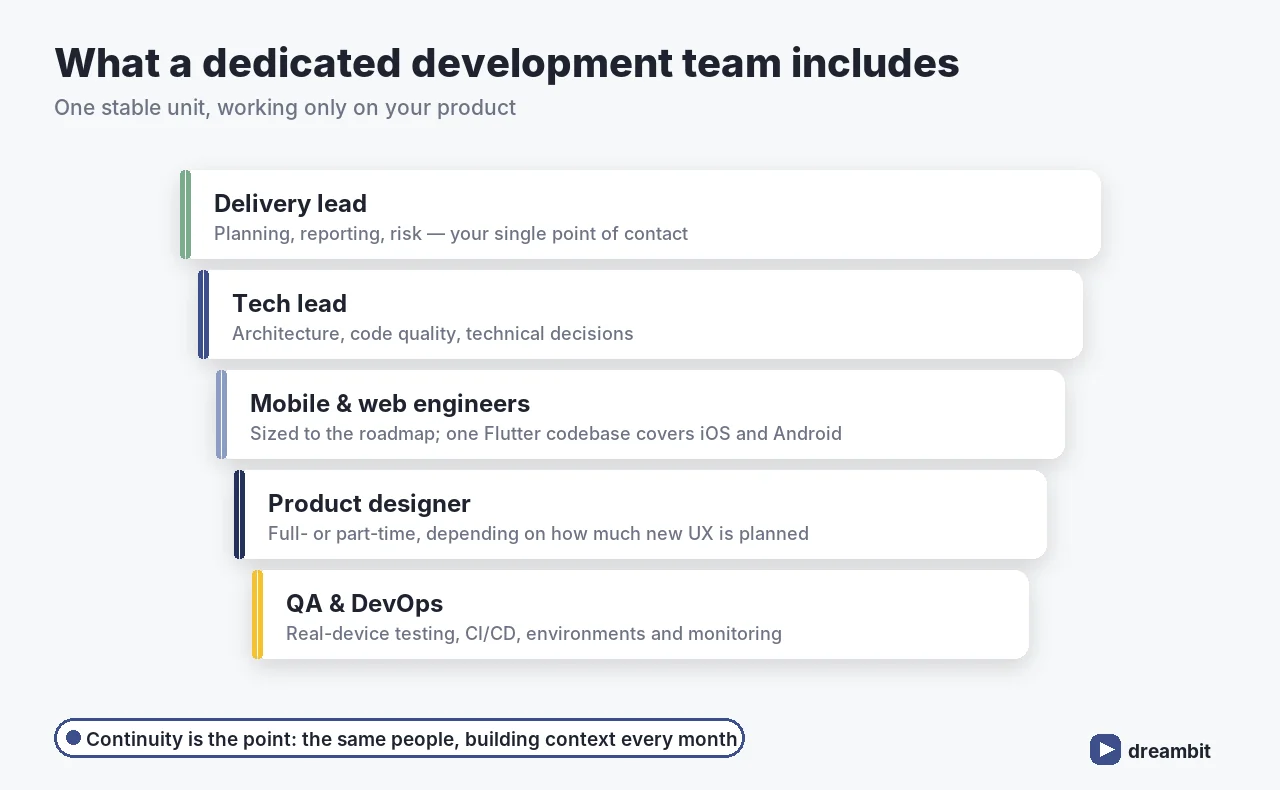
A dedicated team is a stable, cross-functional unit assigned exclusively to your product. A typical setup includes:
- A delivery lead or project manager, who runs planning, reporting and risk, and is your single point of contact.
- A tech lead, who owns architecture, code quality and technical decisions.
- Mobile and/or web engineers, sized to the roadmap.
- A product designer, full- or part-time, depending on how much new UX the roadmap needs.
- QA engineers, for manual and automated testing on real devices.
- DevOps support, usually shared, for CI/CD, environments and monitoring.
The defining feature isn’t the job titles. It’s continuity: the same people, accumulating knowledge of your product, your users and your codebase month after month.
Dedicated team vs fixed price vs staff augmentation
The three common engagement models answer different questions:
- Fixed price: “Build exactly this, for this amount.” Strong budget certainty for a well-defined scope. Weak when the scope changes, because every change becomes a renegotiation, and vendors price risk buffers into the quote.
- Dedicated team: “Give us a stable team that builds what matters most each sprint.” The team adapts as priorities shift, at a predictable monthly cost. It needs an engaged product owner on your side.
- Staff augmentation: “Add these specific people to our team.” You manage them day to day. It’s fast and flexible for filling a gap, but only works if you already have a tech lead or PM with time to run them.
A hybrid also works for long programmes with a clear direction: split the work into well-defined phases and price each one fixed, re-scoping between phases as you learn.
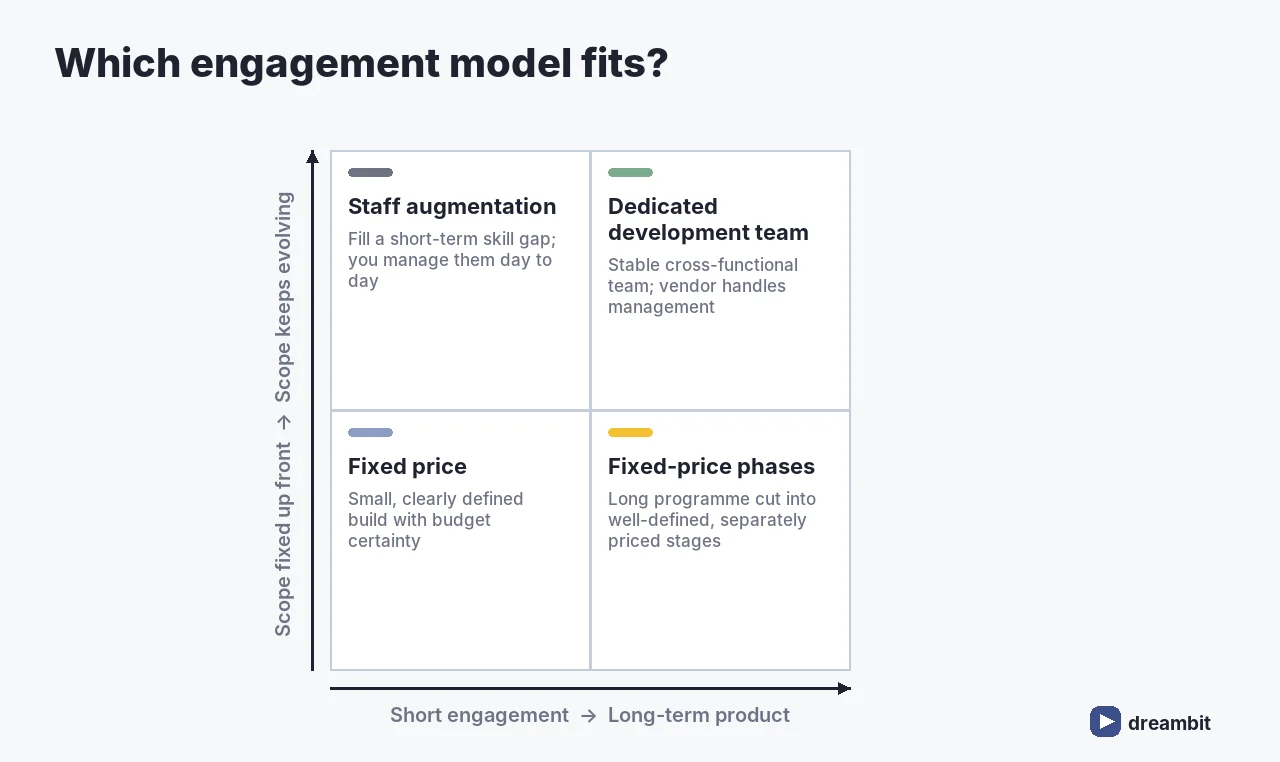
Team size and duration decide the economics. For one or two developers on a short engagement of three to six months, staff augmentation is usually cheaper because there’s no team setup and no long commitment. For three or more people working on a product long term, a dedicated team usually has the lower total cost of ownership, because management, hiring and replacement are handled for you instead of landing on your own leads.
When a dedicated team is the right choice
- The product is ongoing. After launch, it’s a business that keeps evolving.
- Priorities will change. You’ll learn from users and want to act on it quickly, without contract changes.
- You need several disciplines. Design, mobile, backend and QA together, coordinated by someone other than you.
- You can’t or don’t want to hire in-house yet. Hiring a full team takes months and carries retention risk.
- Knowledge continuity matters. Complex domains like healthcare, fintech or logistics reward a team that stays.
When it isn’t: a one-off build with a fixed spec, a prototype for a funding round, or a single missing skill in a team that’s otherwise complete. For the first two, a fixed-scope MVP engagement fits better. For the last, see our guide to hiring mobile app developers.
How much does a dedicated development team cost?
Dedicated teams are priced per person per month, so cost scales with team size, seniority and location. As a rough 2026 guide from market data, a dedicated developer costs roughly $3,500–$15,000 a month depending on region and seniority, and a small cross-functional team commonly lands at around $18,000–$45,000 a month. Rates follow the regional ranges we covered in mobile app development cost.
Two things matter more than the headline rate:
- Seniority mix. A team of two seniors and one mid-level engineer often ships more than five juniors, at lower cost.
- What’s included. Ask whether the price covers the delivery lead, QA, DevOps, tooling, devices and replacement guarantees, or whether those come as extras.
What a healthy dedicated team looks like
From the long-running client teams we’ve worked with, the ones that deliver consistently share the same habits:
- Short, predictable sprints with a demo of working software every one or two weeks. The Scrum Guide is a good baseline, even if you don’t follow it to the letter.
- A product owner on the client side who prioritises the backlog and is available to answer questions within a day.
- Shared tools: your repository, your issue tracker, your cloud accounts. Nothing important lives only in the vendor’s systems.
- Visible metrics: delivery against the plan, escaped defects, crash-free sessions and release frequency.
- Documentation as a habit: architecture notes, release runbooks and onboarding docs kept current, so knowledge survives people changes.
- Stable people. Low turnover is the whole point of the model, so ask about it.
How onboarding a dedicated team works
- Discovery (1–2 weeks): goals, roadmap, existing systems and the team composition they imply. We describe our own version in what we do in the first two weeks of a project.
- Team assembly: you meet and approve the people, not just the CVs.
- Access and setup: repositories, environments, tools, communication channels and working hours overlap.
- First sprint on something real: a small but shippable piece of the roadmap, to calibrate velocity and communication.
- Steady state: sprint cadence, monthly reviews, and a quarterly look at whether the team’s size and mix still fit the roadmap.
If you’re taking over an existing codebase, start with a mobile app audit so the new team knows what it’s inheriting before it commits to estimates.
Red flags in dedicated team proposals
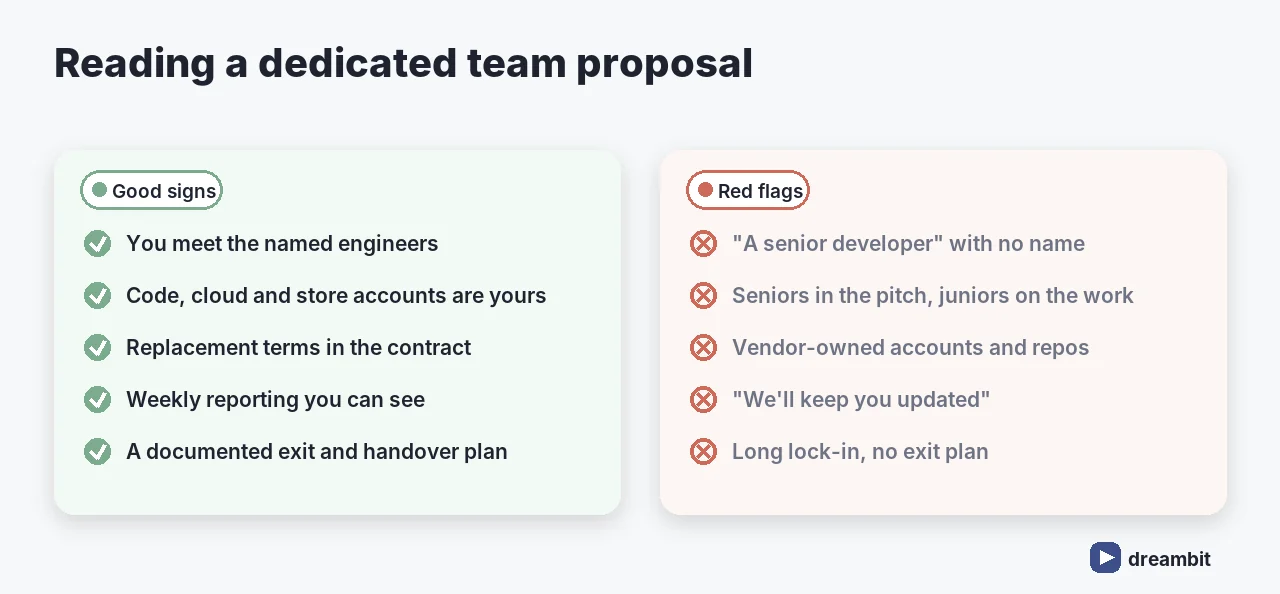
- No named people. “A senior developer” is a placeholder, not a team. You should meet the actual engineers.
- Senior in the pitch, junior on the project. Ask who exactly will work on your code, and get it in the contract.
- The vendor owns the accounts. Code, cloud, store and analytics accounts should be yours from day one.
- No replacement terms. People leave. The contract should say how fast a replacement arrives and who pays for the handover.
- Vague reporting. “We’ll keep you updated” isn’t a process. Ask what you’ll see every week.
- Long lock-in with no exit plan. A good partner makes leaving easy, with documentation and a clean handover, because they don’t expect you to want to.
Scaling a dedicated development team up or down
One advantage of the model is that team size can follow the roadmap instead of your hiring calendar. Before a big launch you might add a second mobile engineer and more QA. After it, you might scale back to a maintenance core. Two rules keep this from hurting quality. First, change size gradually, one or two people at a time, so the core team can absorb newcomers without slowing down. Second, never remove the people who hold the context, usually the tech lead and the longest-serving engineer. Agree the notice periods for scaling in both directions in the contract, so a change of plan doesn’t turn into a negotiation.
Dedicated team vs building in-house
A dedicated team isn’t a permanent alternative to hiring. It’s often the bridge. Many companies start with a dedicated team to reach product-market fit, then gradually hire in-house and keep a smaller external team for specialist work or peak load. The handover goes smoothly if documentation and shared ownership were in place from the start. We’ve written more about the trade-offs in outsourcing vs product development. If you need senior technical leadership before you need a full team, CTO as a service covers that gap.
How we run dedicated teams at Dreambit
Our teams are built around a stable core: a delivery lead, a tech lead who stays with the product, and engineers who’ve worked together before. Most of our mobile work is in Flutter, so a single team covers iOS and Android from one codebase, which keeps the team smaller for the same output. Everything runs in your accounts. You see working software every sprint, and the documentation is written so that your future in-house team, or another vendor, could take over without us. That’s the standard we’d want if we were the client.
Common mistakes when hiring a dedicated team
- Choosing on hourly rate alone. Output per month matters, not cost per hour.
- No product owner on your side. A dedicated team without clear priorities will stay busy without making real progress.
- Starting too big. Begin with a core team and grow once velocity and communication are proven.
- Treating the team as a black box. Join demos, read the release notes and ask questions.
- Ignoring knowledge transfer. If only the vendor understands your product, you’re locked in whether the contract says so or not.
Key Takeaways
- A dedicated development team works only on your product, long term, at a predictable monthly cost, with the vendor handling hiring and management.
- Choose fixed price for a small defined build, staff augmentation for a short-term gap, and a dedicated team for an ongoing product.
- For three or more people over the long term, a dedicated team usually has the lower total cost of ownership.
- Market rates run roughly $3,500–$15,000 per developer per month, depending on region and seniority.
- Healthy teams demo working software every sprint, run in your accounts and keep documentation current.
- Watch for unnamed people, vendor-owned accounts, missing replacement terms and lock-in without an exit plan.
Frequently Asked Questions
A dedicated development team is a stable, cross-functional group of engineers, designers, QA and a delivery lead who work only on your product, long term, for a predictable monthly fee. The vendor handles hiring, management and retention, while you own the product roadmap and priorities.
With staff augmentation you add specific people to your own team and manage them day to day, which suits short-term skill gaps when you already have a tech lead or PM. A dedicated team is a complete, vendor-managed unit with its own delivery lead, which suits ongoing products that need several disciplines and long-term continuity.
Dedicated teams are priced per person per month. Market data puts a dedicated developer at roughly $3,500–$15,000 a month depending on region and seniority, and a small cross-functional team commonly at around $18,000–$45,000 a month. Check whether the price includes the delivery lead, QA, DevOps, tooling and replacement guarantees.
Choose a dedicated team when the product is ongoing, priorities will change as you learn from users, and you need three or more people across disciplines. Choose fixed price for a small, clearly defined build where budget certainty matters more than flexibility. A hybrid of fixed-price phases can suit long programmes with a clear direction.
Typically two to four weeks: one to two weeks of discovery to define goals and team composition, time to meet and approve the named engineers, then access and setup, and a first sprint on a small but shippable piece of the roadmap to calibrate velocity and communication.
You should. Code repositories, cloud accounts, app store accounts and analytics should belong to you from day one, with the team working inside them. Make this explicit in the contract, along with documentation standards and a handover plan, so you can bring work in-house or change vendors without losing anything.