MVP development is the process of building the smallest version of a product that can test your core business bet with real users — not a stripped-down app, but a focused one. Done right, a custom MVP costs roughly $30,000–$120,000 and ships in 3–6 months, and its job is to produce evidence, not features. The hardest part isn’t building it; it’s deciding what to leave out.
Dreambit has shipped 150+ products over 14 years, including 60+ MVPs, with 5M+ downloads. Below is the practical playbook we use with founders — what an MVP really is, what it costs, how long it takes, how to scope it so it proves the right thing, and how AI now compresses the timeline.
What is an MVP — and what MVP development really means
An MVP (minimum viable product) is the smallest thing you can build to learn whether your core assumption is true. MVP development is therefore an exercise in prioritization: define the one flow that tests the bet, build it well, ship it, and measure. It is not “cheap version 1” — a broken experience teaches you nothing except that people dislike broken experiences.
We unpack this mindset in applying product thinking to client projects.
How much does MVP development cost in 2026?
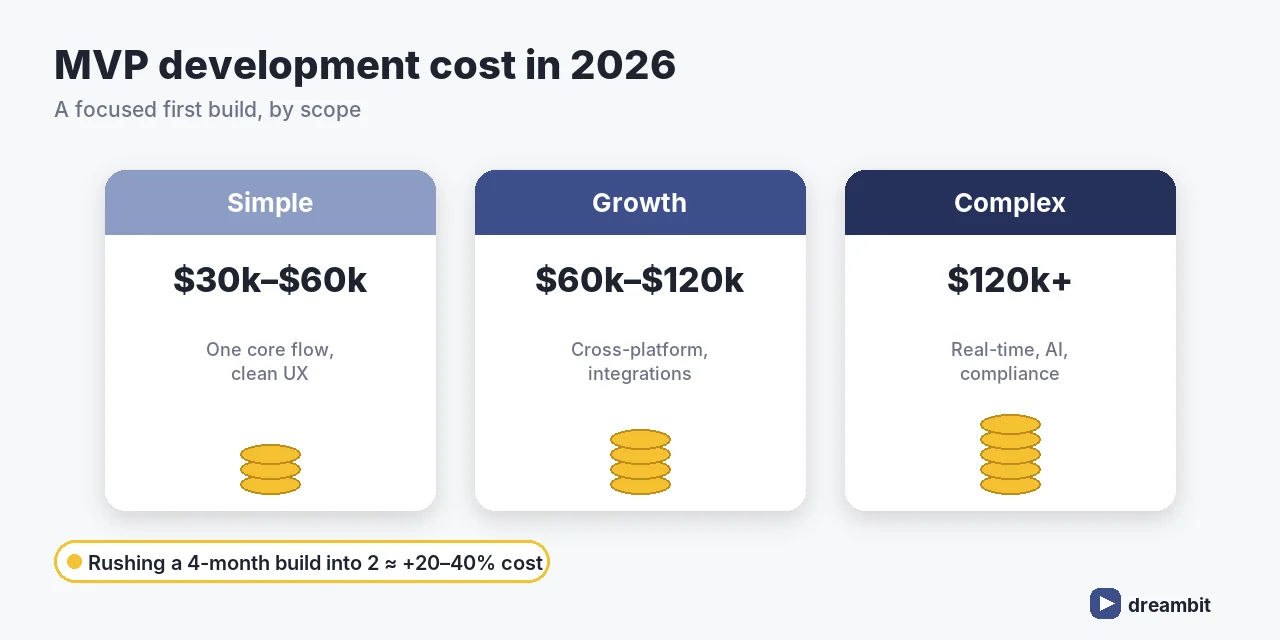
A realistic range for a custom MVP in 2026 is $30,000–$120,000+, depending on scope, platforms, and integrations. A single-platform MVP with one core flow lands at the lower end; a cross-platform product with real-time features, AI, or compliance sits higher. No-code MVPs are cheaper ($5,000–$15,000) but hit scaling limits fast.
A custom MVP with one core flow, clean UX, and the integrations it truly needs typically costs $30,000–$60,000 and ships in 3–4 months. Trying to compress a 4-month build into 2 usually raises the budget 20–40% and the defect rate with it (Dreambit project benchmarks, 2026).
For the full breakdown of what drives software budgets, see the cost of custom software development in 2026.
How long does MVP development take?
A realistic timeline is 3–6 months. A simple, single-platform app with limited backend can ship in 6–8 weeks; a cross-platform product with real-time data, AI, or compliance runs 4–8 months. The variable isn’t coding speed — it’s scope. The tighter the scope, the faster you learn.
How to scope an MVP right
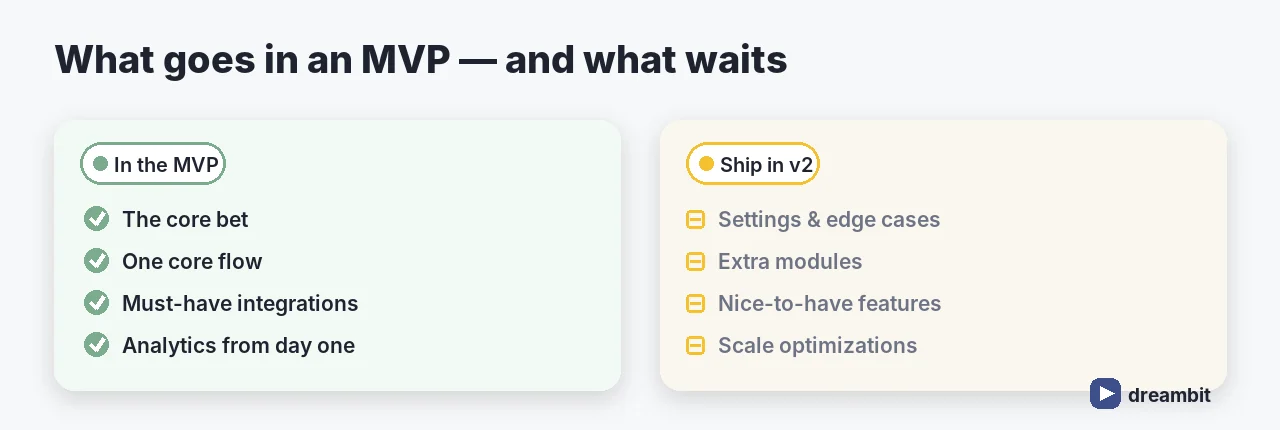
This is where MVP development is won or lost. Our rule: tie every feature to the one hypothesis you’re testing, and cut the rest to a later release.
- Define the core bet — the single thing that must be true for the product to work.
- Pick one core flow — the path that tests that bet end to end.
- Cut “nice to have” to v2 — settings, edge cases, and extra modules can wait.
- Instrument from day one — if you can’t measure it, you can’t learn from it.
Planning a startup build? Start with what future clients need to know before launching.
How AI speeds up MVP development
Used with discipline, AI compresses MVP timelines by roughly 40–60% — the boring parts (boilerplate, first-draft code, tests, docs) get faster, while engineers keep the judgment. But speed without control is dangerous, which is why we build spec-first with tests and verification. See how Dreambit builds with AI.
Our MVP development process
- Discovery (1–2 weeks) — the bet, the core flow, success metrics.
- UX/UI design (2–3 weeks) — prototype the one flow, test it.
- Development (6–14 weeks) — build spec-first, instrumented, tested.
- Launch & measure — ship to real users, watch the metric.
- Iterate — double down on what worked, cut what didn’t.
Curious what the first sprint looks like? Here’s what we do in the first two weeks.
Common MVP development mistakes to avoid
- Building too much. The most common and most expensive mistake — an MVP with 40 features tests nothing.
- Shipping a broken core. Small scope, high quality — not the reverse.
- No metric. If you don’t define what success looks like, you can’t tell if you found it.
- Skipping discovery. A week of it saves months of building the wrong thing.
- Rushing the timeline. Crushing 4 months into 2 inflates cost and defects.
Key Takeaways
- MVP development in 2026 typically costs $30,000–$120,000+ and ships in 3–6 months.
- An MVP is a hypothesis test, not a cheap v1 — scope to one core flow, built well.
- Cut “nice to have” to v2 and instrument the product from day one.
- AI, used with discipline, compresses timelines 40–60% without lowering the bar.
- Rushing scope raises cost and defects — tight scope is the real accelerator.
Frequently Asked Questions
Custom MVP development typically costs $30,000–$120,000+ in 2026. A single-platform MVP with one core flow is usually $30,000–$60,000; cross-platform products with real-time features, AI, or compliance run higher. No-code MVPs are cheaper ($5,000–$15,000) but hit scaling limits fast.
A realistic MVP timeline is 3–6 months. A simple single-platform app can ship in 6–8 weeks; complex platforms with real-time data, AI, or compliance take 4–8 months. Scope, not coding speed, is the main driver — the tighter the scope, the faster you learn.
Only what tests your core bet: one core user flow built to a high standard, the integrations it genuinely needs, and analytics from day one. Settings, edge cases, extra modules, and nice-to-have features belong in v2. An MVP with 40 features tests nothing.
A prototype demonstrates an idea (often clickable, not production-ready); an MVP is a real, shippable product that real users can use to validate a business bet. The MVP produces evidence from actual usage, which a prototype can’t.
Yes — used with discipline, AI compresses MVP timelines by roughly 40–60% by handling boilerplate, first-draft code, tests, and docs, while engineers keep the judgment. We build spec-first with tests and verification so speed never comes at the cost of quality.