E-learning app development is the process of designing, building, and maintaining mobile or web applications for online education — from course marketplaces and corporate training to language tutoring and microlearning. The thing that decides success isn’t the feature list; it’s engagement: an e-learning app only works if learners come back and finish what they start. A focused, engaging MVP usually takes 4–6 months to build and 3–5 core features to get right.
E-learning is one of Dreambit’s core industries, and across 14 years we’ve shipped 150+ products with 5M+ downloads. Below is the practical playbook we use with founders and training teams — what it costs, the features that actually drive completion, where AI helps, how to monetize, and the mistakes that quietly kill retention.
What is e-learning app development?
E-learning app development covers any software built to teach, train, or certify. In practice it splits into a few product types, each with its own engagement and content model:
- Course marketplaces — many instructors, many courses (Udemy-style).
- LMS & corporate training — structured learning, progress tracking, compliance.
- Microlearning apps — short, daily, habit-forming lessons (Duolingo-style).
- Language & tutoring — live or AI-driven practice and feedback.
- Kids & K-12 education — gamified, safe, parent-aware.
- Skill & certification platforms — assessments, credentials, outcomes.
The type you choose shapes your content pipeline, your monetization, and which features matter most.
How much does e-learning app development cost in 2026?
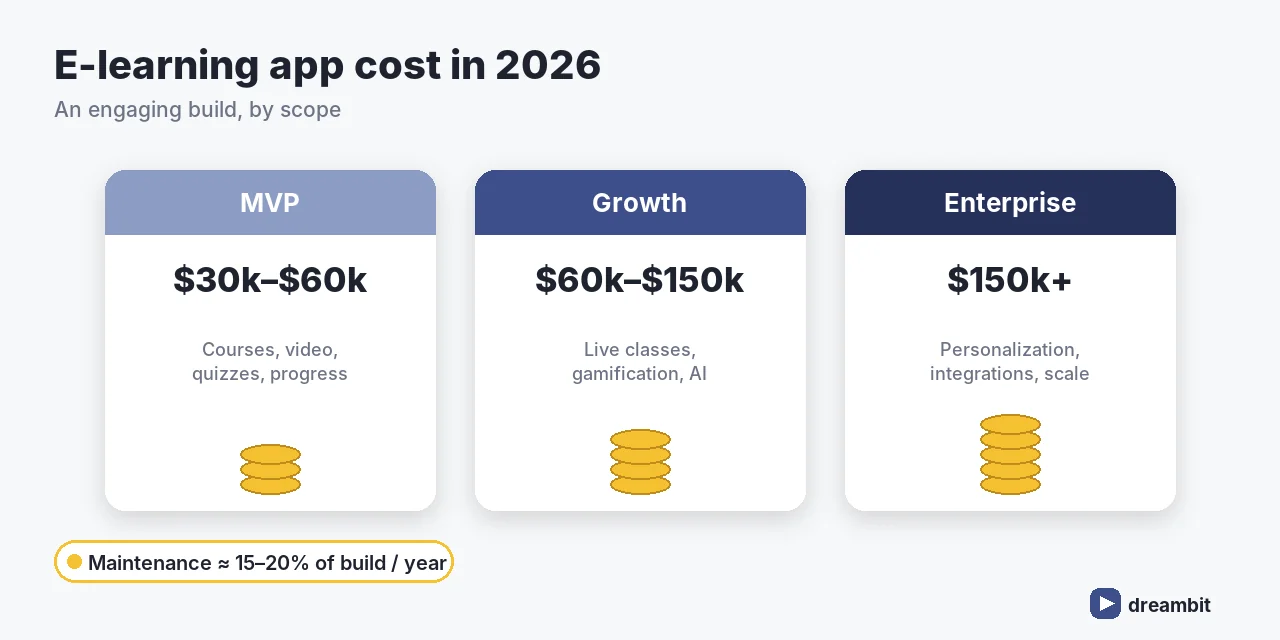
A realistic range for a custom e-learning app in 2026 is $30,000–$200,000+, depending on scope, content features, and platforms. A focused single-platform MVP lands at the lower end; a multi-platform product with live classes, gamification, and AI personalization sits higher.
An engaging e-learning MVP with courses, video lessons, quizzes, and progress tracking typically costs $30,000–$60,000 and reaches the app stores in 4–6 months — adding live classes or AI personalization pushes a build into the $60,000–$150,000 range (Dreambit project benchmarks, 2026).
The main cost drivers are video infrastructure, gamification depth, live/real-time features, AI personalization, and the number of platforms. For a fuller breakdown, see our guide to the cost of custom software development in 2026.
Must-have features for an e-learning app
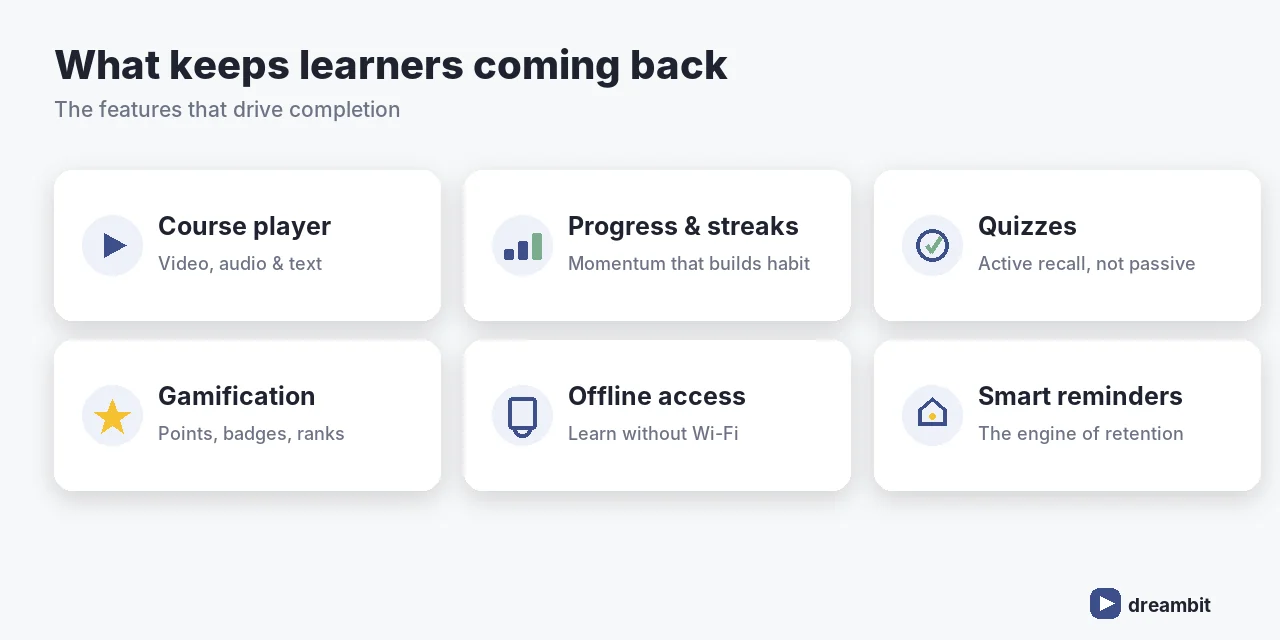
Engagement is the whole game. A credible e-learning app ships with a core built to keep learners coming back:
- Clean course player — video, audio, and text lessons that just work, online and off
- Progress tracking — visible streaks, completion, and next-step nudges
- Quizzes & assessments — active recall, not passive watching
- Gamification — points, badges, leaderboards, streaks that drive habit
- Offline access — learning continues without Wi-Fi
- Notifications & reminders — the quiet engine of daily retention
Retention is where most learning apps fail. We wrote about predicting and preventing drop-off in how we predict user churn and bring users back.
AI in e-learning apps
AI is now a baseline expectation, not a novelty. The highest-value uses we see:
- Personalized learning paths — content adapts to each learner’s pace and gaps
- AI tutoring & feedback — instant, patient help on demand
- Content generation — quizzes, summaries, and flashcards from existing material
- Smart recommendations — the next lesson a learner is most likely to finish
How to monetize an e-learning app
The model shapes the product, so decide it early:
- Subscription — predictable revenue; best for ongoing learning
- Freemium — free core, paid advanced content or features
- Course sales — one-off purchases or bundles
- B2B licensing — sell to companies for employee training (often the highest margin)
The right tech stack for an e-learning app
After 60+ MVPs, our default is a cross-platform front end with a scalable, media-ready back end:
- Frontend: Flutter or React Native — one codebase, 30–40% lower build cost. See why we use Flutter and Firebase for MVPs.
- Backend: Node.js or Python (Django) for content APIs and analytics.
- Media: a video CDN/streaming service for smooth playback at scale.
- Cloud: AWS or Firebase, with analytics wired in from day one.
Our e-learning app development process
- Discovery (1–2 weeks) — audience, content model, success metrics.
- UX/UI design (2–4 weeks) — engagement-first flows and prototypes.
- Development (8–16 weeks) — iterative sprints, analytics instrumented.
- QA & launch — tested across devices, then to the stores.
- Iterate on data — improve the flows that drive completion.
Not sure an app is the right move yet? Start with our checklist on whether your business needs a mobile app.
Common e-learning app development mistakes to avoid
- Building a content dump. More courses don’t help if no one finishes one.
- Ignoring retention from day one. Streaks, reminders, and nudges aren’t “later” features.
- Over-investing in live before validating recorded. Live classes are expensive; prove demand first.
- Skipping offline. Learners use commutes and gaps — meet them there.
- No analytics. If you can’t see where learners drop, you can’t fix it.
Key Takeaways
- Custom e-learning app development in 2026 typically costs $30,000–$200,000+; an engaging MVP is $30,000–$60,000.
- Engagement > features — progress, gamification, reminders, and offline drive completion.
- AI personalization and tutoring are now baseline expectations.
- Pick a monetization model early; B2B licensing is often the highest margin.
- Instrument analytics from day one and iterate on completion, not downloads.
Frequently Asked Questions
Custom e-learning app development typically costs $30,000–$200,000+ in 2026. An engaging MVP with courses, video, quizzes and progress tracking is usually $30,000–$60,000; adding live classes, gamification, or AI personalization pushes it to $60,000–$150,000. Maintenance runs about 15–20% of the build per year.
A focused, engaging e-learning MVP usually takes 4–6 months from discovery to app-store launch. Live classes, deep gamification, or AI personalization add time. The fastest path is to ship a strong recorded-course experience first, then expand based on real completion data.
Engagement features, not sheer content volume: a clean course player with offline access, visible progress and streaks, quizzes for active recall, gamification, and smart reminders. These drive course completion — the metric that actually matters — far more than the number of courses available.
Retention is designed in from day one: streaks and progress create momentum, reminders bring learners back, gamification rewards consistency, and AI personalization keeps content at the right level. We also instrument analytics to see exactly where learners drop and fix those flows.
Common models are subscriptions (predictable revenue for ongoing learning), freemium (free core, paid advanced content), one-off course sales, and B2B licensing to companies for employee training — often the highest-margin route. Pick the model early, because it shapes the product.