Real estate app development is the process of building property search and management software — listing marketplaces, agent tools, rental platforms, and the MLS/IDX integrations that feed them real data. Budget $35,000–$300,000+ depending on scope, and expect 4–9 months. The part that surprises most teams isn’t the app: it’s that MLS integration alone runs $20,000–$40,000, plus $10,000–$20,000 for every additional board you need.
Dreambit has shipped 150+ products over 14 years (5M+ downloads, 4.9★ across 114 reviews), including marketplaces where search quality and data freshness decide whether users convert. Property search is unusual as a product problem: the buying cycle runs for months, users compare you directly against national portals with enormous budgets, and your inventory data comes from third parties you don’t control. Winning means being faster and more relevant in a narrow niche — not out-spending Zillow.
Here’s what real estate app development involves, what it costs, how MLS data actually works, where property apps lose their leads, and how to sequence a build so the budget survives contact with reality.
What is a real estate app?
PropTech products fall into a few distinct types, each with its own data and monetization model:
- Listing marketplace — buyers search, agents list; revenue from featured listings or leads.
- Agent / brokerage tools — CRM, listing management, client pipelines.
- Rental platform — applications, screening, payments, leases.
- Property management — tenants, maintenance requests, accounting.
- Investment / analytics — valuations, yield modelling, portfolio views.
Marketplaces are the hardest of these to get right — two-sided supply and demand plus data operations. Our multi-vendor marketplace guide covers that dynamic in depth.
When building your own property app makes sense
Not every brokerage needs an app. In our experience it pays off in three situations: you serve a specific niche the portals handle badly (new builds, student lets, commercial, a single metro), you have proprietary inventory or off-market stock, or you need internal tooling your agents currently do in spreadsheets. If your plan is a general-purpose portal competing head-on nationally, the honest advice is usually don’t — differentiation has to come before development.
If you’re unsure the app is the right vehicle at all, start with our checklist on whether your business needs a mobile app.
How much does real estate app development cost in 2026?
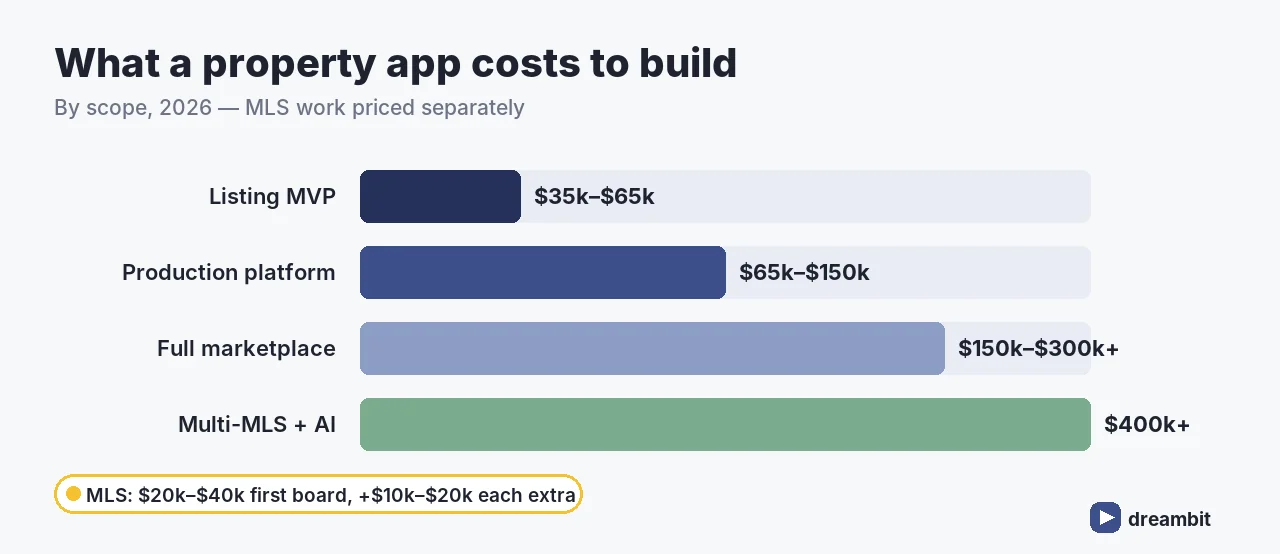
A basic listing MVP runs $35,000–$65,000. A production platform with map search, saved searches, lead routing and admin tooling sits at $65,000–$150,000. A full marketplace with MLS/IDX integration and AI recommendations reaches $150,000–$300,000+, and multi-MLS aggregation platforms can exceed $400,000.
MLS integration is the line item that breaks budgets: a single-board API integration starts around $20,000–$40,000, and each additional MLS board adds roughly $10,000–$20,000 — because every board has its own rules, approval process and data quirks. Maintenance then runs 15–20% of build cost per year (industry benchmarks, 2026).
Scope this like any first build — one market, one core flow. Our MVP development guide is the discipline that keeps a PropTech budget honest.
MLS and IDX integration: what to know before you commit
MLS (Multiple Listing Service) data is how a property app gets real inventory, and IDX is the framework that lets you display it. Four realities to plan for:
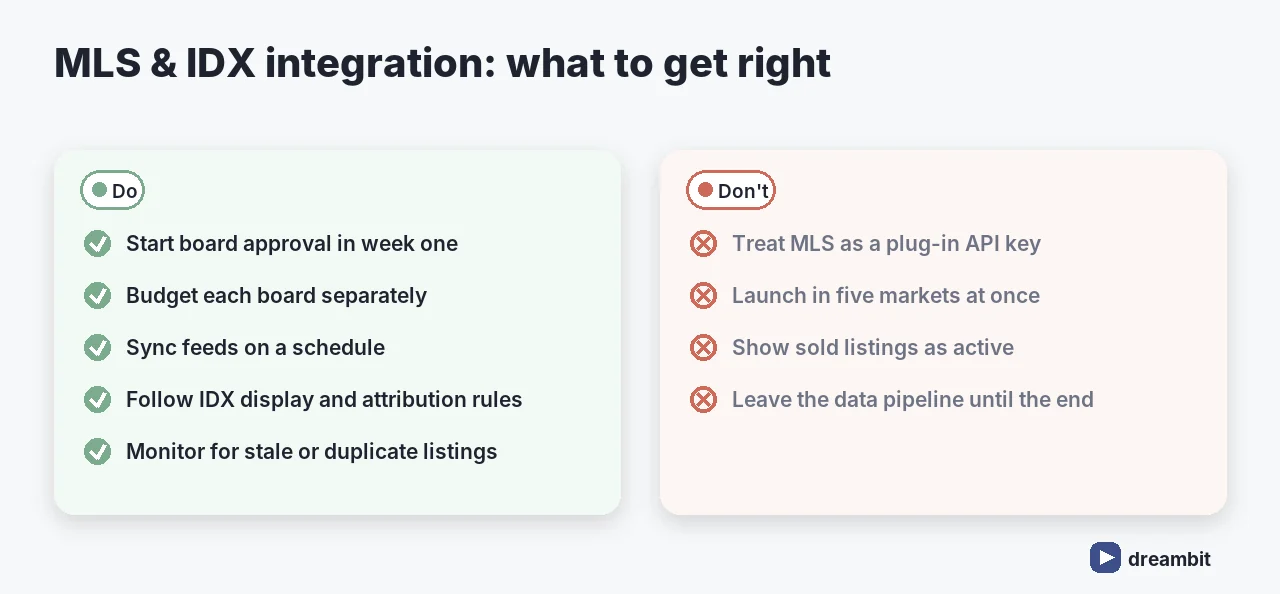
- Every board is separate. Rules, fees, and approval timelines differ per MLS.
- Approval takes time. Access is granted to licensed parties under agreements — start early, not at the end.
- Display rules are strict. Attribution, refresh frequency and what you may not show are all governed.
- Data hygiene is ongoing. Stale or duplicated listings destroy trust faster than any UI flaw.
The National Association of Realtors’ IDX rules are the reference point for US display requirements.
How long does it take?
A realistic timeline is 4–9 months from discovery to launch. An API-only single-MLS integration can be done in 1–3 months on its own; a multi-MLS aggregation platform with AI-native features stretches to 9–12. The critical path is rarely the app — it’s MLS approval and the data pipeline, which is exactly why they should start in week one.
Must-have features for a property app
- Map-based search with real filters — price, beds, area, commute; the core of the product
- Fast, rich listing pages — photos, floor plans, virtual tours
- Saved searches & alerts — property hunting takes months, so retention lives here
- Enquiry & lead routing — the moment revenue happens; never let it fail
- Agent profiles & messaging — trust signals before contact
- Mortgage / affordability calculator — keeps decisions inside your app
Virtual tours, media and the trust problem
Property is a high-consideration purchase made largely on photos. Rich media — good photography, floor plans, 3D or video tours — measurably increases enquiry rates, but it’s also the heaviest part of your app. Plan for a CDN, aggressive image optimisation, and progressive loading, because a listing page that stalls on mobile is a lost lead. Design chaos hurts here too: we wrote about that in why chaos in design destroys trust.
AI in real estate apps
AI has moved from novelty to expectation in PropTech, and the useful applications are narrow and concrete:
- Personalized recommendations — surfacing the next listing a buyer is likely to enquire on, based on real behaviour rather than declared filters.
- Natural-language search — “two beds near a park under $500k” instead of eight dropdowns.
- Automated valuation and yield estimates — useful for investor-facing products, dangerous if presented as fact without a confidence range.
- Listing description generation — a real time-saver for agents, provided a human still approves it.
- Lead scoring — routing the enquiries most likely to close to the right agent first.
The discipline matters more than the model: AI output that looks authoritative but is wrong is worse than no feature at all, which is why we build these spec-first with verification — see how Dreambit builds with AI.
How property apps make money
- Lead generation — agents pay per enquiry or per month; the dominant marketplace model.
- Featured / promoted listings — visibility upsells to sellers and agents.
- Subscription — SaaS pricing for agent and property-management tools.
- Transaction fees — a cut of rent, deposits or application fees on rental platforms.
Pick the model before design, because it dictates what the product optimises for: a lead-gen app is built around the enquiry, a SaaS tool around daily agent workflow.
Where property apps lose leads
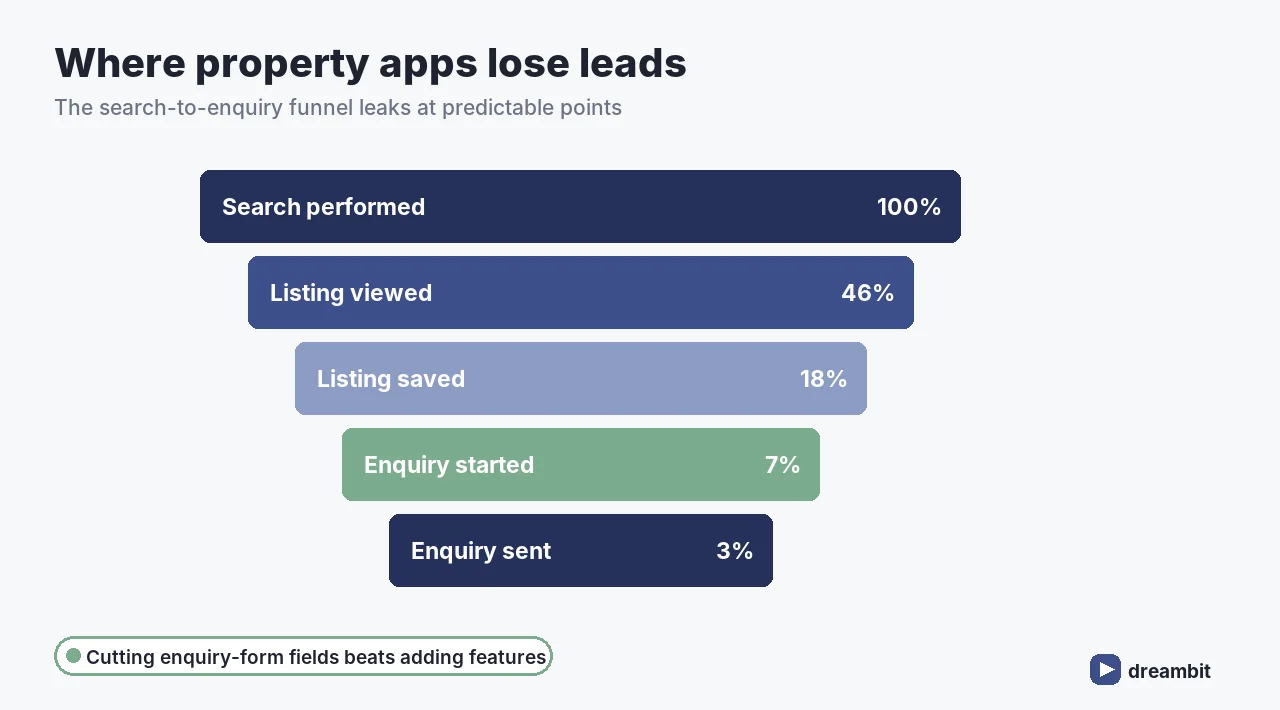
Search-to-enquiry is a funnel, and most PropTech platforms leak at the same predictable points: filters that don’t match how people actually search, listing pages that load too slowly on mobile data, and an enquiry form that asks for too much too soon. Each of those is fixable — but only if you can see it.
In our experience the highest-leverage change in a property app is almost never a new feature: it’s cutting fields from the enquiry form and making map search feel instant. Teams that instrument the search-to-enquiry funnel before building anything new consistently find their biggest win in a flow they already shipped (Dreambit delivery experience, 2026).
Instrument every step — search performed, listing viewed, saved, enquiry started, enquiry sent — before adding features. We made the wider case in how poor navigation kills conversion and how progressive UX saves users at onboarding.
The right tech stack for PropTech
- Apps: Flutter or React Native — one codebase across iOS and Android; see lessons from 60+ builds.
- Search: a dedicated search engine (Elasticsearch/Typesense) — SQL alone won’t do map + facet search at speed.
- Backend: Node.js or Python (Django), with a scheduled sync pipeline for MLS feeds.
- Maps: a mapping platform with geocoding and polygon search — watch per-request pricing.
- Media: a CDN for heavy photo and tour assets.
Our real estate app development process
- Discovery (1–2 weeks) — market, data sources, monetization, success metric.
- Start MLS access early — paperwork runs in parallel with design.
- Design search first — it’s the product; everything else supports it.
- Build & sync — iterative sprints, feed pipeline early not last.
- Launch in one market — prove conversion before adding boards.
- Expand board by board — each with its own budget line.
Common real estate app development mistakes
- Treating MLS as a plug-in. It’s a workstream with legal approval, not an API key.
- Launching in five markets at once. Each board multiplies cost and complexity.
- Weak search. If filters and map don’t feel instant, users leave for the portals.
- Heavy enquiry forms. Every extra field costs leads.
- Ignoring data freshness. Sold-but-still-listed is the fastest way to lose trust.
- Building agent tools nobody asked for. Shadow a working agent for a day before designing their CRM.
- No plan for media weight. Photos and tours will dominate your bandwidth bill and your load times.
Key Takeaways
- Real estate app development costs $35,000–$65,000 for a listing MVP, $65,000–$150,000 mid, $150,000–$300,000+ for a full marketplace.
- MLS integration is $20,000–$40,000 for one board, plus $10,000–$20,000 per additional board.
- Expect 4–9 months; start MLS approval on day one, not at the end.
- Search and map experience is the product — invest there first.
- Launch in one market, prove the search-to-enquiry funnel, then expand board by board.
- Timeline is 4–9 months; MLS approval and the data pipeline are the critical path, not the app.
- Decide monetization (leads, promoted listings, subscription, transaction fees) before design.
Frequently Asked Questions
A basic listing MVP runs $35,000–$65,000, a production platform with map search and lead routing $65,000–$150,000, and a full marketplace with MLS/IDX and AI recommendations $150,000–$300,000+. Multi-MLS aggregation platforms can exceed $400,000. Maintenance adds 15–20% of build cost per year.
A single-board MLS/IDX API integration typically costs $20,000–$40,000, and each additional MLS board adds roughly $10,000–$20,000. Every board has its own rules, fees and approval process, so multi-market coverage multiplies both cost and timeline — budget each board as a separate line item.
Expect 4–9 months from discovery to launch. An API-only single-MLS integration can take 1–3 months on its own, while multi-MLS platforms with AI features stretch to 9–12 months. MLS approval and the data pipeline — not the app itself — are usually the critical path.
Map-based search with filters people actually use, fast listing pages with photos, floor plans and virtual tours, saved searches and alerts, reliable enquiry and lead routing, agent profiles and messaging, and a mortgage or affordability calculator. Search quality is the product; everything else supports it.
Three predictable leaks: filters that don’t match how buyers search, listing pages that load slowly on mobile, and enquiry forms that ask too much too soon. Instrumenting the search-to-enquiry funnel usually reveals the biggest win is in a flow you already shipped, not in a new feature.