
Mobile app testing services — and the quality audit that usually starts them — are how you find out whether your app actually works before your users do. In practice it means checking an app across real devices, load, edge cases, and security, then reporting what to fix and how urgently. A one-time app quality audit typically costs $2,000–$8,000; ongoing managed QA runs $1,500–$5,000+/month. The point isn’t to chase a coverage number — it’s to stop the bugs that cost you installs and trust.
Quality is something Dreambit treats as non-negotiable — across 14 years and 150+ shipped products (5M+ downloads, 4.9★) every release passes the same scrutiny. Here’s what a mobile app quality audit covers, when you need one, what it costs, and how manual and automated testing fit together.
What is a mobile app quality audit?
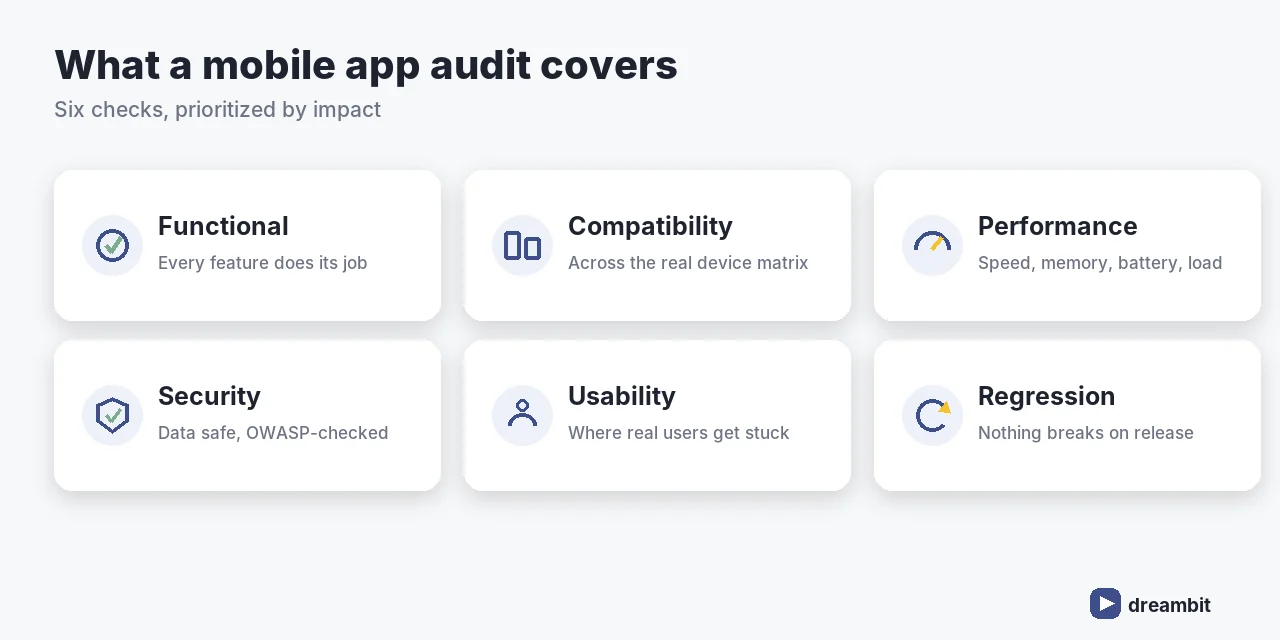
A quality audit is a structured assessment of your app’s health that produces a prioritized list of issues and fixes. Full mobile app testing services then cover the ongoing work. The main testing types:
- Functional — does every feature do what it should?
- Compatibility — behavior across the real device/OS matrix
- Performance — speed, memory, battery, and load
- Security — data protection and common vulnerabilities
- Usability — the flows where real users get stuck
- Regression & automation — nothing breaks when you ship again
We go deeper on our approach in how we approach quality assurance.
When do you need an app audit?
Some signals are hard to ignore:
- Rising crash rates or app freezes and slowdowns
- Falling store ratings and reviews mentioning bugs
- You’re about to launch, raise, or scale to more users
- You inherited a codebase and don’t know its real state
- Releases keep breaking things that used to work
How much do mobile app testing services cost in 2026?
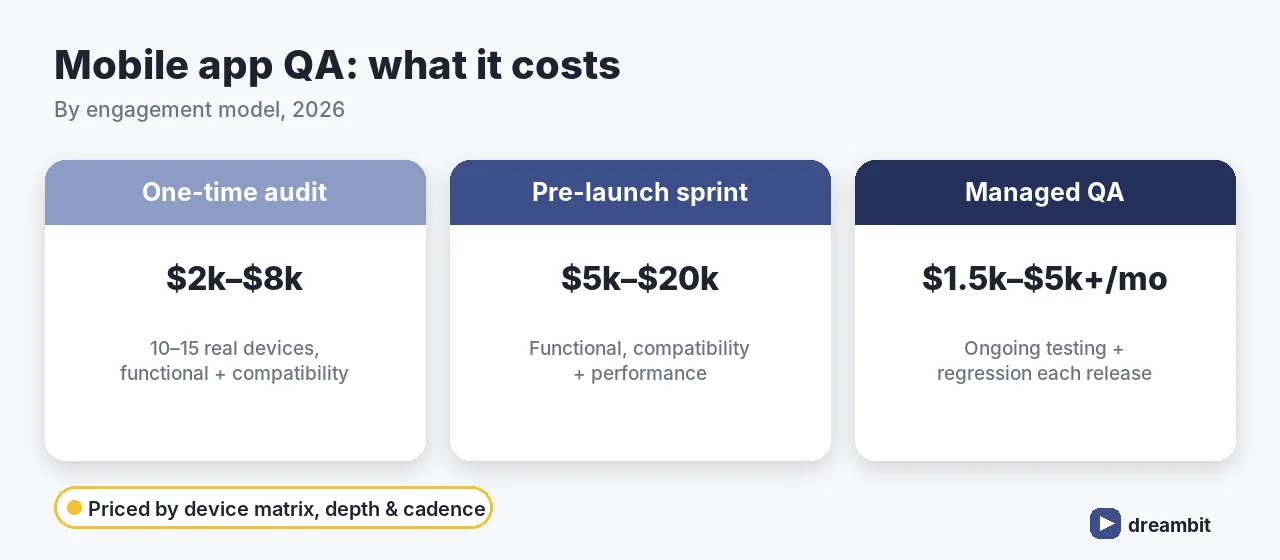
Cost depends on scope — device matrix, depth, and whether it’s one-time or ongoing:
A one-time compatibility and functional audit across 10–15 real devices typically costs $2,000–$8,000; a full pre-launch sprint (functional + compatibility + performance) runs $5,000–$20,000; ongoing managed QA is $1,500–$5,000+/month depending on team size and release cadence (industry benchmarks, 2026). If you want the scoped version for your app, that is what our app quality audit delivers.
The drivers are platform coverage, device matrix, test depth, integrations, and reporting needs — the same forces behind overall software cost.
What a mobile app quality audit covers
A credible audit doesn’t just list bugs — it prioritizes them by impact and gives you a fix plan. Expect: a device/OS compatibility matrix, functional defect log, performance and stability findings, a security review against OWASP mobile standards, and usability observations — each rated by severity so you fix what matters first.
Manual vs automated testing
You need both, for different jobs:
- Manual testing — exploratory, usability, and anything that needs human judgment.
- Automated testing — fast, repeatable regression across builds and devices.
A warning we live by: coverage is not quality. AI and automation can hit 90% coverage while verifying nothing meaningful — which is why we demand behavior- and edge-case tests. More on that discipline in how Dreambit builds with AI.
Our QA process
- Audit (3–5 days) — assess, reproduce, prioritize by severity.
- Test plan — device matrix, cases, and automation targets.
- Execution — manual + automated, on real devices.
- Report — prioritized findings with a fix plan.
- Regression & monitoring — keep it fixed release after release.
Common QA mistakes to avoid
- Chasing coverage numbers. 90% coverage that tests nothing is theater.
- Testing only on emulators. Real devices reveal real bugs.
- Skipping performance and security until something breaks in production.
- No regression suite. Every release quietly re-breaks old features.
- Treating QA as a final gate instead of a continuous practice.
Key Takeaways
- Mobile app testing services span functional, compatibility, performance, security, usability, and regression/automation.
- A one-time audit is $2,000–$8,000; a pre-launch sprint $5,000–$20,000; ongoing managed QA $1,500–$5,000+/month.
- Get an audit before launch, before scaling, or when crashes/ratings slip.
- Use manual and automated testing together — and remember coverage ≠ quality.
- A good audit prioritizes issues by impact and hands you a fix plan, not just a bug list.
Frequently Asked Questions
In 2026, a one-time quality audit across 10–15 real devices typically costs $2,000–$8,000; a full pre-launch sprint (functional, compatibility, performance) runs $5,000–$20,000; and ongoing managed QA is $1,500–$5,000+/month. Cost scales with platform coverage, device matrix, test depth, and release cadence.
A quality audit covers functional testing, device/OS compatibility, performance and stability, a security review against OWASP mobile standards, and usability. Crucially, it prioritizes issues by severity and hands you a fix plan — not just a raw bug list — so you fix what actually costs you users first.
Get one before a launch, before raising or scaling, when crash rates climb or store ratings slip, or when you’ve inherited a codebase and don’t know its real state. If recent releases keep breaking features that used to work, that’s a strong signal you need an audit and a regression suite.
Both. Manual testing handles exploratory, usability, and judgment-heavy checks; automated testing gives fast, repeatable regression across builds and devices. Beware coverage theatre — high automated coverage can still verify nothing meaningful, so demand behaviour- and edge-case tests, not just line coverage.
A focused audit usually takes 3–5 days to assess, reproduce, and prioritize issues, followed by a test plan and execution. Ongoing managed QA then runs continuously alongside your releases, with regression checks each time you ship so fixed issues stay fixed.