Travel app development is the process of building booking and trip-management software — flight and hotel search, itineraries, activities, and the GDS and supplier APIs that supply real inventory and prices. A focused MVP starts around $25,000, a solid mid-level platform runs $45,000–$70,000, and a full OTA reaches $100,000–$200,000+. The part teams underestimate isn’t the app — it’s that every major booking integration costs $5,000–$15,000 and takes 2–6 months on its own.
Dreambit has shipped 150+ products across 14 years (5M+ downloads, 4.9★ from 114 client reviews), including booking-driven products where availability accuracy and checkout trust decide revenue. Travel is a brutal category: you compete with Booking.com and Expedia on search, your prices come from suppliers you don’t control, and your users are often abroad on bad connections. This guide covers what to build, what it costs, which integrations matter, and where travel apps lose bookings.
What kind of travel app are you building?
“Travel app” covers several products with very different economics:
- OTA / booking marketplace — flights, hotels, cars; revenue from commission or markup.
- Hotel or chain app — direct booking, loyalty, digital key, in-stay services.
- Trip planner / itinerary — organise bookings, maps and documents in one place.
- Tours & activities — experiences marketplace with local supply.
- Corporate travel — policy compliance, approvals, expense integration.
- Travel-adjacent utilities — currency, transfers, e-SIM, guides.
Marketplaces are the hardest: two-sided supply plus live inventory. If that’s your model, read our multi-vendor marketplace guide alongside this one.
When a custom travel app is worth building
Competing head-on with the global OTAs on generic search is a losing bet — their inventory, brand spend and SEO footprint are unmatchable. In our experience a custom travel app earns its budget in four situations: you own direct supply (a hotel group, tour operator, transfer fleet) and want to cut commission; you serve a defined niche the majors handle badly (diving trips, accessible travel, pilgrimage, corporate policy travel); you need operational tooling your staff currently run on spreadsheets and email; or you have an existing audience and the app is a retention and loyalty play rather than an acquisition one.
If you’re not sure the app is the right vehicle yet, start with our checklist on whether your business needs a mobile app.
How much does travel app development cost in 2026?
Realistic ranges: a single-vertical MVP (say hotels only, one supplier) starts near $25,000. Add profiles, filters, payments and a decent booking flow and you’re at $45,000–$70,000. A multi-vertical platform with GDS connectivity, real-time pricing and multi-supplier inventory lands at $100,000–$200,000+.
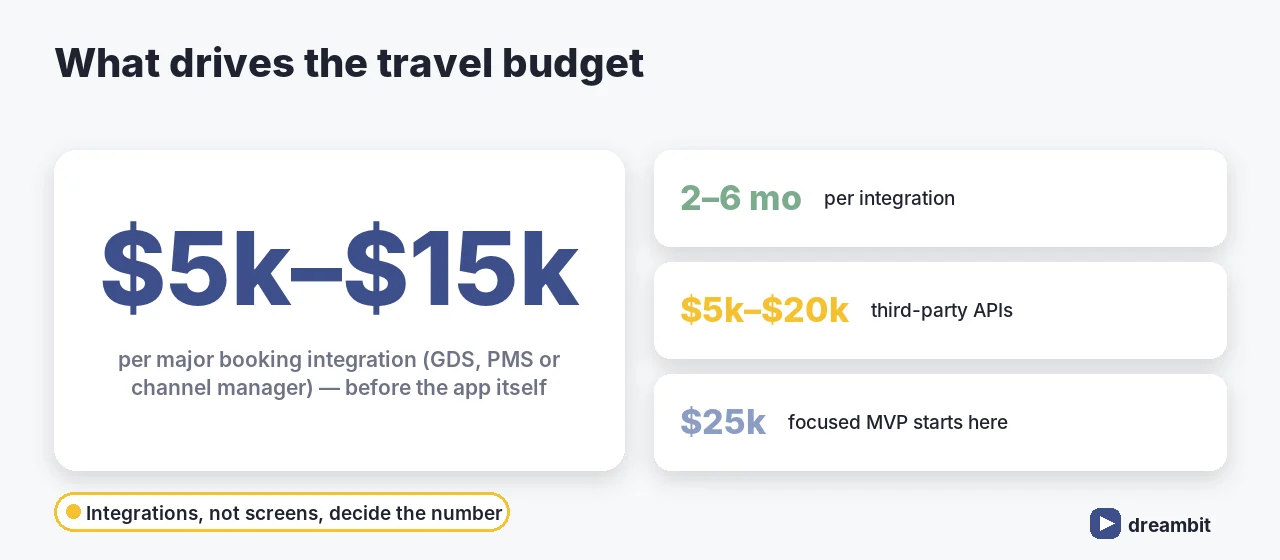
Integrations, not screens, drive the travel budget. A single major integration — GDS, property management system, or channel manager — costs $5,000–$15,000+ to build and takes 2–6 months by itself. Third-party APIs such as Amadeus, Skyscanner or Google Maps typically add another $5,000–$20,000 to the total (industry benchmarks, 2026).
That’s why we scope travel builds around one vertical and one supplier first. The MVP discipline matters more here than in almost any other category, and the wider drivers are covered in the cost of custom software development in 2026.
Booking integrations: GDS, aggregators and direct suppliers
Your inventory comes from somewhere, and that choice shapes the whole product:
- GDS (Amadeus, Sabre, Travelport) — deep flight and hotel content, contracts and certification required, longest integration.
- Aggregator APIs — faster to launch, less margin control, rate limits to design around.
- Direct supplier / channel manager — best margins for hotels and operators, one integration per partner.
- Payments — multi-currency, 3-D Secure, and refund flows that match supplier rules.
Two hard truths: caching is mandatory (live search against a GDS on every keystroke is neither fast nor affordable), and price/availability drift is normal — your UX must handle “that fare just changed” gracefully instead of erroring out. Amadeus publishes its self-service travel APIs if you want to see the shape of the data before committing.
How long does it take?
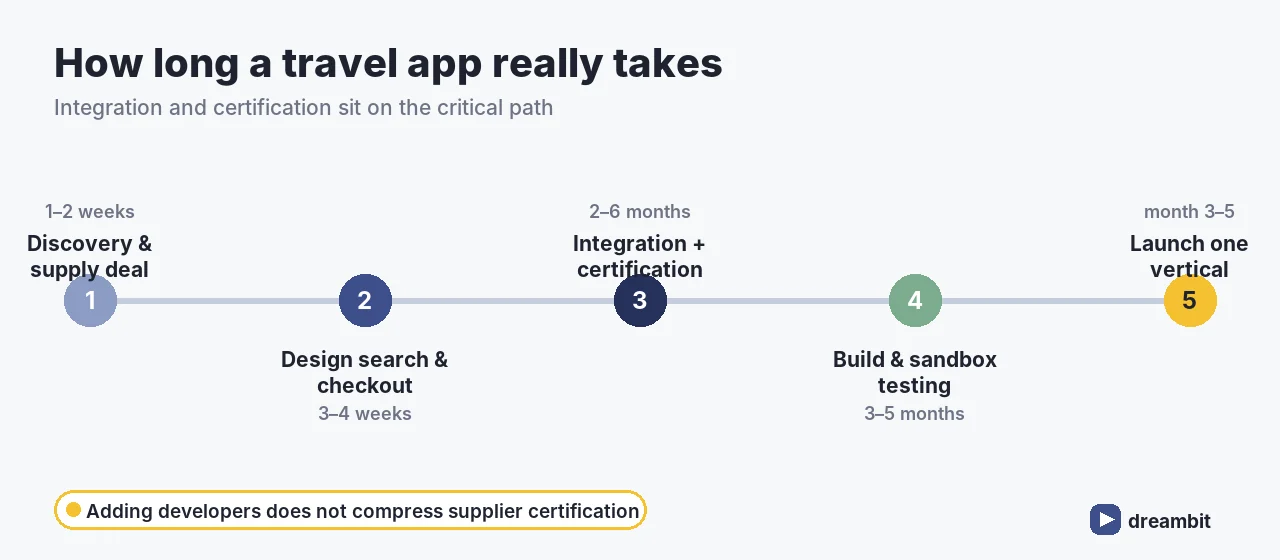
For a single-vertical MVP with one supplier, plan 3–5 months to launch. A mid-level multi-supplier platform runs 6–9 months, and a full multi-vertical OTA with GDS connectivity is realistically 9–14 months — because integration and certification work sits on the critical path and often can’t be compressed by adding developers. Start the commercial and technical paperwork with your supply partners in week one; design and build can proceed in parallel while approvals move.
Must-have features for a travel app
- Fast, forgiving search — flexible dates, nearby airports, filters that match how people actually plan
- Transparent pricing — taxes and fees visible early; surprises at checkout kill conversion
- Frictionless booking & payment — guest checkout, saved travellers, multi-currency
- Confirmations & itineraries — everything in one place, e-tickets and vouchers included
- Offline access — boarding passes and itineraries must open with no signal, abroad
- Notifications — gate changes, check-in reminders, delay alerts
- Support & cancellation flows — the difference between a refund and a chargeback
Offline is not optional in travel — roaming is expensive and airport Wi-Fi is unreliable. We made the general case in when your app works without Wi-Fi, it works for your clients.
The traveller journey — and where bookings leak
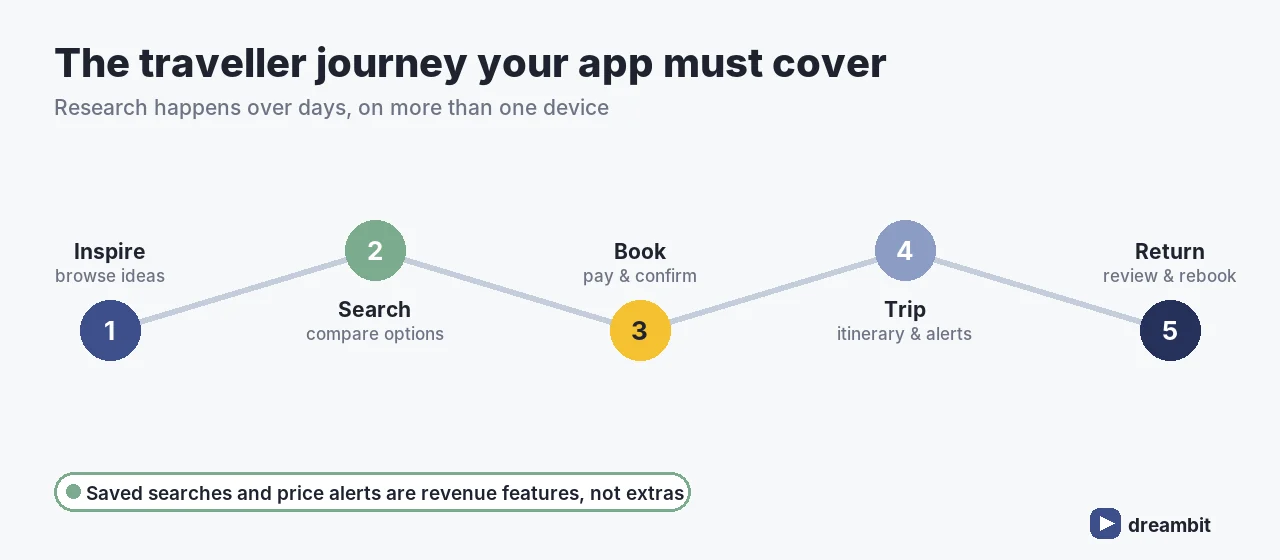
Travel has an unusually long, multi-session funnel: people research on a phone at night, compare for days, then book on another device. Two consequences: your saved searches, price alerts and cross-device continuity are revenue features, not extras; and abandoned-cart recovery works better here than in most categories.
The most common leak is checkout. Every additional field, forced account creation, or late-appearing fee costs bookings — the same pattern we documented in how to reduce cart abandonment by removing checkout steps.
How travel apps make money
- Commission — a cut of each booking; the standard OTA model, and the reason look-to-book rate is the metric that matters.
- Markup — you buy net rates and set your own price; better margin, more pricing responsibility.
- Direct booking savings — for hotels and operators the “revenue” is the commission you no longer pay a third party.
- Subscription / SaaS — for corporate travel and operator tooling.
- Ancillaries — insurance, transfers, seat selection, activities; often the healthiest margin in the basket.
Decide this before design, because it changes the product: a commission model optimises the funnel to booking, while a loyalty-driven direct app optimises for repeat visits and account value.
Retention: the part most travel apps skip
Travel purchases are infrequent, so an app that only handles booking gets deleted between trips. The apps that survive on the home screen do something useful during the trip — itinerary, documents, check-in reminders, digital key, on-trip support — and something valuable between trips, usually loyalty status or price alerts on saved searches.
The strongest retention lever in travel isn’t a discount, it’s usefulness in the airport: itineraries and boarding passes that open instantly with no signal, plus proactive delay and gate notifications. An app that solves a stressful moment gets reopened on the next trip (Dreambit delivery experience, 2026).
Predicting and preventing drop-off is its own discipline — see how we predict user churn and bring users back.
Dynamic pricing and AI in travel apps
AI in travel is most useful where it reduces decision fatigue:
- Personalised ranking — order results by what this traveller actually books, not just price.
- Price prediction and alerts — “wait or book now” guidance, with honest confidence.
- Natural-language trip search — “warm, direct flights, under $600 in October”.
- Itinerary generation — draft day plans a human can edit.
- Support automation — grounded in your real fare and cancellation rules, never invented.
The risk is specific: a confidently wrong answer about a refund policy becomes a support and legal problem. That’s why we build these features spec-first with verification — see how Dreambit builds with AI.
The right tech stack for travel
- Apps: Flutter or React Native for iOS and Android from one codebase — see lessons from 60+ builds.
- Search: a dedicated search layer plus aggressive caching of supplier responses.
- Backend: Node.js or Python (Django) with queues for booking and ticketing jobs.
- Payments: a gateway with multi-currency, 3-D Secure and partial refunds.
- Offline: local storage for itineraries, passes and documents.
Our travel app development process
- Discovery (1–2 weeks) — vertical, supply source, margin model, success metric.
- Start integration paperwork immediately — GDS certification runs in parallel with design.
- Design search and checkout first — they are the product.
- Build with a sandbox supplier — real API shapes from week one.
- Launch one vertical, one market — prove look-to-book before expanding.
- Instrument and iterate — search speed, look-to-book, checkout completion.
What the first sprint looks like is described in what we do in the first two weeks.
Common travel app development mistakes
- Underestimating integrations. Each major one is a months-long project, not a sprint task.
- No caching strategy. Live supplier calls on every search are slow and expensive.
- Hiding fees until checkout. The single biggest conversion killer in travel.
- Assuming connectivity. Your users are abroad, roaming off, in an airport basement.
- Ignoring cancellation and refund UX. It drives reviews, support cost and repeat business.
- Launching four verticals at once. Flights, hotels, cars and activities are four products.
Key Takeaways
- Travel app development costs ~$25,000 for a focused MVP, $45,000–$70,000 mid-level, $100,000–$200,000+ for a full OTA.
- Each major booking integration adds $5,000–$15,000 and 2–6 months; third-party APIs add $5,000–$20,000.
- Caching and graceful price-drift handling are architectural requirements, not polish.
- Offline itineraries and transparent pricing are the features that protect bookings.
- Launch one vertical in one market, prove look-to-book, then expand supply.
- Timelines: 3–5 months single-vertical MVP, 6–9 months mid-level, 9–14 months full OTA.
- Decide the money model — commission, markup, direct savings, subscription, ancillaries — before design.
- Build in-trip usefulness (itineraries, alerts, offline documents) or the app gets deleted between trips.
Frequently Asked Questions
A focused single-vertical MVP starts around $25,000, a mid-level platform with profiles, filters and payments runs $45,000–$70,000, and a full multi-vertical OTA with GDS connectivity reaches $100,000–$200,000+. Each major booking integration adds $5,000–$15,000, and third-party APIs another $5,000–$20,000.
Plan 3–5 months for a single-vertical MVP with one supplier, 6–9 months for a mid-level multi-supplier platform, and 9–14 months for a full OTA. Supplier integration and certification sit on the critical path and can’t be compressed by adding developers, so start that paperwork in week one.
A GDS such as Amadeus, Sabre or Travelport provides deep flight and hotel inventory, but requires contracts and certification and takes the longest to integrate. Aggregator APIs launch faster with less margin control, while direct supplier or channel-manager integrations give the best margins for hotels and tour operators.
Fast forgiving search with flexible dates, transparent pricing with fees shown early, frictionless payment, confirmations and itineraries in one place, offline access to boarding passes and documents, proactive notifications, and clear cancellation and support flows. Offline access is essential — users are abroad on poor connections.
Mostly at checkout: extra form fields, forced account creation and fees that appear late. Travel also has a long multi-session funnel, so missing saved searches, price alerts and cross-device continuity loses users who research for days before booking. Instrument look-to-book and checkout completion before adding features.