Not “we use AI.” An engineering system where AI is a full participant in the process — bounded by our rules, and verified by our own controls — through Spec-Driven Development.
Why this isn’t another AI article
Every other studio today says “we do AI.” The only thing that matters is whether there’s engineering discipline behind it, or just marketing. Here’s how it actually works for us — with specifics, not slogans.
The core: Spec-Driven Development
We build through Spec-Driven Development (SDD). This isn’t a detail — it’s the reason AI gives us predictable results instead of guesswork.
The model never works from a vague “build this feature.” First comes a clear specification that becomes a contract for both the human and the AI:
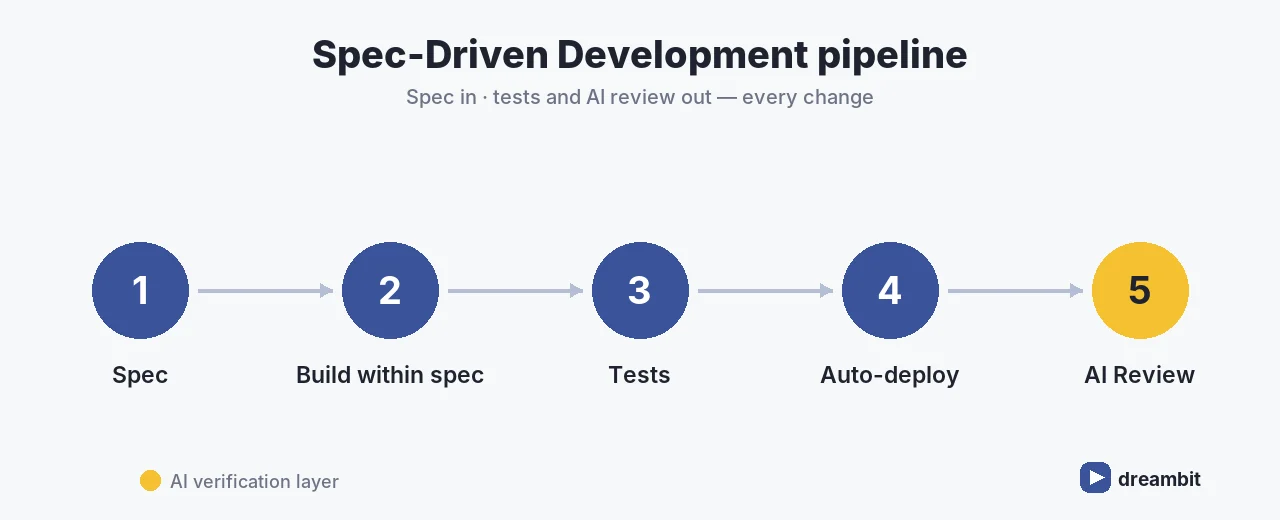
- Spec first — we define expected behavior before any code is written
- Implementation within the spec — the engineer drives the AI along the contract, not the other way around
- Full test coverage — tests confirm conformance to the spec, not abstract coverage numbers
- Automatic deployment — passes the pipeline → it ships, no manual busywork
- AI verification of the result — a separate verification layer on top of the tests
The point: AI is never left unchecked. Spec on the way in, tests and AI review on the way out. That’s why speed never costs us quality.
A real task, in numbers
To avoid speaking in abstractions. Take a typical feature — integrating a payment provider into a B2B product:
- Before: ~10 working days — ramp-up, implementation, tests, review, fixes
- Now: ~2.5 days at the same level of coverage and quality
- Where the time was saved: ramping up on the API and docs — hours instead of days; initial implementation and tests in parallel; first-pass review — AI catches the obvious before a human does
- What did NOT change: the final call on architecture and edge cases stays with the engineer (the spirit of CTO-as-a-service)
This isn’t “AI did everything.” AI removed the rote work, and our people reinvested that time where they’re irreplaceable.
What practice taught us (not tutorials)
The real value isn’t the tools — it’s knowing their limits. A few lessons that show we genuinely live in this:
- Coverage ≠ test quality. AI will happily generate tests that hit 90% coverage and verify nothing meaningful. We’ve learned to demand behavior- and edge-case tests, not line-chasing.
- More context ≠ better output. Dumping the whole codebase on the model is worse than handing it a precise slice. Curated context wins. At scale, that’s the difference between a working solution and mush.
- AI is confidently wrong. The most dangerous output is plausible-but-incorrect code. That’s exactly why everything goes through spec + tests + verification, not “looks fine → merge.”
The full set of our processes, skills, and templates is our intellectual property. But the depth at which we can talk about it is the proof that it exists.
How we keep quality and security with AI
Speaking directly to what a CTO worries about:
- Code security. Generated code goes through the same reviews and checks as human code — plus a dedicated AI pass for vulnerabilities. AI gets no bypass.
- Client data & IP. We work in environments where client code and data are not used to train models; sensitive projects run under a separate access regime.
- Maintainability. SDD ties code to a specification and tests — anyone on the team can maintain it, not just the original author.
- Hallucination control. Spec + tests + AI verification are three independent filters. A plausible error doesn’t survive to production.
Tooling: the right model for the task
Our approach is pragmatic, not religious. It doesn’t matter which IDE an engineer uses — Cursor, Copilot, Figma AI, and others are all in play. What does matter: on critical work, we don’t cut corners on model quality. We match the model to the context — the strongest where the cost of error is high, and we don’t burn resources where the task is simple.
The team: a standard, not individual chaos
- Documented processes and constraints for working with AI — the same for everyone
- Onboarding and training — new people are brought into the methodology, not left to figure it out alone
- A strong team — knowledge circulates, there’s always someone to ask; the bar doesn’t depend on “getting lucky with an AI enthusiast”
The result
3–5× faster at the same level of quality.
No compromise — the speed came from methodology, not cut corners. Scale, flexibility, security — proven in practice, not in theory. You get a battle-tested system, not an experiment.
Frequently Asked Questions
Spec-Driven Development is an approach where a clear specification is written before any code, becoming a contract for both the engineer and the AI. The model implements within the spec, tests confirm conformance, and a separate AI review verifies the result. It is how we get predictable output from AI instead of guesswork.
Generated code goes through the same reviews and checks as human-written code, plus a dedicated AI pass for vulnerabilities — AI gets no bypass. Combined with the spec and tests, that gives three independent filters, so a plausible-but-wrong change does not reach production.
Not the way we work. Speed comes from methodology, not cut corners. Spec-driven development ties every change to a specification and tests, so any team member can maintain it — not just the original author. Coverage alone is not enough; we demand behaviour and edge-case tests.
The most dangerous output is plausible-but-incorrect code, so we never merge on “looks fine.” Spec, tests, and AI verification act as three independent filters, so a confident-but-wrong result is caught before it ships.
On a typical feature — integrating a payment provider into a B2B product — we went from about 10 working days to roughly 2.5 at the same quality: 3–5× faster overall. The speed came from methodology, not from lowering the bar.