To hire mobile app developers you have four realistic models — in-house/direct hire, freelancers, staff augmentation, and a full development agency — and the right one depends on whether the app is your long-term product or a project to ship. Rates in 2026 run roughly $55–$85/hour for juniors and $145+/hour for seniors, while a full-time US hire costs $90,000–$300,000 a year all-in. The expensive mistake isn’t the rate; it’s choosing the wrong model.
Dreambit works as both a delivery partner and an embedded team, and across 14 years we’ve shipped 150+ products with 5M+ downloads and a 4.9★ rating across 114 client reviews. Here’s how to choose a hiring model, what it really costs, which roles you need, and the red flags to screen for.
The four ways to hire mobile app developers
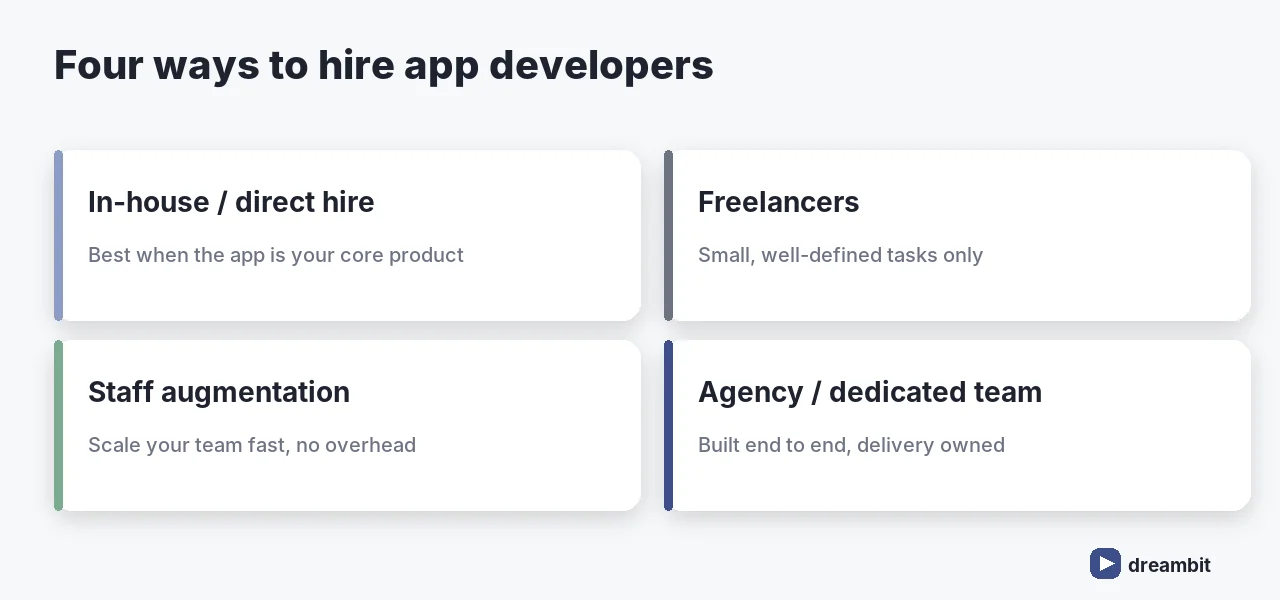
Each model fits a different situation:
- In-house / direct hire — best when the app is your core product and someone must own it for years. Highest commitment and cost.
- Freelancers — good for small, well-defined tasks; weak for anything mission-critical or long-lived.
- Staff augmentation — external engineers join your team and report to you; ideal when you have a team but need to scale or fill a skill gap fast.
- Development agency / dedicated team — a complete team with process and delivery ownership; best when you want the product built end to end.
Choosing a partner rather than a body-shop matters — see why an agency partnership is key to project success.
How much does it cost to hire mobile app developers?
Rates vary by seniority and region. In 2026, hourly rates typically run $55–$85 for juniors, ~$110 mid-level, ~$145 senior, and $225+ for leads or specialists in regulated fintech/health or heavy native work. A full development agency charges $100–$250/hour but delivers a complete team.
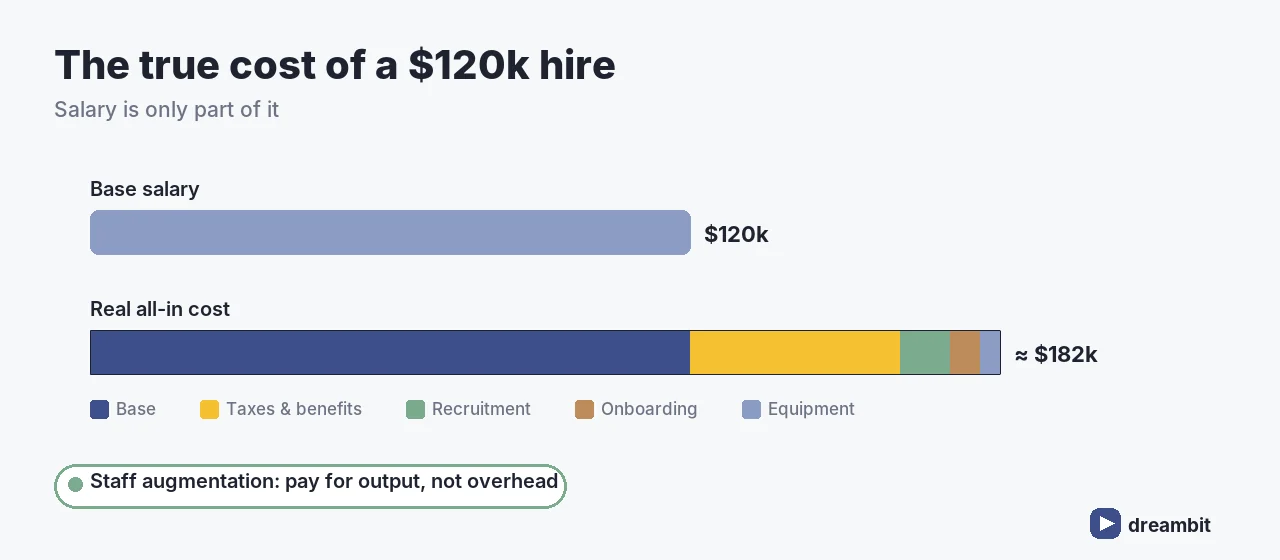
A $120,000/year developer really costs $165,000–$185,000 all-in once you add employer taxes and benefits (30–45%), recruitment ($7,000–$28,000), onboarding ($5,000–$10,000), and equipment. Staff augmentation avoids most of that — you pay for output, not overhead (industry benchmarks, 2026).
For the wider budget picture, see the cost of custom software development in 2026. Rate benchmarks for roles are also published by the U.S. Bureau of Labor Statistics.
Staff augmentation vs in-house vs agency: when to use each
The decision comes down to ownership and time horizon:
- Choose in-house when the app is the business and you’ll evolve it for years.
- Choose staff augmentation when you have a team and process but need capacity or a specific skill now, without long-term overhead.
- Choose an agency/dedicated team when you want the product designed and built end to end, fast, with delivery owned for you.
Many companies blend them — an agency to launch, augmentation to scale, a key in-house hire to own it. This is also where CTO-as-a-service helps set the strategy.
Which roles do you actually need?
A shippable mobile product usually needs more than “a developer”:
- Mobile engineers — Flutter/React Native, or native iOS/Android
- Backend engineer — APIs, data, integrations
- UI/UX designer — the difference between used and uninstalled
- QA engineer — quality that survives real devices
- Product/PM — someone owning outcomes, not just tasks
How to vet mobile app developers — and red flags
Screen for judgment, not just syntax:
- Ask for shipped apps — real store links, not just repos.
- Check communication — a great dev who can’t explain trade-offs is a risk.
- Probe for product thinking — do they ask why, or just take the ticket? See product thinking in client projects.
Red flags: no verifiable portfolio, quotes far below market, no QA/testing story, no questions about your users or goals, and reluctance to sign clear contracts or NDAs.
Common mistakes when hiring app developers
- Hiring on rate alone. The cheapest quote often costs the most by launch.
- Choosing the wrong model. A freelancer for a multi-year product, or a full team for a two-week task.
- Forgetting the all-in cost. Salary is a fraction of what a full-time hire really costs.
- No design or QA. Developers alone don’t make a product users keep.
- Skipping product ownership. Someone must own outcomes, not just close tickets.
Key Takeaways
- There are four ways to hire mobile app developers: in-house, freelance, staff augmentation, and agency/dedicated team.
- 2026 rates: ~$55–$85/hr junior, ~$145 senior, $225+ lead; agencies $100–$250/hr.
- A $120k hire really costs $165k–$185k all-in — staff augmentation avoids most of that overhead.
- Match the model to ownership and time horizon, and hire for a team (design, QA, product), not just code.
- Vet for shipped work, communication, and product thinking; beware below-market quotes.
Frequently Asked Questions
In 2026, hourly rates run roughly $55–$85 for juniors, ~$145 for seniors, and $225+ for leads or specialists; development agencies charge $100–$250/hour for a full team. A full-time US hire costs $90,000–$300,000 a year, and a $120k salary really costs $165,000–$185,000 all-in.
With staff augmentation, external engineers join your existing team and report to you — ideal for scaling capacity or filling a skill gap. An agency or dedicated team owns delivery end to end, with its own process and management. Augmentation extends your team; an agency runs the build.
Hire in-house when the app is your core product and must be owned for years. Outsource — via staff augmentation or an agency — when you need to ship faster, scale flexibly, or access skills you don’t have, without the full overhead and long-term commitment of employment.
Ask for shipped apps with real store links (not just repositories), check how clearly they explain trade-offs, and see whether they ask about your users and goals. Red flags: no verifiable portfolio, far-below-market quotes, no QA or testing story, and reluctance to sign clear contracts or NDAs.
More than one developer. A shippable product typically needs mobile engineers, a backend engineer, a UI/UX designer, a QA engineer, and someone owning product decisions. Hiring only coders — without design, QA, and product ownership — is a common reason apps launch but don’t retain users.