
Insurance app development is the process of building the software an insurer or broker puts in front of customers and staff — quote-and-buy journeys, policy self-service, claims submission and tracking, and the compliance and integration layer underneath. A focused MVP typically runs $50,000–$90,000, a production platform $90,000–$180,000, and a full multi-product insurer platform $200,000+. The defining constraint isn’t the UI: it’s that insurance is a regulated, document-heavy business where a single mishandled claim damages trust permanently.
Dreambit has shipped 150+ products across 14 years (5M+ downloads, 4.9★ from 114 client reviews), including fintech and healthcare products where compliance and sensitive data are non-negotiable — the two disciplines insurance sits between. This guide covers what to build, what it costs, how the quote-to-claim lifecycle works, where AI genuinely helps, and the mistakes that turn an insurance app into a support burden.
What kind of insurance app are you building?
“Insurance app” spans several products with different users and economics:
- Policyholder self-service — view cover, documents, payments, renewals; the retention workhorse.
- Quote & buy — acquisition journeys for motor, home, travel, pet or life.
- Claims app — FNOL (first notice of loss), photo evidence, status tracking.
- Broker / agent tools — pipelines, comparison, commissions, renewals.
- Health insurance — cover, providers, pre-authorisation, reimbursement.
- Embedded insurance — cover sold inside another product’s checkout.
Each shares the same backbone: identity, documents, payments, and an audit trail. Decide which surface earns its budget first — the MVP scoping discipline applies here as strongly as anywhere.
When a custom insurance app is worth building
Insurance has more off-the-shelf software than most verticals, so custom development has to justify itself. In our experience it does in four cases: you have a differentiated product (usage-based, parametric, niche cover) that packaged software can’t express; your claims experience is the differentiator and generic portals undermine it; you need embedded distribution inside a partner’s checkout; or your core system is capable but its front end is driving customers to the call centre. If none of those apply, a configured platform is often the honest answer — and we’ll say so.
How much does insurance app development cost in 2026?
Realistic ranges: a single-line MVP (one product, quote-to-purchase or claims only) is typically $50,000–$90,000. A production platform with policy self-service, payments, documents and claims sits at $90,000–$180,000. A multi-product insurer platform with core-system integration and AI claims triage reaches $200,000+.
Compliance and integration — not screens — dominate the insurance budget. In compliance-heavy builds we consistently see security, audit, documentation and regulatory work absorb 20–30% of total effort, and integration with an existing policy administration or core system is usually the single largest line item after the apps themselves (Dreambit delivery experience, 2026).
The pattern mirrors what we documented for fintech app development and HIPAA-compliant healthcare apps: the regulated parts set the floor on cost and timeline. Broader drivers are in the cost of custom software development.
The quote → policy → claim lifecycle
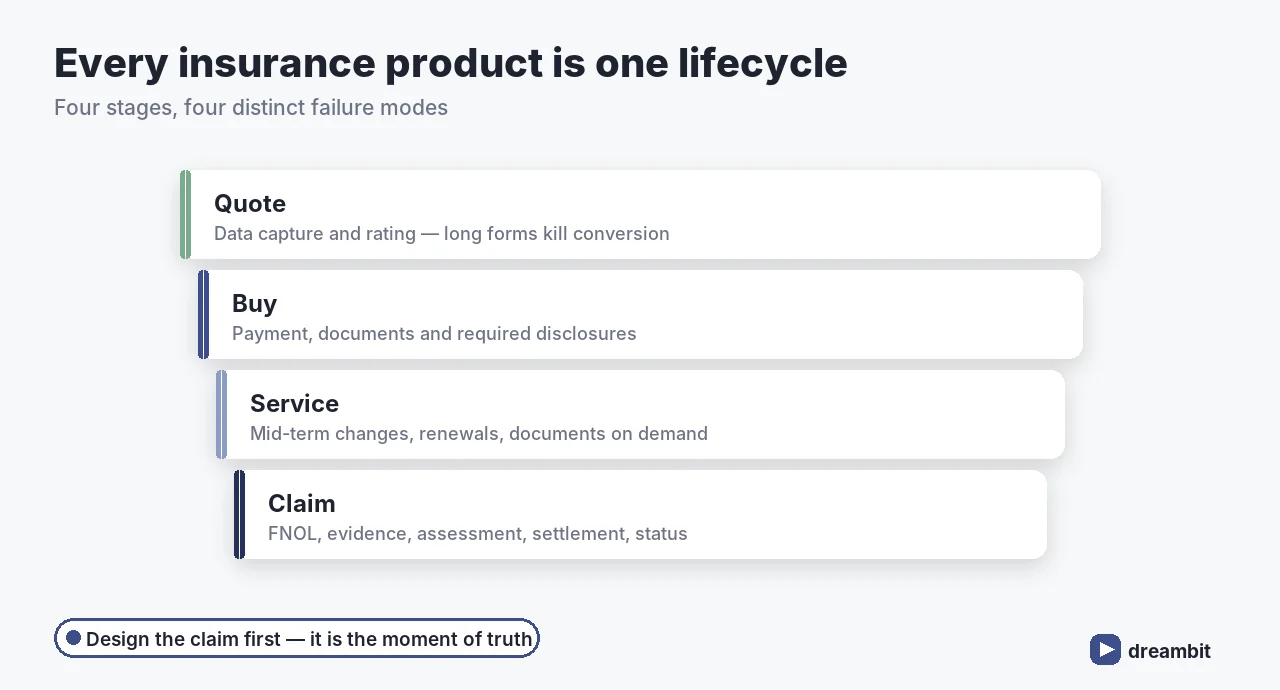
Almost every insurance product is the same four-stage lifecycle, and each stage has its own failure mode:
- Quote — data capture and rating. Too many questions kills conversion; too few means mispricing.
- Buy — payment, documents, and the legally required disclosures.
- Service — mid-term adjustments, renewals, documents on demand.
- Claim — FNOL, evidence, assessment, settlement, status visibility.
Claims is the moment of truth: it’s the only time most customers judge whether the product was worth buying. Silence during a claim is what generates complaints, not the outcome itself.
How long does it take?
A single-line MVP is realistically 4–6 months. A production platform with policy self-service, payments, documents and claims runs 7–11 months, and a multi-product build with deep core-system integration stretches beyond a year. The critical path is rarely the app — it is regulatory sign-off and the policy administration integration, both of which involve parties outside your delivery team. Start them in week one and run design in parallel.
Compliance and data protection
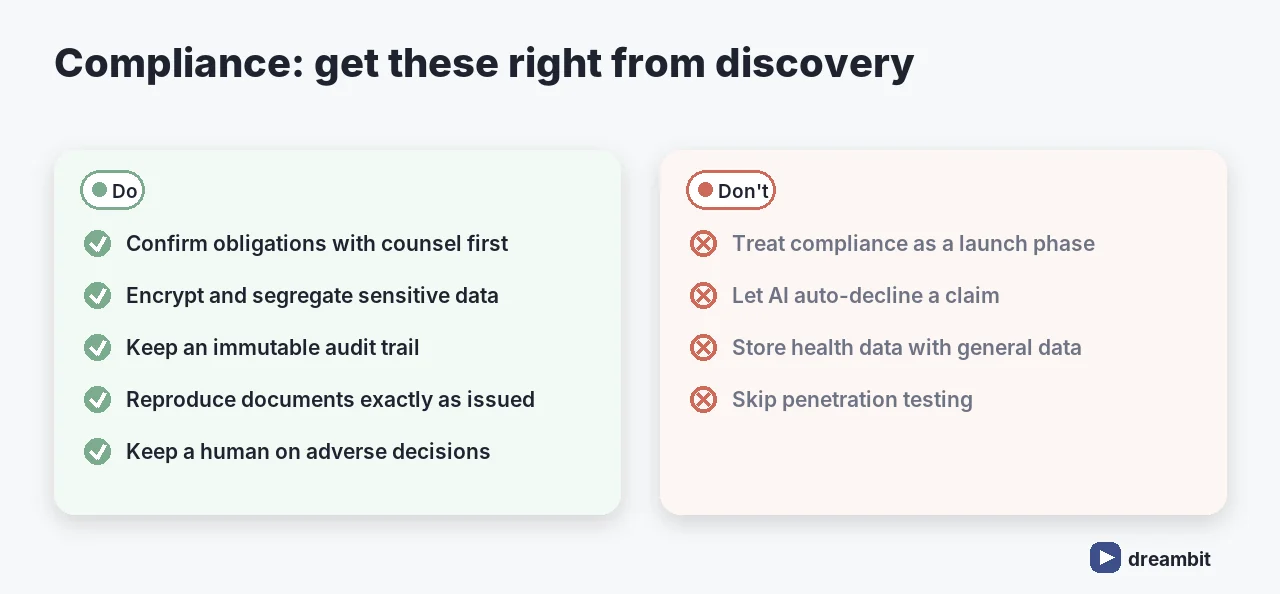
Insurance sits under a dense regulatory layer, and the specifics depend on your market and line of business. Plan for these from discovery, not before launch:
- Data protection — GDPR or local equivalents; insurance data is personal and often sensitive.
- Health data — health lines pull in stricter regimes (HIPAA in the US) and separate access controls.
- Conduct and disclosure rules — what must be shown, when, and in what wording.
- KYC/AML — where premiums and payouts move money.
- Audit trail — who saw and changed what, retained for the regulated period.
- Document integrity — policy wordings and certificates must be reproducible exactly as issued.
Requirements vary by jurisdiction — in the US, state-level rules are coordinated through the NAIC. Confirm your obligations with counsel before design; retrofitting compliance is the most expensive way to build.
Claims automation and AI in insurance
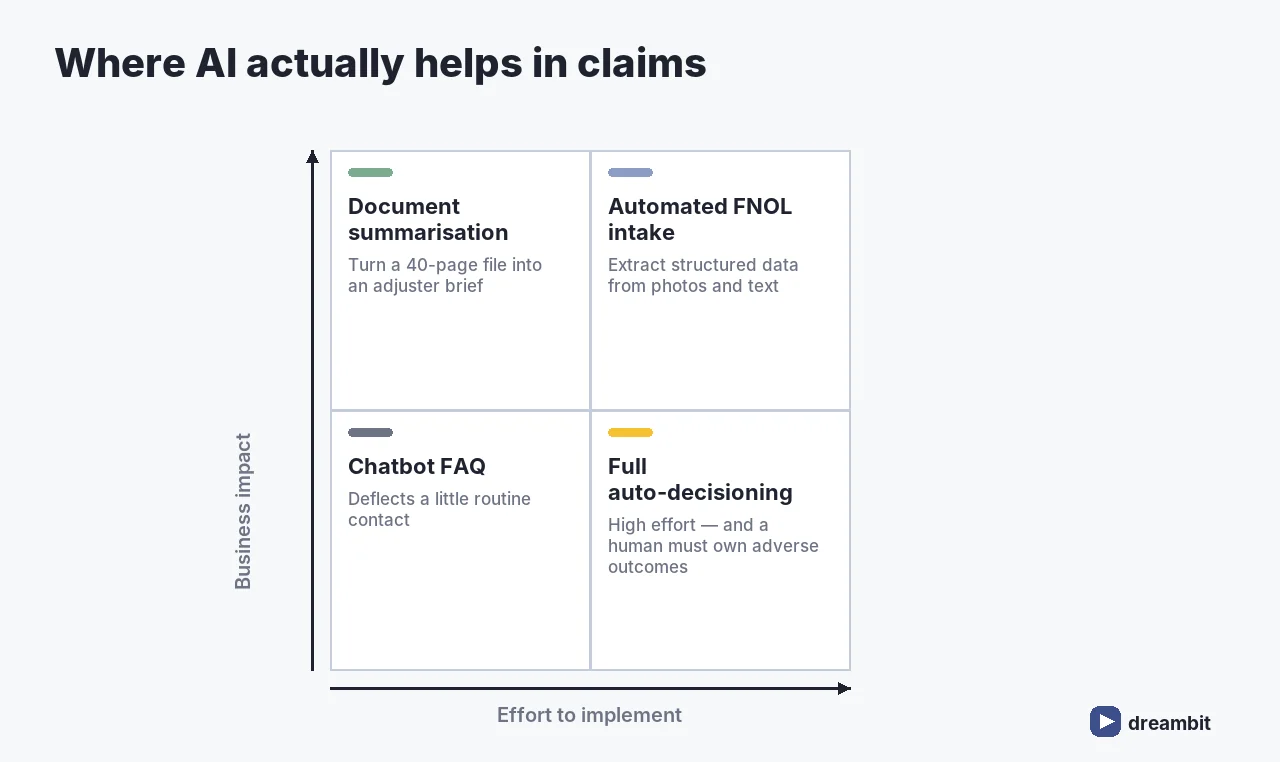
Claims is where AI earns its place, provided it stays inside guardrails:
- Automated FNOL intake — extract structured data from photos, documents and free text.
- Triage and routing — send simple claims down a fast path, complex ones to a human.
- Damage estimation — image-based first estimates for motor and property.
- Fraud signals — flag anomalies for review, never auto-decline.
- Document summarisation — turn a 40-page file into an adjuster-ready brief.
Two rules we hold to: a human decides anything adverse to the customer, and every automated step is explainable and logged. A confidently wrong claims decision is a regulatory problem, not just a bug — which is why we build these spec-first with verification, as described in how Dreambit builds with AI and in what we build with AI.
Retention: renewals are where the money is
Insurance economics live on renewal. An app that only exists to sell a policy gets deleted the week after purchase; an app that holds documents, handles mid-term changes, and makes renewal one tap becomes the cheapest retention channel a carrier has.
The most under-built screen in insurance apps is claim status. Customers rarely complain about a decision they understand — they complain about not knowing what is happening. Proactive status updates during a claim reduce inbound support contacts and protect renewal intent far more effectively than a redesigned quote flow (Dreambit delivery experience, 2026).
Preventing quiet churn is its own discipline — see how we predict user churn and bring users back.
Must-have features for an insurance app
- Secure onboarding & identity — MFA, biometric login, verified identity
- Policy dashboard — cover, dates, premium, documents in one place
- Digital documents — certificates and wordings, downloadable offline
- Claims submission with photo/video evidence — guided, forgiving, resumable
- Transparent claim status — the single biggest driver of claim satisfaction
- Payments & renewals — recurring premiums, mid-term adjustments
- Support handoff — a human reachable at the moment it matters
Embedded insurance: distribution without an app store fight
One of the fastest-growing routes to market doesn’t involve customers downloading anything: cover sold inside someone else’s checkout — travel insurance at booking, device cover at purchase, cancellation cover on a ticket. Technically this shifts the work from UI to API: you need a quote endpoint fast enough to sit in a partner’s flow, clean disclosure handling, and per-partner reporting and reconciliation. Commercially it trades margin for volume and removes acquisition cost almost entirely.
If embedded distribution is the plan, build the API and the partner onboarding experience as the product — the policyholder app becomes the servicing layer that follows, not the launch vehicle.
The right tech stack for insurance
- Apps: Flutter or React Native for one codebase across platforms — see lessons from 60+ builds.
- Backend: Node.js or Python (Django) with strict role-based access and immutable audit logging.
- Data: PostgreSQL with encryption at rest; sensitive data segregated and access-logged.
- Documents: versioned storage with tamper-evident retention.
- Integration: APIs into the policy administration / core insurance system, plus payments.
- Security testing: penetration testing before launch — see our mobile app testing and quality audit guide.
Our insurance app development process
- Discovery (2 weeks) — lines of business, regulatory scope, core-system reality.
- Confirm compliance requirements — with counsel, before design decisions harden.
- Design the claim first — if the worst day works, the rest follows.
- Integrate early — the core system is always harder than the demo suggests.
- Security testing & audit — penetration test, access review, log verification.
- Launch one line, then expand — prove the lifecycle before multiplying products.
Common insurance app development mistakes
- Treating compliance as a phase. It is an architecture constraint from day one.
- Optimising the quote, ignoring the claim. Acquisition wins the customer; claims keeps them.
- Long quote forms. Every extra question costs conversion — pre-fill whatever you can.
- Opaque claim status. Silence generates complaints and support cost.
- Underestimating core-system integration. Legacy policy systems set your real timeline.
- Letting AI decide adverse outcomes. Keep a human on anything that denies or reduces a payout.
Key Takeaways
- Insurance app development typically costs $50,000–$90,000 for a single-line MVP, $90,000–$180,000 for a production platform, $200,000+ multi-product.
- Compliance, audit and documentation work commonly absorbs 20–30% of effort in regulated builds.
- The product is a lifecycle: quote → buy → service → claim. Design the claim first.
- AI belongs in FNOL intake, triage, estimation and summarisation — with a human on adverse decisions.
- Core-system integration, not screen count, usually determines the real timeline.
- Timelines: 4–6 months single-line MVP, 7–11 months production platform, 12+ months multi-product.
- Renewals and claim-status transparency are the retention levers — build them, don’t defer them.
Frequently Asked Questions
A single-line MVP — one product, quote-to-buy or claims only — typically costs $50,000–$90,000. A production platform with policy self-service, payments, documents and claims runs $90,000–$180,000, and a multi-product insurer platform with core-system integration and AI claims triage reaches $200,000 and above.
Roughly 4–6 months for a single-line MVP, 7–11 months for a production platform, and over a year for a multi-product build with deep core-system integration. Regulatory sign-off and policy administration integration sit on the critical path, so start both in week one and run design in parallel.
It depends on market and line of business, but plan for data-protection law (GDPR or local equivalent), stricter regimes for health data, conduct and disclosure rules, KYC/AML where money moves, an immutable audit trail, and exact reproducibility of issued documents. Confirm your obligations with counsel before design.
AI works well for first-notice-of-loss intake, triage and routing, image-based damage estimates, fraud signalling and document summarisation. It should not make adverse decisions: keep a human on anything that denies or reduces a payout, and make every automated step explainable and logged.
Renewals and claim transparency, not the quote flow. An app that stores documents, handles mid-term changes and makes renewal one tap becomes a cheap retention channel. Proactive claim-status updates reduce inbound support contacts and protect renewal intent more than redesigning acquisition.