
AI agent development is the process of building software that doesn’t just answer — it acts: an LLM wired to your tools, data and business rules so it can carry out multi-step work end to end. A single-workflow agent typically costs $3,000–$15,000, a production agent with RAG and real integrations $15,000–$75,000, and a multi-agent enterprise system $75,000–$250,000+. The number most teams forget is the monthly one: a production agent serving real users runs $3,200–$13,000 a month to operate.
Dreambit builds AI into products every day and uses it internally under a spec-first discipline — we’ve written about how we build with AI and what we build with AI. So this guide is deliberately unglamorous: what an agent actually is, when it’s worth building, what it costs to build *and run*, and the cases where the honest answer is “don’t build an agent.”
What is an AI agent — and what it isn’t
The word is doing a lot of work in the market right now, so here’s the distinction that matters commercially:
- A single LLM call — text in, text out. Summarise, classify, rewrite. Cheap, predictable, no autonomy.
- A chatbot / RAG assistant — retrieves from your documents and answers with sources. Still fundamentally answering.
- An AI agent — decides on a sequence of steps, calls tools (APIs, databases, internal systems), checks its own results, and completes a task. It does something.
- A multi-agent system — several specialised agents coordinated by an orchestrator, each owning part of a workflow.
If your problem is answered by one well-prompted call, building an agent is over-engineering — and you’ll pay for that in both build and running cost. Anthropic’s engineering write-up on building effective agents makes the same point: start with the simplest thing that works.
When an AI agent is genuinely worth building
From the projects we’ve scoped, agents earn their cost in four situations:
- Multi-step work with clear rules — the task has 5–20 steps, touches several systems, and a human currently does it by copying between tabs.
- High volume, moderate stakes — enough repetitions to matter, and a wrong answer is recoverable.
- The data lives in systems, not heads — the agent can actually reach what it needs via API.
- A human checkpoint is acceptable — you can insert review where the cost of error is high.
And where it isn’t: one-shot text tasks (use a plain LLM call), anything where an error is unrecoverable or legally adverse without review, workflows whose rules nobody can write down, and processes that change weekly — you’ll spend more maintaining the agent than doing the work. Saying so early is part of the job; we made that argument in our take on AI.
How much does AI agent development cost in 2026?
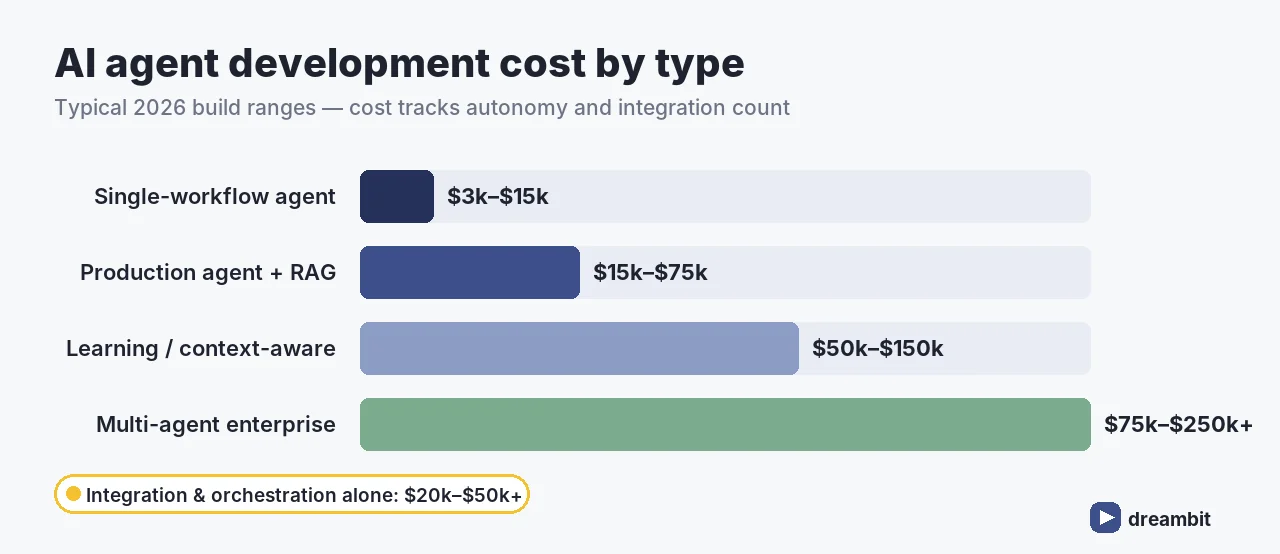
Cost tracks autonomy and integration count, not model choice:
- Rule-based / single-workflow agent — $3,000–$15,000. One process, one or two tools, scripted fallbacks.
- Production agent with RAG + integrations — $15,000–$75,000. Grounded in your data, several tools, real error handling and evals.
- Learning / context-aware agent — $50,000–$150,000. Personalisation, richer memory, tighter feedback loops.
- Multi-agent enterprise system — $75,000–$250,000+ (and $150,000–$500,000 for large, regulated estates). Orchestration, domain training, evaluation infrastructure.
Integration and orchestration alone commonly runs $20,000–$50,000+ — before the agent does anything clever. The number of systems it must touch, not the sophistication of the prompt, is the single best predictor of an agent project’s cost (industry benchmarks, 2026).
The same logic drives budgets across custom builds — see the cost of custom software development in 2026.
The running cost nobody budgets for
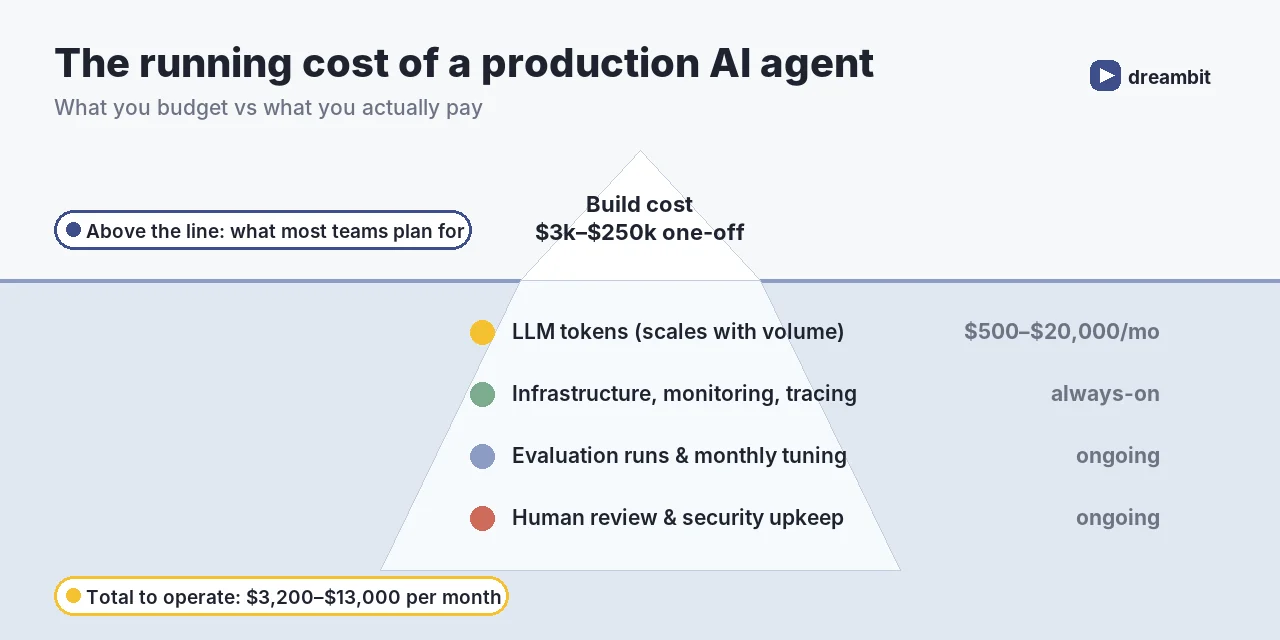
This is where agent projects surprise people. Unlike a normal feature, an agent has a meaningful monthly bill: token usage that scales with volume, infrastructure, monitoring and tracing, evaluation runs, periodic tuning, and human review time.
Budget $3,200–$13,000 per month to operate a production agent serving real users — LLM tokens, infrastructure, monitoring, monthly tuning and security upkeep. Token spend alone ranges from a few hundred dollars to $20,000+ a month depending on volume and context size, which is why context discipline is a cost decision, not just an engineering one (industry benchmarks, 2026).
Two practical levers: keep context tight (bigger prompts are not better prompts), and route simple steps to cheaper models while reserving the strongest model for where error is expensive.
Agents vs RPA and workflow tools
A fair question we get: why not Zapier, n8n or classic RPA? Because they solve a different shape of problem. Deterministic workflow tools are excellent when the steps are fixed and the inputs are structured — and when that’s true, they are cheaper, faster and more reliable than any agent. An agent earns its place when the input is messy (free text, documents, screenshots), when the path isn’t fixed (the next step depends on what was just found), or when judgement is needed between steps.
In practice the best systems are hybrids: deterministic automation carries the predictable spine, and an agent handles the ambiguous stretch in the middle. If someone proposes replacing a working rules engine with an agent, ask what ambiguity the agent is resolving — if the answer is “none”, keep the rules engine.
How an AI agent is actually built
Under the marketing, a working agent is five unglamorous parts:
- Tools — typed, well-documented functions into your systems. This is most of the work.
- Grounding (RAG) — your documents and data, retrieved with sources so answers aren’t invented.
- Orchestration — the loop that plans, calls tools, and decides when it’s done.
- Guardrails — input validation, output schemas, permission scoping, spend limits, and a hard stop.
- Evaluation — a test set of real tasks with expected outcomes, run on every change.
Evaluation is what separates a demo from a product. We build agents spec-first with tests and a verification pass for exactly this reason — the same discipline described in how Dreambit builds with AI.
Human-in-the-loop: where to put the checkpoint
Full autonomy is rarely the goal. The design question is where the human sits:
- Approve before acting — agent drafts, human confirms. Best for anything customer-facing or financial.
- Act, then review — agent completes, human audits a sample. Good for high volume, low stakes.
- Escalate on uncertainty — agent handles the confident cases, routes the rest to a person.
The last pattern is usually the commercial sweet spot: it captures most of the volume without owning the tail risk. In insurance we apply it to claims triage — simple claims down a fast path, complex ones to an adjuster (see insurance app development).
Security and data boundaries
An agent with tool access is, by definition, software with permissions — so treat it like a service account, not a chat window. What we insist on:
- Least privilege — scoped credentials per tool, read-only wherever writing isn’t required.
- No destructive actions without confirmation — deletes, payments and outbound messages get a human gate.
- Prompt-injection defence — treat retrieved documents and web content as untrusted input, never as instructions.
- Full audit trail — every tool call, input and output logged and replayable.
- Spend limits — hard caps so a loop can’t run up a five-figure bill overnight.
The audit trail matters twice over: it’s how you debug a misbehaving agent, and it’s what a regulator or client will ask for. Generated code and agent actions go through the same review as human work — no bypass.
What to measure
Agents fail quietly, so instrument them from day one: task success rate (did it actually complete the job), escalation rate, cost per completed task, latency, and intervention rate. Cost per completed task is the one that tells you whether the agent is a business win — an agent that succeeds 90% of the time but costs more per task than a human is a science project, not a product.
Our AI agent development process
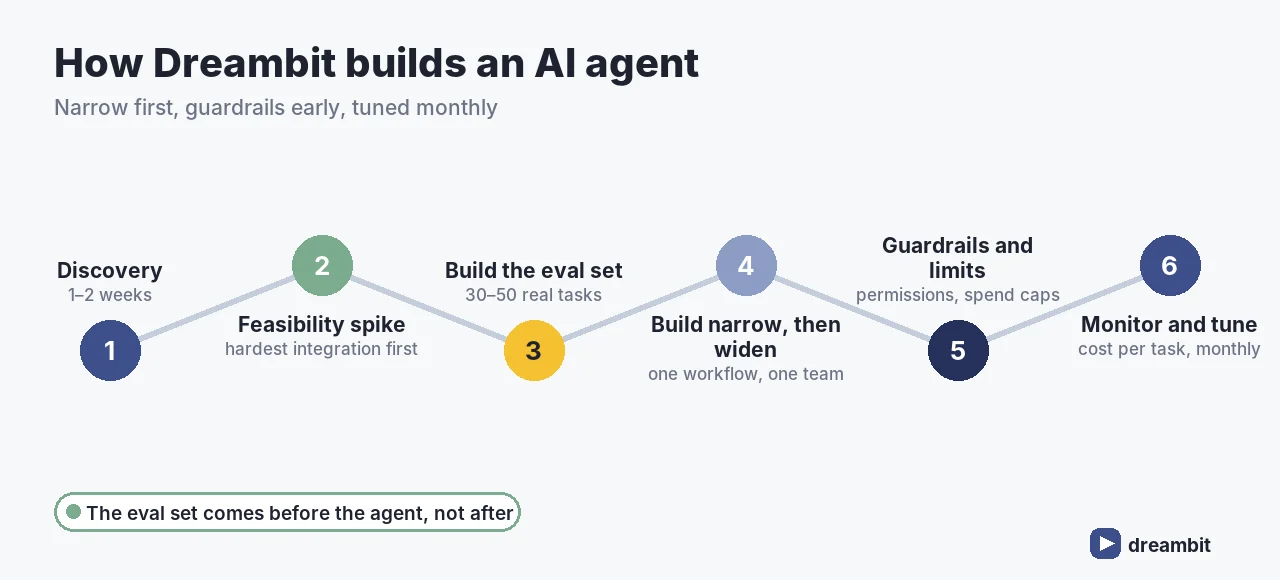
- Discovery (1–2 weeks) — map the real workflow, count the systems, define success.
- Feasibility spike — prove the hardest tool integration before committing.
- Build the eval set first — 30–50 real tasks with known-good outcomes.
- Build narrow, then widen — one workflow, one team, real usage.
- Add guardrails and limits — permissions, spend caps, hard stops.
- Monitor and tune — track cost per task and escalation rate monthly.
If you’re validating a brand-new product rather than automating an existing process, the MVP scoping approach applies first.
Common AI agent development mistakes
- Building an agent for a one-shot task. A single LLM call would have done it for a fraction of the cost.
- No evaluation set. Without one you cannot tell whether a change improved anything.
- Unlimited autonomy on day one. Scope permissions and spend before you scope ambition.
- Ignoring the monthly bill. Token and monitoring costs decide whether the ROI is real.
- Dumping everything into context. More context is slower, pricier and often worse.
- Automating a process nobody can describe. Fix the process first, then automate it.
Key Takeaways
- AI agent development costs $3,000–$15,000 single-workflow, $15,000–$75,000 production with RAG, $75,000–$250,000+ multi-agent enterprise.
- Integration and orchestration alone is often $20,000–$50,000+ — system count drives cost.
- Running a production agent costs $3,200–$13,000/month; budget it from the start.
- An agent is worth it for multi-step, multi-system, high-volume work with a human checkpoint available.
- Escalate-on-uncertainty is usually the best human-in-the-loop pattern commercially.
- Measure cost per completed task — that’s the number that proves or kills the business case.
- Prefer deterministic workflow tools where steps are fixed; use an agent for the ambiguous middle.
- Treat an agent as a permissioned service: least privilege, human gate on destructive actions, full audit trail, spend caps.
Frequently Asked Questions
AI agent development is the process of building software in which an LLM is connected to your tools, data and business rules so it can carry out multi-step work end to end — planning steps, calling APIs and databases, checking its own results and completing a task, rather than just answering a question. It differs from a chatbot or a single LLM call in that it acts inside your systems.
A rule-based single-workflow agent typically costs $3,000–$15,000. A production agent with RAG grounding and real integrations runs $15,000–$75,000, a learning or context-aware agent $50,000–$150,000, and a multi-agent enterprise system $75,000–$250,000 and above. Integration and orchestration alone commonly accounts for $20,000–$50,000+ of that.
Budget $3,200–$13,000 per month to operate a production agent serving real users. That covers LLM token usage, infrastructure, monitoring and tracing, evaluation runs, periodic tuning and human review time. Token spend alone ranges from a few hundred dollars to $20,000+ a month depending on volume and context size.
Skip the agent when a single well-prompted LLM call solves the task, when an error is unrecoverable or legally adverse and nobody can review the output, when nobody can write down the rules of the workflow, or when the process changes weekly. If the steps are fixed and the inputs are structured, a deterministic workflow tool or rules engine is cheaper and more reliable.
A single-workflow agent is usually 4–8 weeks: discovery, a feasibility spike on the hardest integration, an evaluation set of 30–50 real tasks, then a narrow build. A production agent with RAG and several integrations takes 3–5 months, and a multi-agent enterprise system 6–12 months, with tool and system integration — not the model work — on the critical path.