Logistics app development is the process of building the software that moves goods — customer tracking apps, driver apps, dispatch dashboards, and the integrations that tie them to your warehouse and carriers. The costly misconception is treating it as one app: a working logistics product is really four connected products. Budget $30,000–$300,000+ depending on scope, and expect real-time tracking and an offline-capable driver app to matter more than any feature list.
Dreambit has shipped 150+ products over 14 years (5M+ downloads, 4.9★ across 114 reviews), including operations-heavy platforms where uptime and data accuracy are non-negotiable. Here’s what logistics app development actually involves, what it costs to build and run, and the mistakes that quietly wreck delivery operations.
What is a logistics app — and why it’s four products
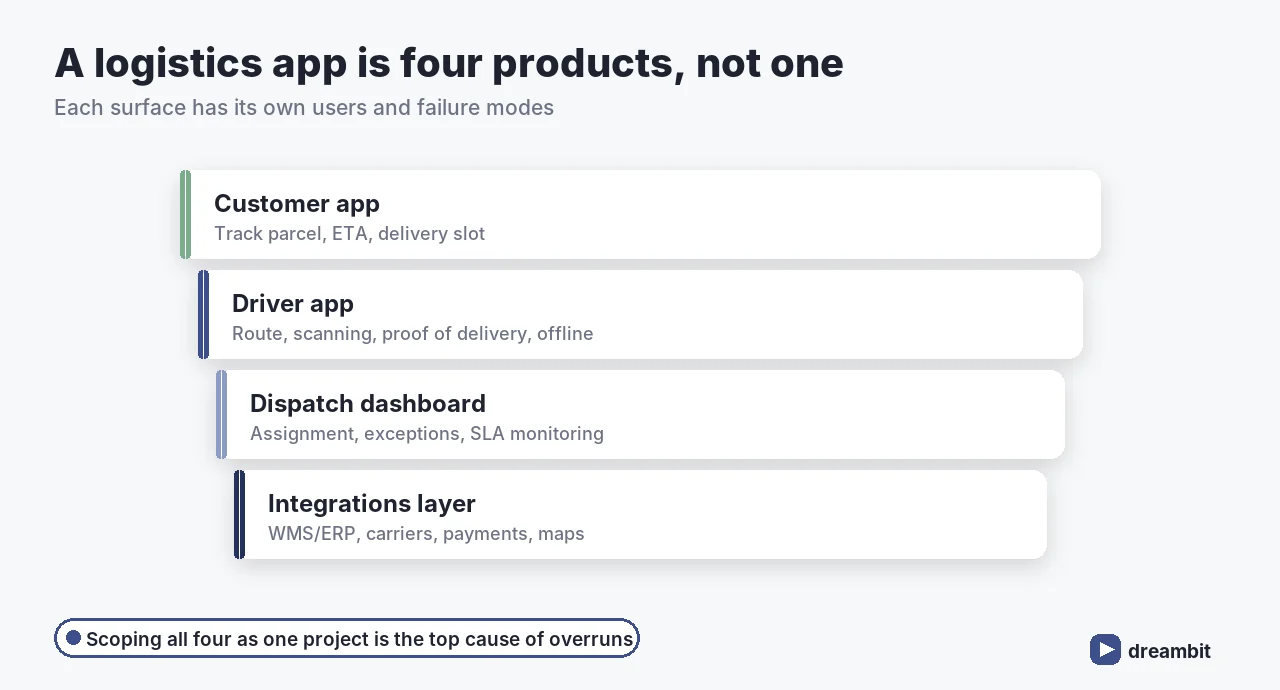
Most logistics platforms need four distinct surfaces, each with its own users and failure modes:
- Customer app — track a parcel, see an ETA, pick a delivery slot.
- Driver app — route, scanning, proof of delivery, and it must work offline.
- Dispatch dashboard — assignment, exceptions, SLA monitoring.
- Integrations layer — WMS/ERP, carriers, payments, maps.
Scoping them as one project is the single most common reason logistics builds overrun. This is where MVP scoping discipline pays for itself: pick the surface that proves the business case first.
How much does logistics app development cost in 2026?
Realistic ranges by scope: a basic tracking app runs $15,000–$50,000; a moderately complex platform with route optimization and inventory sits at $50,000–$120,000; and full enterprise logistics platforms reach $150,000–$300,000+. Fleet management alone is typically $25,000–$75,000, warehouse apps $30,000–$100,000.
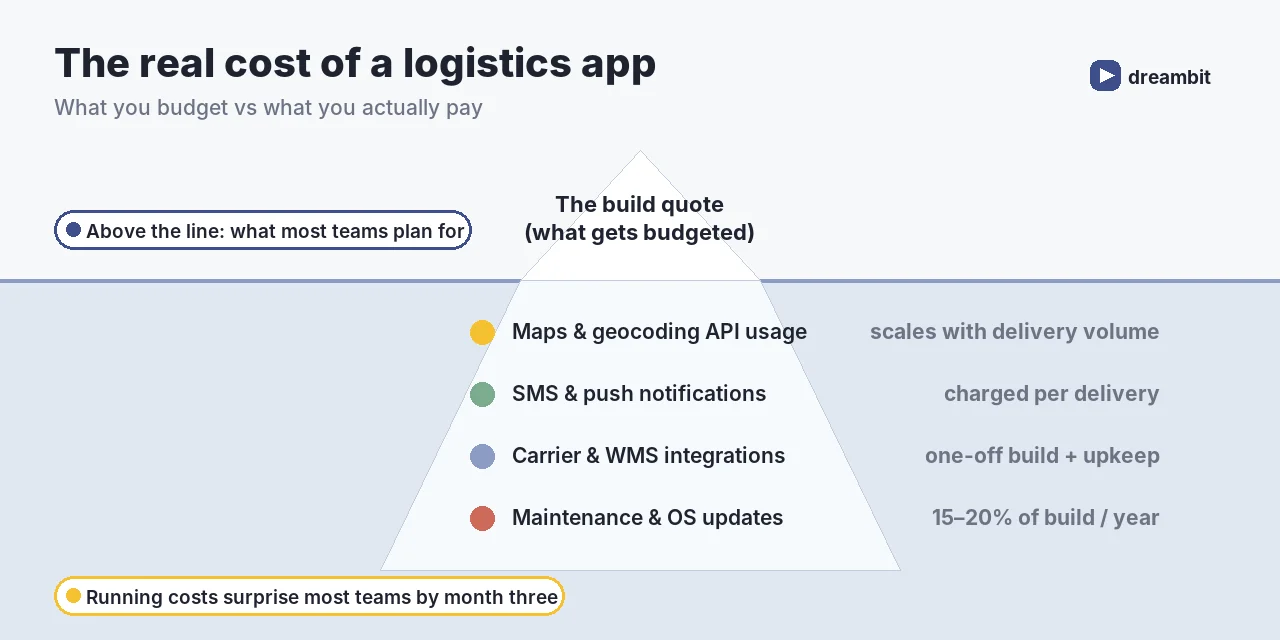
The build is only part of the bill. Logistics apps carry unusually high running costs — maps and geocoding API usage that scales with delivery volume, per-delivery SMS and push notifications, carrier and WMS integration upkeep, plus 15–20% of build cost per year in maintenance (industry benchmarks, 2026).
Plan those running costs from day one alongside ongoing maintenance — they’re the line items that surprise teams in month three.
Must-have features for a logistics app
Feature depth varies, but the non-negotiable core is consistent:
- Real-time GPS tracking & ETAs — the feature customers actually judge you on
- Route optimization — fewer miles, more drops per shift
- Offline-first driver app — warehouses and rural routes lose signal constantly
- Barcode/QR scanning & proof of delivery — the chain of custody
- Dispatch & exception handling — what happens when a delivery fails
- Notifications — proactive updates cut inbound support volume
- Analytics — on-time rate, failed attempts, cost per drop
Offline capability isn’t a nice-to-have here — we made the wider case in why an app that works without Wi-Fi works for your clients.
The metrics a logistics app is judged on
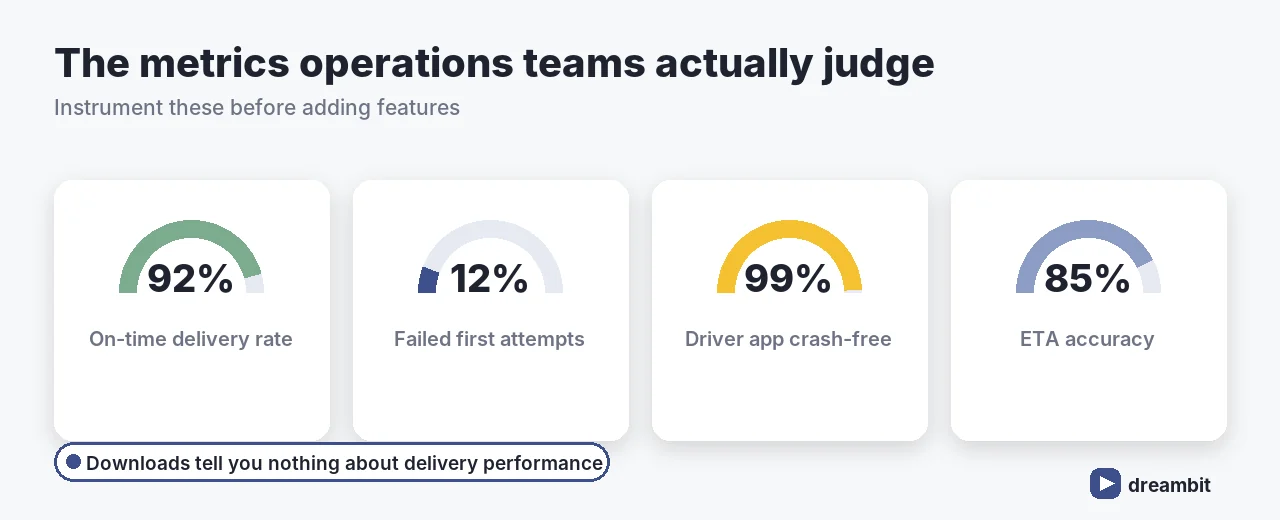
Operations teams don’t care about downloads. They care about on-time delivery rate, failed first attempts, ETA accuracy, and driver-app stability. Instrument these before you add features — they tell you which feature is actually worth building next.
The right tech stack for logistics
Our default for operations software is a cross-platform front end with a resilient, integration-friendly back end:
- Apps: Flutter or React Native — one codebase for customer and driver apps, 30–40% lower build cost. See lessons from 60+ Flutter/Firebase builds.
- Backend: Node.js or Python (Django) with a queue for dispatch events.
- Data: PostgreSQL, plus local storage on the driver app for offline sync.
- Maps & routing: a mapping platform with routing and geocoding — watch per-request pricing.
- Integrations: standards-based where possible; GS1 barcode standards keep scanning interoperable.
Our logistics app development process
- Discovery (1–2 weeks) — map the real operation, not the ideal one.
- Prioritize one surface — usually driver or dispatch, whichever unblocks the most.
- Design for the field — gloves, sunlight, one hand, poor signal.
- Build & integrate — iterative sprints, integrations early not last.
- Pilot with real routes — a handful of drivers before the full fleet.
- Scale & monitor — instrument the operational metrics above.
Common logistics app development mistakes
- Assuming connectivity. An online-only driver app fails on day one.
- Leaving integrations until the end. WMS/ERP work always takes longer than planned.
- Ignoring API running costs. Maps and SMS scale with volume, not with your budget.
- Designing for the office, not the van. Field UX is a different discipline.
- Skipping the pilot. Real routes reveal what no spec captured.
Key Takeaways
- Logistics app development costs $15,000–$50,000 basic, $50,000–$120,000 mid, $150,000–$300,000+ enterprise.
- Treat it as four products: customer app, driver app, dispatch, integrations.
- Offline-first on the driver app and accurate ETAs matter more than feature count.
- Budget the running costs — maps/geocoding, SMS, integration upkeep, 15–20%/yr maintenance.
- Pilot with real routes and instrument on-time rate, failed attempts, and ETA accuracy.
Frequently Asked Questions
A basic tracking app runs $15,000–$50,000, a mid-complexity platform with route optimization and inventory $50,000–$120,000, and full enterprise logistics platforms $150,000–$300,000+. Fleet management alone is typically $25,000–$75,000. Add 15–20% of build cost per year for maintenance, plus maps and SMS usage.
Real-time GPS tracking with accurate ETAs, route optimization, an offline-capable driver app, barcode or QR scanning with proof of delivery, dispatch and exception handling, proactive notifications, and analytics on on-time rate and failed attempts. Offline capability is essential, not optional.
Because it needs four distinct surfaces: a customer app for tracking and slots, a driver app for routes and scanning, a dispatch dashboard for assignment and exceptions, and an integrations layer for WMS/ERP, carriers and maps. Each has different users and failure modes — scoping them as one project is the top cause of overruns.
The build quote is only part of it. Maps and geocoding API usage scales with delivery volume, SMS and push notifications are charged per delivery, carrier and WMS integrations need ongoing upkeep, and maintenance runs 15–20% of build cost per year. These usually surprise teams by month three.
A focused single-surface app — usually driver or dispatch — can ship in 3–5 months. Full multi-surface platforms with WMS/ERP integrations and route optimization typically take 6–12 months. Starting with one surface and piloting on real routes is far faster than building all four at once.