E-Commerce
E-commerce app development is the process of designing, building, and maintaining mobile or web shopping applications — from single-brand retail stores to multi-vendor marketplaces and grocery delivery. What separates a profitable retail app from an expensive one isn’t the feature list; it’s conversion: how smoothly a shopper goes from browse to paid. A focused e-commerce MVP usually takes 3–5 months, and the checkout flow matters more than almost anything else you build.
Retail is one of Dreambit’s core industries, and across 14 years we’ve shipped 150+ products with 5M+ downloads. Below is the practical playbook we use with retail and D2C clients — what it costs, the features that actually convert, where AI helps, the tech stack, and the mistakes that quietly bleed revenue.
What is e-commerce app development?
E-commerce app development covers any software built to sell products or services. In practice it splits into a few product types, each with its own catalog and logistics model:
- Single-brand store — your own products, your brand, full control (D2C).
- Multi-vendor marketplace — many sellers, commissions, ratings.
- Grocery & q-commerce — fast delivery, real-time inventory, slots.
- Subscription commerce — recurring boxes, replenishment, retention.
- Social & live shopping — discovery, video, impulse purchase.
The type you choose shapes your logistics, payments, and which features earn their cost. Building a marketplace? See our definitive guide to multi-vendor marketplaces.
How much does e-commerce app development cost in 2026?
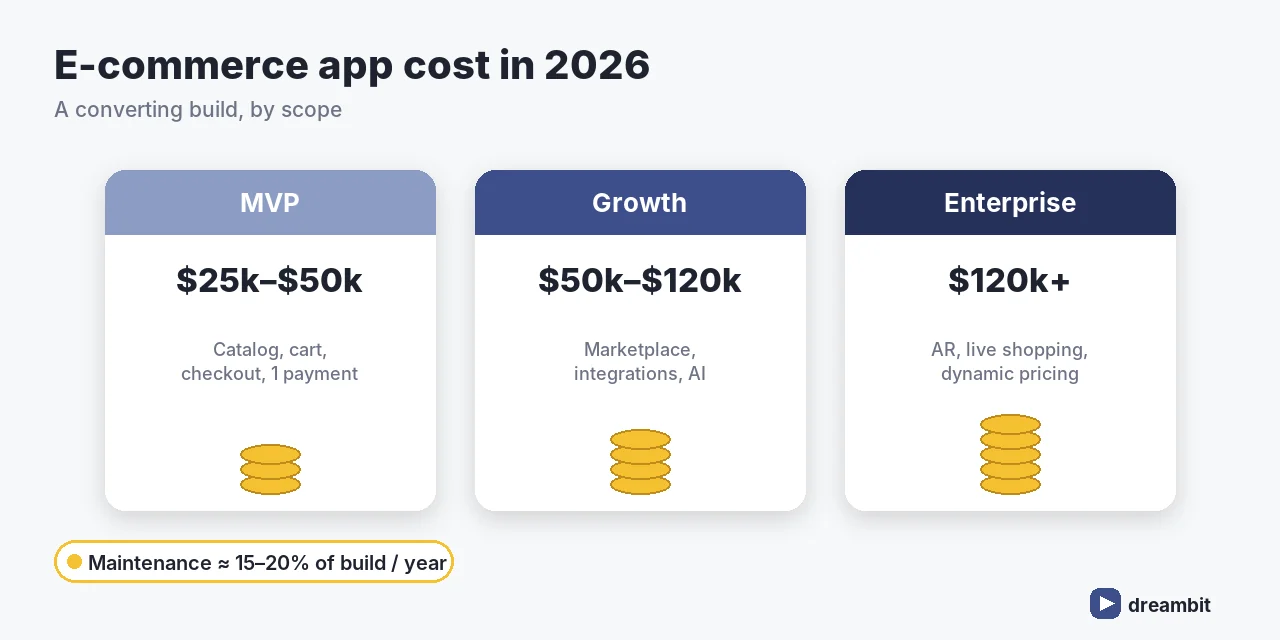
A realistic range for a custom e-commerce app in 2026 is $25,000–$300,000+, depending on scope, integrations, and platforms. A focused single-brand MVP lands at the lower end; a multi-vendor marketplace with AI personalization and live shopping sits at the top.
A single-brand e-commerce MVP with catalog, cart, secure checkout, and one payment provider typically costs $25,000–$50,000 and ships in 3–5 months — marketplaces, AR try-on, or AI personalization push a build into the $50,000–$120,000 range and beyond (Dreambit project benchmarks, 2026).
The biggest cost driver is feature complexity, followed by integrations (payments, ERP, logistics) and platform count. For the full picture, see our guide to the cost of custom software development in 2026.
Must-have features for an e-commerce app
Conversion is the whole game. A credible retail app ships with a core built to move shoppers to checkout:
- Fast product catalog & search — filters and search that find the right item in seconds
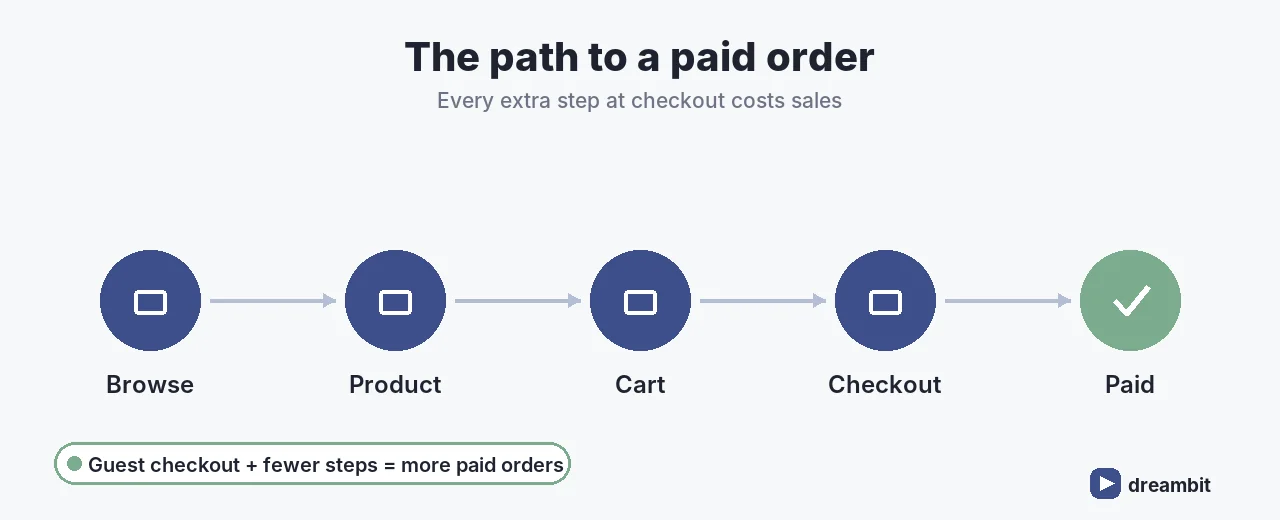
- Frictionless cart & checkout — guest checkout, saved details, minimal steps
- Multiple payment options — cards, wallets, BNPL, local methods
- Order tracking & notifications — status updates that reduce support load
- Reviews & wishlists — social proof and saved intent
- Secure accounts — fast login, saved addresses, reorder
Most revenue leaks happen at checkout. We covered the fix in how to reduce cart abandonment by 20% by removing checkout steps.
Conversion & UX: where retail apps win or lose
An e-commerce app lives and dies on conversion rate. The levers that move it most:
- One-tap, guest-friendly checkout — every extra field costs sales
- Speed — fast load and smooth scrolling keep shoppers in flow
- Personalized merchandising — the right product in front of the right shopper
- Trust signals — reviews, clear returns, secure-payment cues
AI in e-commerce apps
AI is now a baseline expectation in retail:
- Personalized recommendations — “you might also like,” done well
- Smart search — natural-language and visual product search
- AR try-on & preview — fewer returns, more confidence
- Dynamic pricing & fraud detection — margin and safety at scale
The right tech stack for an e-commerce app
After 60+ MVPs, our default is a cross-platform front end with a scalable commerce back end:
- Frontend: Flutter or React Native — one codebase, 30–40% lower build cost. See why we use Flutter and Firebase for MVPs.
- Backend: Node.js or Python (Django), or a headless commerce platform where it fits.
- Payments: Stripe/Adyen + local gateways, PCI-compliant by tokenization.
- Cloud: AWS or Firebase, with analytics and A/B testing from day one.
Our e-commerce app development process
- Discovery (1–2 weeks) — catalog model, logistics, success metrics.
- UX/UI design (2–4 weeks) — conversion-first flows and prototypes.
- Development (8–16 weeks) — iterative sprints, analytics instrumented.
- QA & launch — tested across devices and payment paths.
- Iterate on data — optimize the funnel that drives revenue.
Not sure an app is the right move yet? Start with our checklist on whether your business needs a mobile app.
Common e-commerce app development mistakes to avoid
- A heavy checkout. Every extra step and field drops conversion.
- Forcing account creation. Offer guest checkout; ask for the account after the sale.
- Slow, cluttered UI. Speed and clarity beat feature count.
- Ignoring retention. Push, reorder, and loyalty bring shoppers back cheaply.
- No analytics on the funnel. If you can’t see where shoppers drop, you can’t fix it.
Key Takeaways
- Custom e-commerce app development in 2026 typically costs $25,000–$300,000+; a single-brand MVP is $25,000–$50,000.
- Conversion > features — a frictionless, guest-friendly checkout matters most.
- AI (recommendations, smart search, AR) is now a baseline retail expectation.
- Use a cross-platform stack with PCI-compliant payments and analytics from day one.
- Instrument the funnel and iterate on conversion, not downloads.
Frequently Asked Questions
Custom e-commerce app development typically costs $25,000–$300,000+ in 2026. A single-brand MVP with catalog, cart and secure checkout is usually $25,000–$50,000; marketplaces, AR, or AI personalization push it to $50,000–$120,000 and beyond. Maintenance runs about 15–20% of the build per year.
A focused single-brand e-commerce MVP usually ships in 3–5 months. Multi-vendor marketplaces, complex logistics, AR try-on, or deep integrations add time. The fastest path is to launch a clean catalog-to-checkout experience first, then expand based on real funnel data.
Conversion features above all: fast catalog and search, a frictionless guest-friendly checkout, multiple payment options, order tracking, reviews and wishlists. These move shoppers from browse to paid far more than sheer feature count — checkout quality is the single biggest lever on revenue.
Strip the checkout to the fewest steps, offer guest checkout, save details for reorder, and keep the app fast. Add trust signals, personalized merchandising, and clear returns. We instrument the funnel from day one so we can see exactly where shoppers drop and fix it.
Start with what matches your business. A single-brand D2C store is faster and cheaper to launch and validate; a marketplace adds vendors, commissions, and ratings but is more complex and costly. Many clients launch single-brand first, then expand to a marketplace once demand is proven.