Month: July 2026
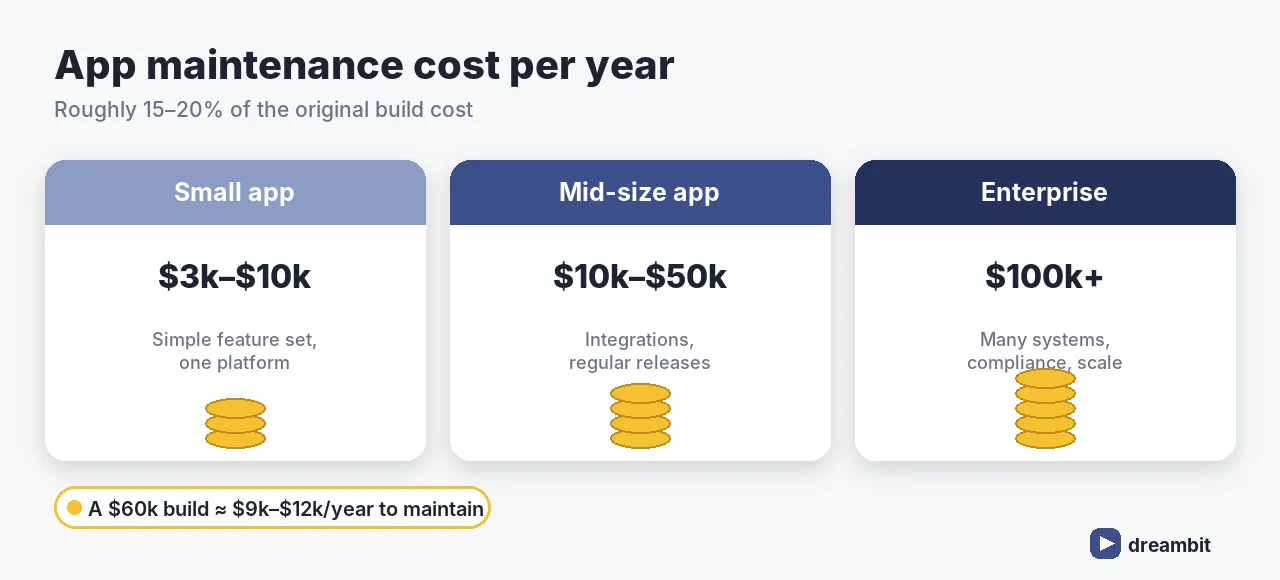
Mobile app maintenance is the ongoing work that keeps a live app secure, compatible, and worth using after launch — OS updates, bug fixes, dependency and security patches, hosting, and steady improvement. Budget roughly 15–20% of your original build cost per year: about $3,000–$10,000 for a small app, $10,000–$50,000 for a mid-size one, and $100,000+ for enterprise. Skipping it isn’t saving money; it’s deferring a bigger bill.
Dreambit has shipped and supported 150+ products over 14 years (5M+ downloads, 4.9★ across 114 reviews), and Priority Maintenance Support is one of our core services. Here’s what maintenance actually includes, what it costs, what happens when you neglect it, and how to choose the right support model.
What is mobile app maintenance?
Maintenance is not “fixing bugs when users complain.” It’s four distinct kinds of work:
- Corrective — fixing defects and crashes as they surface.
- Adaptive — keeping up with new iOS/Android versions, devices, and third-party API changes.
- Preventive — dependency and security patches, refactoring, monitoring before things break.
- Perfective — improving UX and performance, and adding what users actually ask for.
We covered the post-launch reality in what you should know about maintenance and updates after release.
How much does mobile app maintenance cost in 2026?
The reliable rule of thumb is 15–20% of the original development cost, per year. In absolute terms:
Small apps typically cost $3,000–$10,000 a year to maintain, mid-size apps $10,000–$50,000, and complex or enterprise apps $100,000+ — roughly 15–20% of the original build cost annually. An app that cost $60,000 to build should carry a $9,000–$12,000 yearly maintenance budget (industry benchmarks, 2026).
The main drivers are hosting and cloud infrastructure, bug fixing, OS/device compatibility, third-party integrations, UI/UX improvements, and compliance (GDPR, HIPAA, PCI DSS). Plan it alongside the cost of custom software development — not as an afterthought.
What happens if you skip maintenance
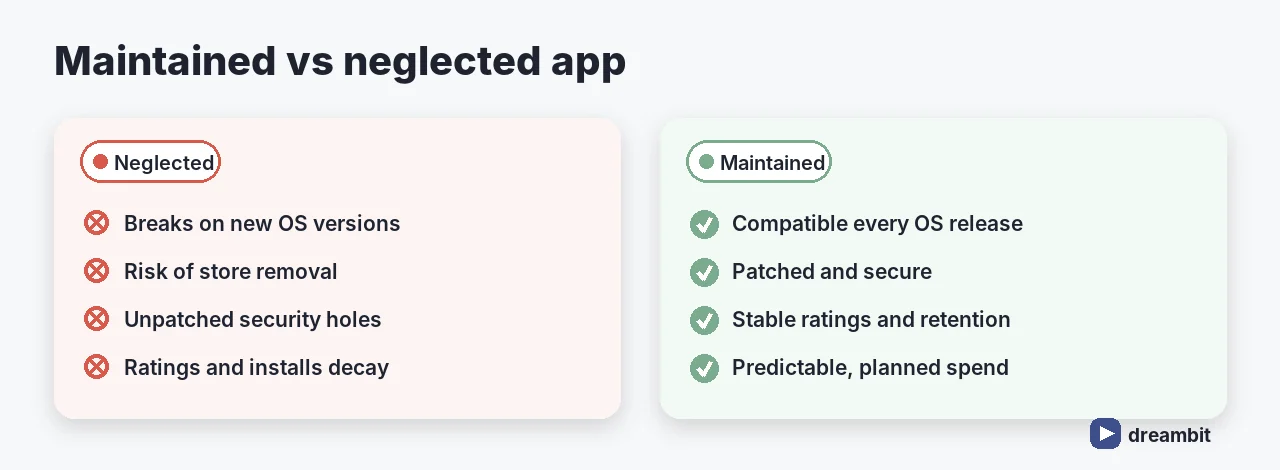
Neglect is quiet at first, then expensive:
- The app breaks on new OS versions — Apple and Google ship yearly; unmaintained apps eventually stop working.
- Store removal risk — both stores enforce minimum API/SDK levels and can delist stale apps.
- Security exposure — unpatched dependencies are the easiest way in.
- Rating decay — crashes and slowness show up in reviews fast, and installs follow.
- Compounding tech debt — a year of deferred updates turns a patch into a rewrite.
Both platforms publish their requirements — see Google Play’s target API level requirements.
Support models: which one fits you
- Ad-hoc / time & materials — pay per fix. Cheapest until something urgent breaks.
- Monthly retainer — a set block of hours, predictable budget, priority queue.
- Full managed support (SLA) — monitoring, guaranteed response times, proactive updates.
The right choice depends on how much revenue depends on the app being up. If downtime costs you customers, buy the SLA.
What a good maintenance plan includes
- Monitoring & crash reporting — you learn about problems before users tell you.
- Regular OS and dependency updates — scheduled, not reactive.
- Security patching — with a defined response window.
- Performance checks — startup time, memory, battery.
- Regression testing on each release — see our mobile app testing and quality audit guide.
- A roadmap for improvements — maintenance should also move the product forward.
Common maintenance mistakes to avoid
- No maintenance budget at all. The most common and most costly planning error.
- Reacting instead of scheduling. Planned updates are far cheaper than emergency ones.
- Ignoring analytics and crash data. The fix list is already there — read it.
- Letting dependencies rot. Small, frequent upgrades beat one giant migration.
- Treating maintenance as pure cost. Done well, it protects revenue and retention.
Key Takeaways
- Budget 15–20% of your build cost per year for mobile app maintenance.
- Typical ranges: $3,000–$10,000 small, $10,000–$50,000 mid-size, $100,000+ enterprise.
- Maintenance is four jobs: corrective, adaptive, preventive, and perfective.
- Skipping it risks OS breakage, store removal, security holes, and rating decay.
- Pick a support model based on how much revenue depends on uptime.
Frequently Asked Questions
If you would rather not run this in-house, our priority maintenance and support covers monitoring, SLA response times and the update cadence described above.
Budget roughly 15–20% of the original build cost annually. In practice that’s about $3,000–$10,000 a year for a small app, $10,000–$50,000 for a mid-size app, and $100,000+ for complex or enterprise apps. An app that cost $60,000 to build needs roughly $9,000–$12,000 a year.
Four kinds of work: corrective (fixing bugs and crashes), adaptive (new iOS/Android versions, devices, third-party API changes), preventive (dependency and security patches, monitoring, refactoring), and perfective (UX and performance improvements). A good plan also includes crash reporting and regression testing on every release.
It breaks on new OS releases, risks removal from the stores for failing minimum API requirements, accumulates unpatched security vulnerabilities, and loses ratings and installs as crashes pile up. Deferred updates also compound into technical debt, turning a routine patch into an expensive rewrite.
Plan a regular cadence rather than reacting to breakages: security and dependency patches promptly, compatibility updates around each major iOS/Android release (yearly), and smaller improvement releases every few weeks or months depending on your roadmap. Scheduled updates are far cheaper than emergency ones.
It depends on how much revenue depends on uptime. Ad-hoc time-and-materials is cheapest until something urgent breaks. A monthly retainer gives predictable budget and a priority queue. Full managed support with an SLA adds monitoring and guaranteed response times — worth it when downtime costs you customers.
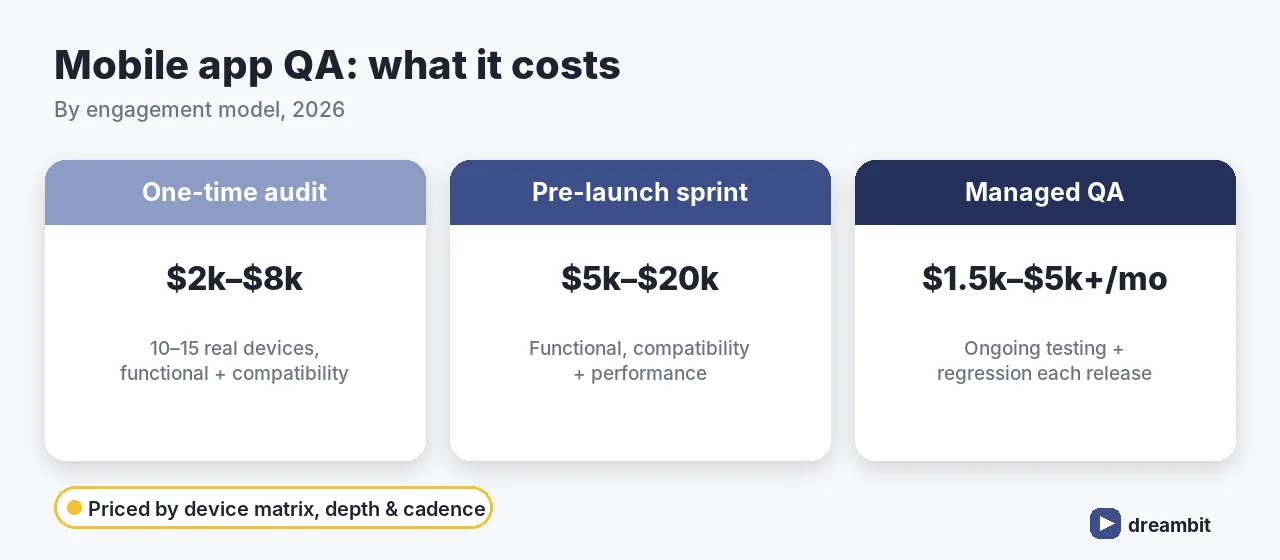
Mobile app testing services — and the quality audit that usually starts them — are how you find out whether your app actually works before your users do. In practice it means checking an app across real devices, load, edge cases, and security, then reporting what to fix and how urgently. A one-time app quality audit typically costs $2,000–$8,000; ongoing managed QA runs $1,500–$5,000+/month. The point isn’t to chase a coverage number — it’s to stop the bugs that cost you installs and trust.
Quality is something Dreambit treats as non-negotiable — across 14 years and 150+ shipped products (5M+ downloads, 4.9★) every release passes the same scrutiny. Here’s what a mobile app quality audit covers, when you need one, what it costs, and how manual and automated testing fit together.
What is a mobile app quality audit?
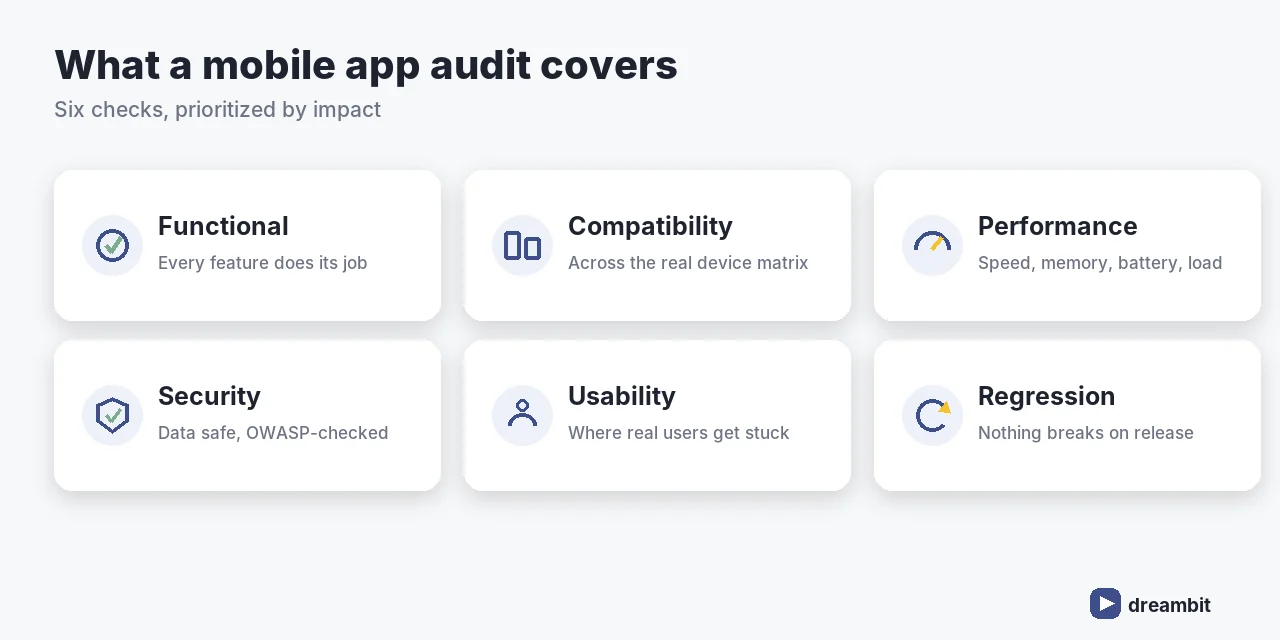
A quality audit is a structured assessment of your app’s health that produces a prioritized list of issues and fixes. Full mobile app testing services then cover the ongoing work. The main testing types:
- Functional — does every feature do what it should?
- Compatibility — behavior across the real device/OS matrix
- Performance — speed, memory, battery, and load
- Security — data protection and common vulnerabilities
- Usability — the flows where real users get stuck
- Regression & automation — nothing breaks when you ship again
We go deeper on our approach in how we approach quality assurance.
When do you need an app audit?
Some signals are hard to ignore:
- Rising crash rates or app freezes and slowdowns
- Falling store ratings and reviews mentioning bugs
- You’re about to launch, raise, or scale to more users
- You inherited a codebase and don’t know its real state
- Releases keep breaking things that used to work
How much do mobile app testing services cost in 2026?
Cost depends on scope — device matrix, depth, and whether it’s one-time or ongoing:
A one-time compatibility and functional audit across 10–15 real devices typically costs $2,000–$8,000; a full pre-launch sprint (functional + compatibility + performance) runs $5,000–$20,000; ongoing managed QA is $1,500–$5,000+/month depending on team size and release cadence (industry benchmarks, 2026).
The drivers are platform coverage, device matrix, test depth, integrations, and reporting needs — the same forces behind overall software cost.
What a mobile app quality audit covers
A credible audit doesn’t just list bugs — it prioritizes them by impact and gives you a fix plan. Expect: a device/OS compatibility matrix, functional defect log, performance and stability findings, a security review against OWASP mobile standards, and usability observations — each rated by severity so you fix what matters first.
Manual vs automated testing
You need both, for different jobs:
- Manual testing — exploratory, usability, and anything that needs human judgment.
- Automated testing — fast, repeatable regression across builds and devices.
A warning we live by: coverage is not quality. AI and automation can hit 90% coverage while verifying nothing meaningful — which is why we demand behavior- and edge-case tests. More on that discipline in how Dreambit builds with AI.
Our QA process
- Audit (3–5 days) — assess, reproduce, prioritize by severity.
- Test plan — device matrix, cases, and automation targets.
- Execution — manual + automated, on real devices.
- Report — prioritized findings with a fix plan.
- Regression & monitoring — keep it fixed release after release.
Common QA mistakes to avoid
- Chasing coverage numbers. 90% coverage that tests nothing is theater.
- Testing only on emulators. Real devices reveal real bugs.
- Skipping performance and security until something breaks in production.
- No regression suite. Every release quietly re-breaks old features.
- Treating QA as a final gate instead of a continuous practice.
Key Takeaways
- Mobile app testing services span functional, compatibility, performance, security, usability, and regression/automation.
- A one-time audit is $2,000–$8,000; a pre-launch sprint $5,000–$20,000; ongoing managed QA $1,500–$5,000+/month.
- Get an audit before launch, before scaling, or when crashes/ratings slip.
- Use manual and automated testing together — and remember coverage ≠ quality.
- A good audit prioritizes issues by impact and hands you a fix plan, not just a bug list.
Frequently Asked Questions
In 2026, a one-time quality audit across 10–15 real devices typically costs $2,000–$8,000; a full pre-launch sprint (functional, compatibility, performance) runs $5,000–$20,000; and ongoing managed QA is $1,500–$5,000+/month. Cost scales with platform coverage, device matrix, test depth, and release cadence.
A quality audit covers functional testing, device/OS compatibility, performance and stability, a security review against OWASP mobile standards, and usability. Crucially, it prioritizes issues by severity and hands you a fix plan — not just a raw bug list — so you fix what actually costs you users first.
Get one before a launch, before raising or scaling, when crash rates climb or store ratings slip, or when you’ve inherited a codebase and don’t know its real state. If recent releases keep breaking features that used to work, that’s a strong signal you need an audit and a regression suite.
Both. Manual testing handles exploratory, usability, and judgment-heavy checks; automated testing gives fast, repeatable regression across builds and devices. Beware coverage theatre — high automated coverage can still verify nothing meaningful, so demand behaviour- and edge-case tests, not just line coverage.
A focused audit usually takes 3–5 days to assess, reproduce, and prioritize issues, followed by a test plan and execution. Ongoing managed QA then runs continuously alongside your releases, with regression checks each time you ship so fixed issues stay fixed.
To hire mobile app developers you have four realistic models — in-house/direct hire, freelancers, staff augmentation, and a full development agency — and the right one depends on whether the app is your long-term product or a project to ship. Rates in 2026 run roughly $55–$85/hour for juniors and $145+/hour for seniors, while a full-time US hire costs $90,000–$300,000 a year all-in. The expensive mistake isn’t the rate; it’s choosing the wrong model.
Dreambit works as both a delivery partner and an embedded team, and across 14 years we’ve shipped 150+ products with 5M+ downloads and a 4.9★ rating across 114 client reviews. Here’s how to choose a hiring model, what it really costs, which roles you need, and the red flags to screen for.
The four ways to hire mobile app developers
Each model fits a different situation:
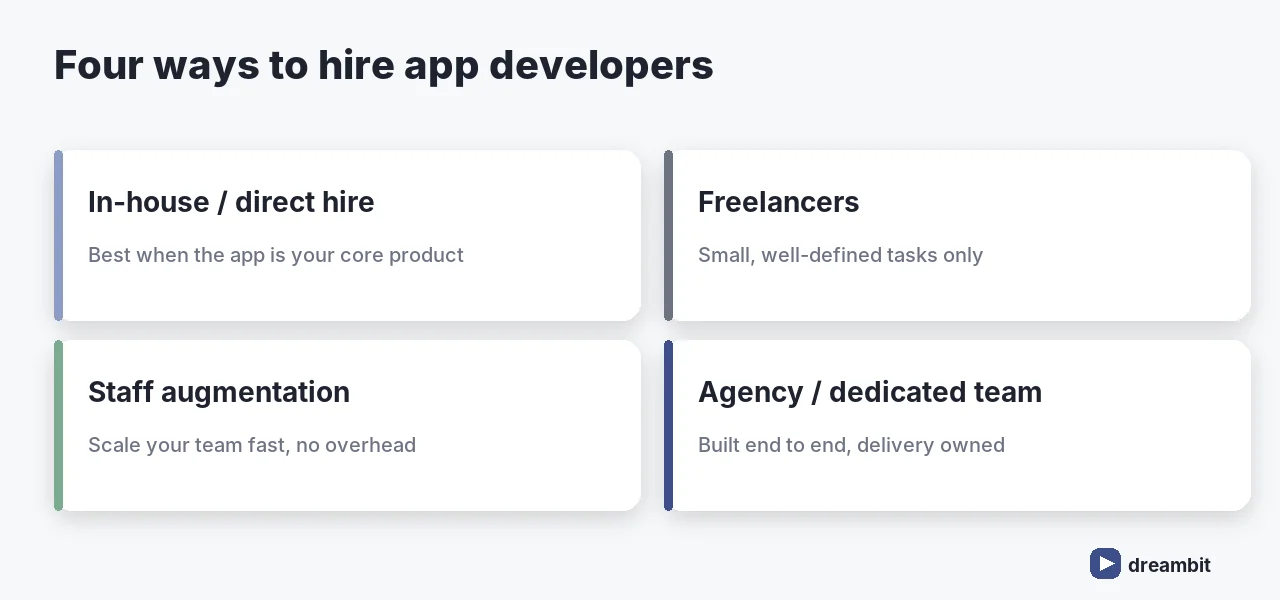
- In-house / direct hire — best when the app is your core product and someone must own it for years. Highest commitment and cost.
- Freelancers — good for small, well-defined tasks; weak for anything mission-critical or long-lived.
- Staff augmentation — external engineers join your team and report to you; ideal when you have a team but need to scale or fill a skill gap fast.
- Development agency / dedicated team — a complete team with process and delivery ownership; best when you want the product built end to end.
Choosing a partner rather than a body-shop matters — see why an agency partnership is key to project success.
How much does it cost to hire mobile app developers?
Rates vary by seniority and region. In 2026, hourly rates typically run $55–$85 for juniors, ~$110 mid-level, ~$145 senior, and $225+ for leads or specialists in regulated fintech/health or heavy native work. A full development agency charges $100–$250/hour but delivers a complete team.
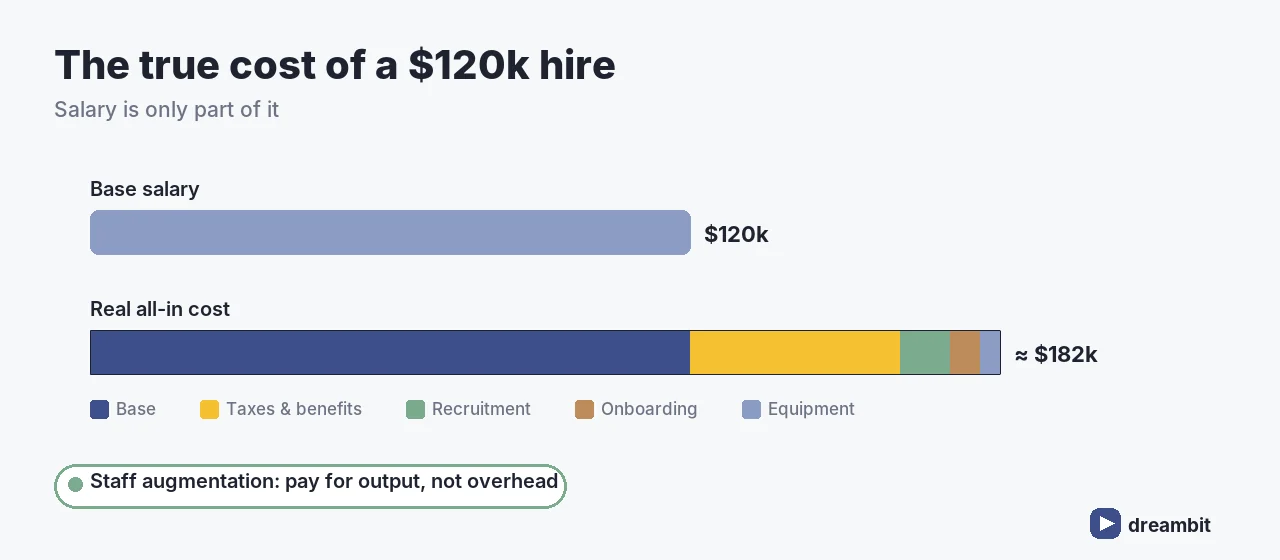
A $120,000/year developer really costs $165,000–$185,000 all-in once you add employer taxes and benefits (30–45%), recruitment ($7,000–$28,000), onboarding ($5,000–$10,000), and equipment. Staff augmentation avoids most of that — you pay for output, not overhead (industry benchmarks, 2026).
For the wider budget picture, see the cost of custom software development in 2026. Rate benchmarks for roles are also published by the U.S. Bureau of Labor Statistics.
Staff augmentation vs in-house vs agency: when to use each
The decision comes down to ownership and time horizon:
- Choose in-house when the app is the business and you’ll evolve it for years.
- Choose staff augmentation when you have a team and process but need capacity or a specific skill now, without long-term overhead.
- Choose an agency/dedicated team when you want the product designed and built end to end, fast, with delivery owned for you.
Many companies blend them — an agency to launch, augmentation to scale, a key in-house hire to own it. This is also where CTO-as-a-service helps set the strategy.
Which roles do you actually need?
A shippable mobile product usually needs more than “a developer”:
- Mobile engineers — Flutter/React Native, or native iOS/Android
- Backend engineer — APIs, data, integrations
- UI/UX designer — the difference between used and uninstalled
- QA engineer — quality that survives real devices
- Product/PM — someone owning outcomes, not just tasks
How to vet mobile app developers — and red flags
Screen for judgment, not just syntax:
- Ask for shipped apps — real store links, not just repos.
- Check communication — a great dev who can’t explain trade-offs is a risk.
- Probe for product thinking — do they ask why, or just take the ticket? See product thinking in client projects.
Red flags: no verifiable portfolio, quotes far below market, no QA/testing story, no questions about your users or goals, and reluctance to sign clear contracts or NDAs.
Common mistakes when hiring app developers
- Hiring on rate alone. The cheapest quote often costs the most by launch.
- Choosing the wrong model. A freelancer for a multi-year product, or a full team for a two-week task.
- Forgetting the all-in cost. Salary is a fraction of what a full-time hire really costs.
- No design or QA. Developers alone don’t make a product users keep.
- Skipping product ownership. Someone must own outcomes, not just close tickets.
Key Takeaways
- There are four ways to hire mobile app developers: in-house, freelance, staff augmentation, and agency/dedicated team.
- 2026 rates: ~$55–$85/hr junior, ~$145 senior, $225+ lead; agencies $100–$250/hr.
- A $120k hire really costs $165k–$185k all-in — staff augmentation avoids most of that overhead.
- Match the model to ownership and time horizon, and hire for a team (design, QA, product), not just code.
- Vet for shipped work, communication, and product thinking; beware below-market quotes.
Frequently Asked Questions
In 2026, hourly rates run roughly $55–$85 for juniors, ~$145 for seniors, and $225+ for leads or specialists; development agencies charge $100–$250/hour for a full team. A full-time US hire costs $90,000–$300,000 a year, and a $120k salary really costs $165,000–$185,000 all-in.
With staff augmentation, external engineers join your existing team and report to you — ideal for scaling capacity or filling a skill gap. An agency or dedicated team owns delivery end to end, with its own process and management. Augmentation extends your team; an agency runs the build.
Hire in-house when the app is your core product and must be owned for years. Outsource — via staff augmentation or an agency — when you need to ship faster, scale flexibly, or access skills you don’t have, without the full overhead and long-term commitment of employment.
Ask for shipped apps with real store links (not just repositories), check how clearly they explain trade-offs, and see whether they ask about your users and goals. Red flags: no verifiable portfolio, far-below-market quotes, no QA or testing story, and reluctance to sign clear contracts or NDAs.
More than one developer. A shippable product typically needs mobile engineers, a backend engineer, a UI/UX designer, a QA engineer, and someone owning product decisions. Hiring only coders — without design, QA, and product ownership — is a common reason apps launch but don’t retain users.
MVP development is the process of building the smallest version of a product that can test your core business bet with real users — not a stripped-down app, but a focused one. Done right, a custom MVP costs roughly $30,000–$120,000 and ships in 3–6 months, and its job is to produce evidence, not features. The hardest part isn’t building it; it’s deciding what to leave out.
Dreambit has shipped 150+ products over 14 years, including 60+ MVPs, with 5M+ downloads. Below is the practical playbook we use with founders — what an MVP really is, what it costs, how long it takes, how to scope it so it proves the right thing, and how AI now compresses the timeline.
What is an MVP — and what MVP development really means
An MVP (minimum viable product) is the smallest thing you can build to learn whether your core assumption is true. MVP development is therefore an exercise in prioritization: define the one flow that tests the bet, build it well, ship it, and measure. It is not “cheap version 1” — a broken experience teaches you nothing except that people dislike broken experiences.
We unpack this mindset in applying product thinking to client projects.
How much does MVP development cost in 2026?
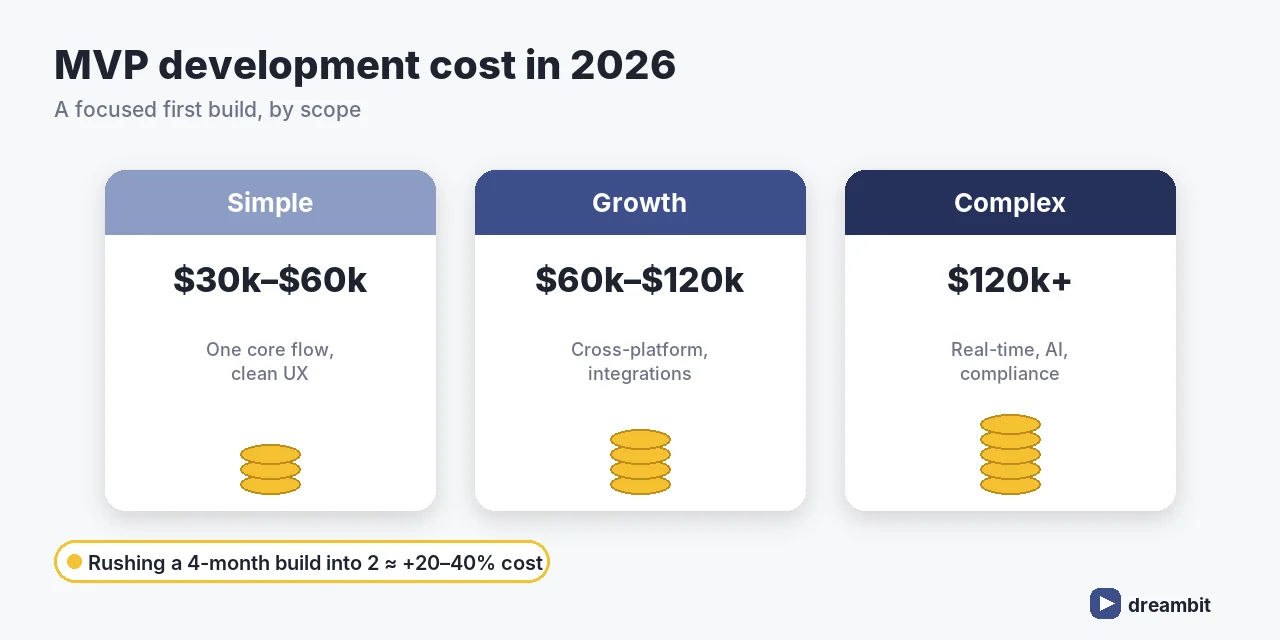
A realistic range for a custom MVP in 2026 is $30,000–$120,000+, depending on scope, platforms, and integrations. A single-platform MVP with one core flow lands at the lower end; a cross-platform product with real-time features, AI, or compliance sits higher. No-code MVPs are cheaper ($5,000–$15,000) but hit scaling limits fast.
A custom MVP with one core flow, clean UX, and the integrations it truly needs typically costs $30,000–$60,000 and ships in 3–4 months. Trying to compress a 4-month build into 2 usually raises the budget 20–40% and the defect rate with it (Dreambit project benchmarks, 2026).
For the full breakdown of what drives software budgets, see the cost of custom software development in 2026.
How long does MVP development take?
A realistic timeline is 3–6 months. A simple, single-platform app with limited backend can ship in 6–8 weeks; a cross-platform product with real-time data, AI, or compliance runs 4–8 months. The variable isn’t coding speed — it’s scope. The tighter the scope, the faster you learn.
How to scope an MVP right
This is where MVP development is won or lost. Our rule: tie every feature to the one hypothesis you’re testing, and cut the rest to a later release.
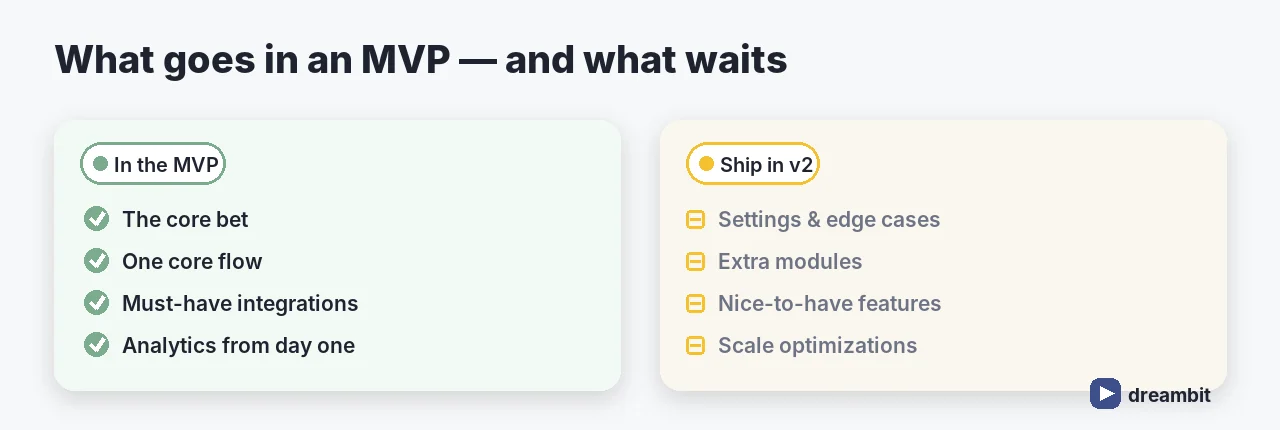
- Define the core bet — the single thing that must be true for the product to work.
- Pick one core flow — the path that tests that bet end to end.
- Cut “nice to have” to v2 — settings, edge cases, and extra modules can wait.
- Instrument from day one — if you can’t measure it, you can’t learn from it.
Planning a startup build? Start with what future clients need to know before launching.
How AI speeds up MVP development
Used with discipline, AI compresses MVP timelines by roughly 40–60% — the boring parts (boilerplate, first-draft code, tests, docs) get faster, while engineers keep the judgment. But speed without control is dangerous, which is why we build spec-first with tests and verification. See how Dreambit builds with AI.
Our MVP development process
- Discovery (1–2 weeks) — the bet, the core flow, success metrics.
- UX/UI design (2–3 weeks) — prototype the one flow, test it.
- Development (6–14 weeks) — build spec-first, instrumented, tested.
- Launch & measure — ship to real users, watch the metric.
- Iterate — double down on what worked, cut what didn’t.
Curious what the first sprint looks like? Here’s what we do in the first two weeks.
Common MVP development mistakes to avoid
- Building too much. The most common and most expensive mistake — an MVP with 40 features tests nothing.
- Shipping a broken core. Small scope, high quality — not the reverse.
- No metric. If you don’t define what success looks like, you can’t tell if you found it.
- Skipping discovery. A week of it saves months of building the wrong thing.
- Rushing the timeline. Crushing 4 months into 2 inflates cost and defects.
Key Takeaways
- MVP development in 2026 typically costs $30,000–$120,000+ and ships in 3–6 months.
- An MVP is a hypothesis test, not a cheap v1 — scope to one core flow, built well.
- Cut “nice to have” to v2 and instrument the product from day one.
- AI, used with discipline, compresses timelines 40–60% without lowering the bar.
- Rushing scope raises cost and defects — tight scope is the real accelerator.
Frequently Asked Questions
Custom MVP development typically costs $30,000–$120,000+ in 2026. A single-platform MVP with one core flow is usually $30,000–$60,000; cross-platform products with real-time features, AI, or compliance run higher. No-code MVPs are cheaper ($5,000–$15,000) but hit scaling limits fast.
A realistic MVP timeline is 3–6 months. A simple single-platform app can ship in 6–8 weeks; complex platforms with real-time data, AI, or compliance take 4–8 months. Scope, not coding speed, is the main driver — the tighter the scope, the faster you learn.
Only what tests your core bet: one core user flow built to a high standard, the integrations it genuinely needs, and analytics from day one. Settings, edge cases, extra modules, and nice-to-have features belong in v2. An MVP with 40 features tests nothing.
A prototype demonstrates an idea (often clickable, not production-ready); an MVP is a real, shippable product that real users can use to validate a business bet. The MVP produces evidence from actual usage, which a prototype can’t.
Yes — used with discipline, AI compresses MVP timelines by roughly 40–60% by handling boilerplate, first-draft code, tests, and docs, while engineers keep the judgment. We build spec-first with tests and verification so speed never comes at the cost of quality.