Month: June 2026
E-commerce app development is the process of designing, building, and maintaining mobile or web shopping applications — from single-brand retail stores to multi-vendor marketplaces and grocery delivery. What separates a profitable retail app from an expensive one isn’t the feature list; it’s conversion: how smoothly a shopper goes from browse to paid. A focused e-commerce MVP usually takes 3–5 months, and the checkout flow matters more than almost anything else you build.
Retail is one of Dreambit’s core industries, and across 14 years we’ve shipped 150+ products with 5M+ downloads. Below is the practical playbook we use with retail and D2C clients — what it costs, the features that actually convert, where AI helps, the tech stack, and the mistakes that quietly bleed revenue.
What is e-commerce app development?
E-commerce app development covers any software built to sell products or services. In practice it splits into a few product types, each with its own catalog and logistics model:
- Single-brand store — your own products, your brand, full control (D2C).
- Multi-vendor marketplace — many sellers, commissions, ratings.
- Grocery & q-commerce — fast delivery, real-time inventory, slots.
- Subscription commerce — recurring boxes, replenishment, retention.
- Social & live shopping — discovery, video, impulse purchase.
The type you choose shapes your logistics, payments, and which features earn their cost. Building a marketplace? See our definitive guide to multi-vendor marketplaces.
How much does e-commerce app development cost in 2026?
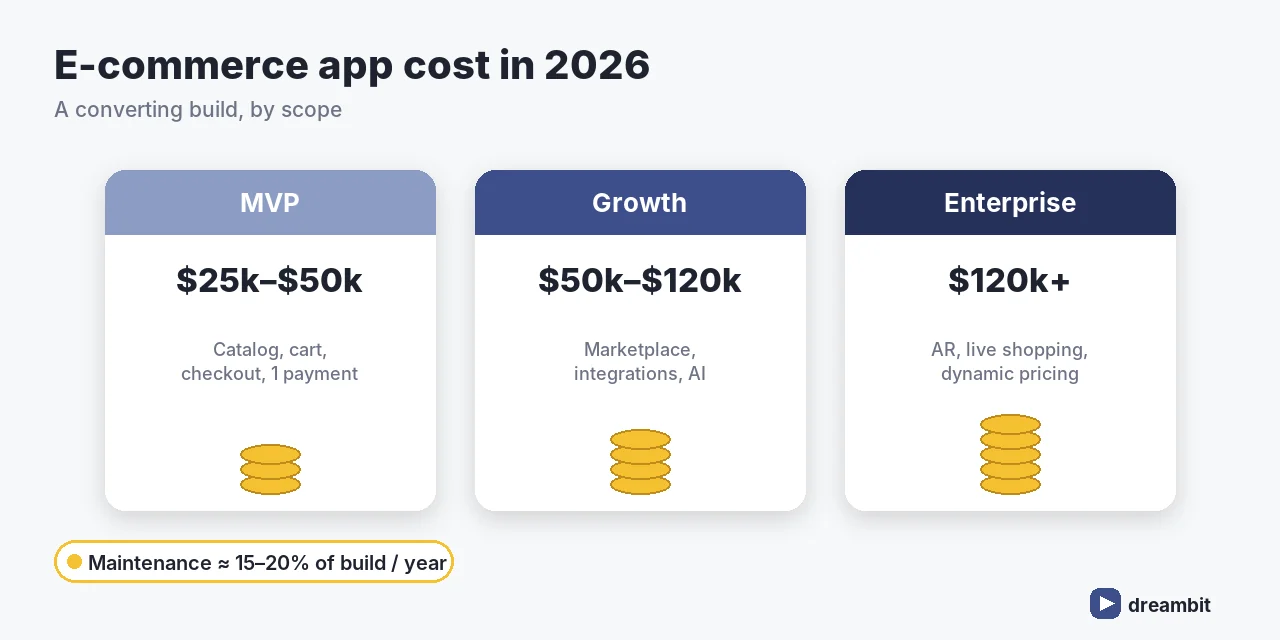
A realistic range for a custom e-commerce app in 2026 is $25,000–$300,000+, depending on scope, integrations, and platforms. A focused single-brand MVP lands at the lower end; a multi-vendor marketplace with AI personalization and live shopping sits at the top.
A single-brand e-commerce MVP with catalog, cart, secure checkout, and one payment provider typically costs $25,000–$50,000 and ships in 3–5 months — marketplaces, AR try-on, or AI personalization push a build into the $50,000–$120,000 range and beyond (Dreambit project benchmarks, 2026).
The biggest cost driver is feature complexity, followed by integrations (payments, ERP, logistics) and platform count. For the full picture, see our guide to the cost of custom software development in 2026.
Must-have features for an e-commerce app
Conversion is the whole game. A credible retail app ships with a core built to move shoppers to checkout:
- Fast product catalog & search — filters and search that find the right item in seconds
- Frictionless cart & checkout — guest checkout, saved details, minimal steps
- Multiple payment options — cards, wallets, BNPL, local methods
- Order tracking & notifications — status updates that reduce support load
- Reviews & wishlists — social proof and saved intent
- Secure accounts — fast login, saved addresses, reorder
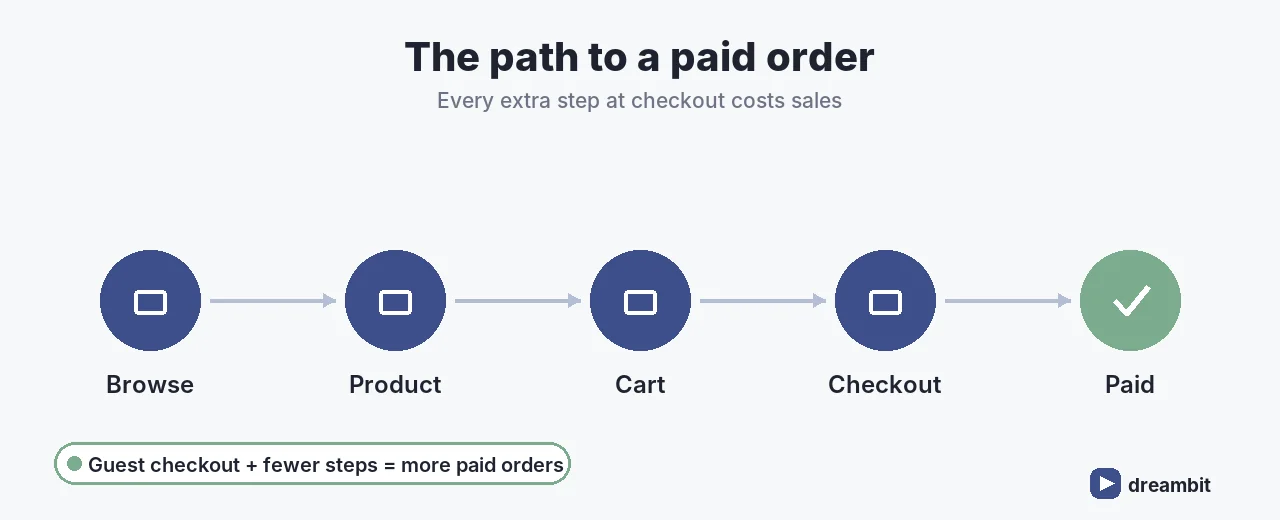
Most revenue leaks happen at checkout. We covered the fix in how to reduce cart abandonment by 20% by removing checkout steps.
Conversion & UX: where retail apps win or lose
An e-commerce app lives and dies on conversion rate. The levers that move it most:
- One-tap, guest-friendly checkout — every extra field costs sales
- Speed — fast load and smooth scrolling keep shoppers in flow
- Personalized merchandising — the right product in front of the right shopper
- Trust signals — reviews, clear returns, secure-payment cues
AI in e-commerce apps
AI is now a baseline expectation in retail:
- Personalized recommendations — “you might also like,” done well
- Smart search — natural-language and visual product search
- AR try-on & preview — fewer returns, more confidence
- Dynamic pricing & fraud detection — margin and safety at scale
The right tech stack for an e-commerce app
After 60+ MVPs, our default is a cross-platform front end with a scalable commerce back end:
- Frontend: Flutter or React Native — one codebase, 30–40% lower build cost. See why we use Flutter and Firebase for MVPs.
- Backend: Node.js or Python (Django), or a headless commerce platform where it fits.
- Payments: Stripe/Adyen + local gateways, PCI-compliant by tokenization.
- Cloud: AWS or Firebase, with analytics and A/B testing from day one.
Our e-commerce app development process
- Discovery (1–2 weeks) — catalog model, logistics, success metrics.
- UX/UI design (2–4 weeks) — conversion-first flows and prototypes.
- Development (8–16 weeks) — iterative sprints, analytics instrumented.
- QA & launch — tested across devices and payment paths.
- Iterate on data — optimize the funnel that drives revenue.
Not sure an app is the right move yet? Start with our checklist on whether your business needs a mobile app.
Common e-commerce app development mistakes to avoid
- A heavy checkout. Every extra step and field drops conversion.
- Forcing account creation. Offer guest checkout; ask for the account after the sale.
- Slow, cluttered UI. Speed and clarity beat feature count.
- Ignoring retention. Push, reorder, and loyalty bring shoppers back cheaply.
- No analytics on the funnel. If you can’t see where shoppers drop, you can’t fix it.
Key Takeaways
- Custom e-commerce app development in 2026 typically costs $25,000–$300,000+; a single-brand MVP is $25,000–$50,000.
- Conversion > features — a frictionless, guest-friendly checkout matters most.
- AI (recommendations, smart search, AR) is now a baseline retail expectation.
- Use a cross-platform stack with PCI-compliant payments and analytics from day one.
- Instrument the funnel and iterate on conversion, not downloads.
Frequently Asked Questions
Custom e-commerce app development typically costs $25,000–$300,000+ in 2026. A single-brand MVP with catalog, cart and secure checkout is usually $25,000–$50,000; marketplaces, AR, or AI personalization push it to $50,000–$120,000 and beyond. Maintenance runs about 15–20% of the build per year.
A focused single-brand e-commerce MVP usually ships in 3–5 months. Multi-vendor marketplaces, complex logistics, AR try-on, or deep integrations add time. The fastest path is to launch a clean catalog-to-checkout experience first, then expand based on real funnel data.
Conversion features above all: fast catalog and search, a frictionless guest-friendly checkout, multiple payment options, order tracking, reviews and wishlists. These move shoppers from browse to paid far more than sheer feature count — checkout quality is the single biggest lever on revenue.
Strip the checkout to the fewest steps, offer guest checkout, save details for reorder, and keep the app fast. Add trust signals, personalized merchandising, and clear returns. We instrument the funnel from day one so we can see exactly where shoppers drop and fix it.
Start with what matches your business. A single-brand D2C store is faster and cheaper to launch and validate; a marketplace adds vendors, commissions, and ratings but is more complex and costly. Many clients launch single-brand first, then expand to a marketplace once demand is proven.
Applying product thinking to client projects means treating outsourced work not as a list of features to ship, but as a product with users, outcomes, and a business to grow. The difference between outsourcing and product development is not who writes the code — it is whether the team optimises for output (tickets closed) or outcomes (problems solved, metrics moved). The best agencies erase that line: they bring a product mindset to every client engagement.
At Dreambit we sit on both sides of this. We have delivered 150+ products for clients over 14 years, and we build our own products too — which forces us to think like owners, not order-takers. Here is how product thinking changes client work, why it matters, and how to apply it without blowing up scope or budget.
Outsourcing vs. product development: what’s the real difference?
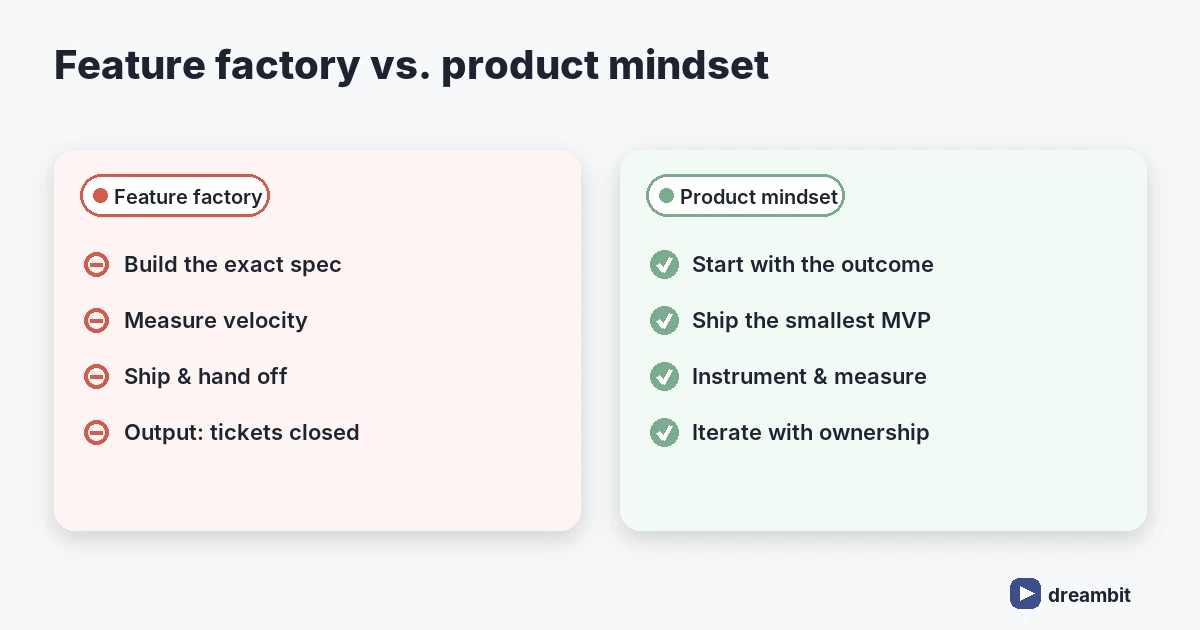
Classic outsourcing is a “feature factory”: the client hands over a spec, the vendor builds exactly that, and success is measured by on-time delivery. Product development asks a different question first — what outcome are we trying to create, and how will we know it worked? The deliverable might be the same app, but the decisions along the way are different.
- Feature factory: build what’s on the ticket → measure velocity → ship.
- Product mindset: understand the user and the metric → build the smallest thing that moves it → measure → iterate.
Neither is “wrong,” but only one compounds value. We wrote more about this partnership dynamic in why an agency partnership is key to project success.
Why product thinking matters for client projects
Because clients rarely want software — they want a result. A booking app exists to fill calendars; a fintech app exists to move money safely and retain users. When an agency optimises only for “did we build the spec,” it can deliver a technically perfect product that fails commercially.
Teams that measure outcomes over output ship fewer features but create more value — in our experience, the highest-performing client projects cut their initial feature list by 30–50% and reinvested that time into the few flows that actually drove activation (Dreambit delivery data, 2026).
How to apply product thinking to client projects
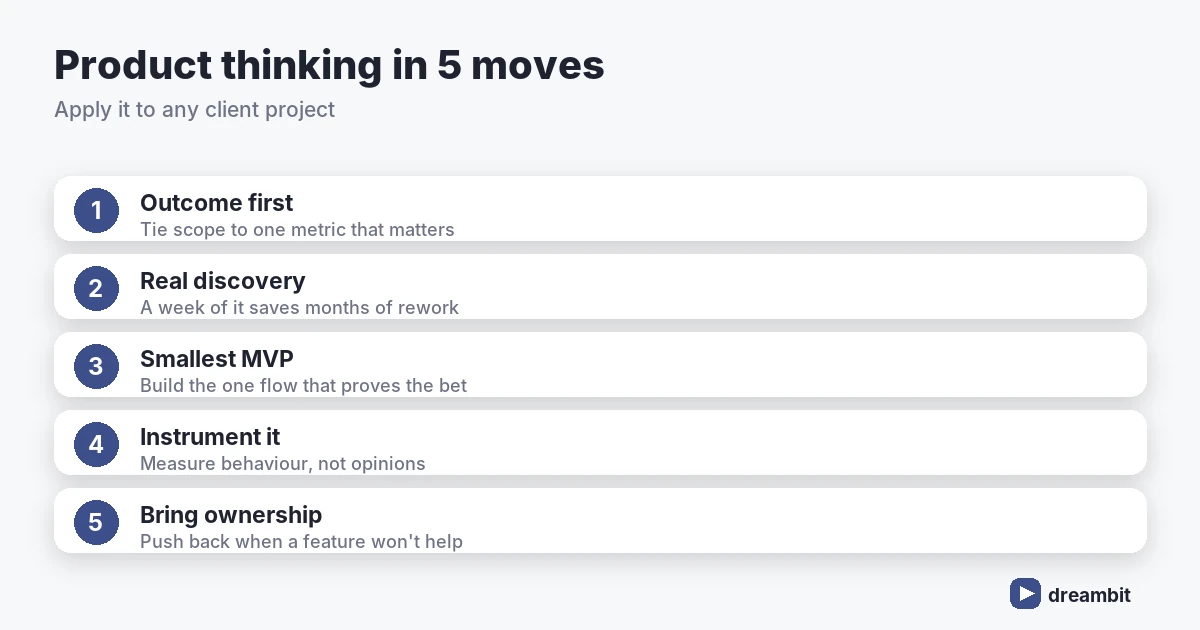
You do not need to become the client’s product manager to think like one. Five practical moves carry most of the value:
1. Start with the outcome, not the feature list
Before estimating, ask what metric this project is meant to move — activation, retention, revenue, cost saved. Tie scope to that metric.
2. Run real discovery
A week of discovery — users, constraints, success criteria — saves months of building the wrong thing. See what we actually do in the first two weeks of a project.
3. Ship the smallest version that proves value
An MVP is a hypothesis, not a downsized product. Build the one flow that tests the core bet. Our lessons from 60+ Flutter/Firebase MVPs go deeper here.
4. Instrument and measure
If you cannot see what users do, you are guessing. Analytics and clear success metrics turn opinions into decisions.
5. Bring ownership, not just hours
Push back when a requested feature won’t serve the outcome. Clients hire experts for judgement, not just hands — that is the heart of CTO-as-a-service thinking.
What our partner sees from their side
We explored this same question with our partners at SDA, who put it sharply in their companion piece on product thinking in outsourcing:
“Sometimes the most valuable contribution a team can make isn’t what it built, but what it helped the client decide not to build at all.”
— SDA, on product thinking in outsourced projects
It is a view we share completely: product thinking is not a methodology you import once, it is a habit both partners practise on every engagement — challenging the backlog, protecting the budget, and building only what moves the outcome.
Common pitfalls when applying product thinking
- Discovery theatre. Running a workshop and then ignoring it. Let findings change scope.
- Gold-plating the MVP. Adding “just one more” feature until the hypothesis is buried.
- No metric ownership. If no one watches the numbers after launch, product thinking stops at launch.
- Treating the client as the enemy of scope. Product thinking is collaborative, not a fight over the contract.
Key Takeaways
- Outsourcing vs. product development is a mindset difference: output vs. outcomes.
- Apply product thinking by starting with the metric, running real discovery, shipping a true MVP, instrumenting it, and bringing ownership.
- The best agencies build client work like their own product — Dreambit does both, across 150+ launches.
- Product thinking is a shared habit between partners, practised every engagement.
Frequently Asked Questions
What is product thinking in the context of client projects?
Product thinking means treating a client engagement like a product: focusing on the user, the outcome, and the business metric rather than just delivering a fixed feature list. It shifts success from “we shipped the spec” to “we moved the result the client actually cares about,” which usually means fewer features built better.
Is outsourcing worse than in-house product development?
Not inherently. Outsourcing becomes a problem only when the vendor acts as a feature factory with no stake in outcomes. An agency that applies product thinking — discovery, metrics, MVP, ownership — can match or beat in-house teams, while bringing wider cross-project experience.
How do you apply product thinking without expanding scope?
By tying scope to a single outcome metric and cutting anything that doesn’t serve it. Product thinking often shrinks scope: you build the smallest flow that proves the core bet, measure it, and only then invest in more. That keeps budgets focused rather than inflated.
Why is Dreambit qualified to talk about this?
Because Dreambit is both an agency and a product builder. Over 14 years we have delivered 150+ products for clients and shipped our own, earning a 4.9★ average rating across 114 reviews. Building our own products forces us to bring an owner’s mindset to every client engagement.
Frequently Asked Questions
Product thinking means treating a client engagement like a product — focusing on the user, the outcome, and the business metric rather than a fixed feature list. Success shifts from “we shipped the spec” to “we moved the result the client cares about,” which usually means building fewer features, better.
Traditional outsourcing builds exactly what the spec says and measures velocity. Product thinking starts with the outcome and the metric, then builds the smallest thing that moves it and iterates. The deliverable may look the same, but only the second approach compounds real business value.
Usually the opposite. Product thinking ties scope to one outcome and cuts what does not serve it, so budgets focus on the few flows that matter. Teams often ship a leaner MVP two to three months sooner, then invest based on real usage rather than guesses.
Yes. The most effective partners combine development with business analysis, discovery, and a metrics-driven mindset. Dreambit does both — we build clients’ products and our own, across 150+ launches — which forces an owner’s mindset onto every engagement.
Tie scope to a single outcome metric and cut anything that does not serve it. Run real discovery, ship the smallest MVP that proves the core bet, instrument it, and only then expand. Product thinking usually shrinks scope rather than inflating it.
Build with a product-minded partner
Outsourcing and product development don’t have to be opposites. The agencies worth hiring apply product thinking to every client project — starting with outcomes, shipping lean, and owning the result. Book a free discovery call and let’s apply product thinking to yours.
E-learning app development is the process of designing, building, and maintaining mobile or web applications for online education — from course marketplaces and corporate training to language tutoring and microlearning. The thing that decides success isn’t the feature list; it’s engagement: an e-learning app only works if learners come back and finish what they start. A focused, engaging MVP usually takes 4–6 months to build and 3–5 core features to get right.
E-learning is one of Dreambit’s core industries, and across 14 years we’ve shipped 150+ products with 5M+ downloads. Below is the practical playbook we use with founders and training teams — what it costs, the features that actually drive completion, where AI helps, how to monetize, and the mistakes that quietly kill retention.
What is e-learning app development?
E-learning app development covers any software built to teach, train, or certify. In practice it splits into a few product types, each with its own engagement and content model:
- Course marketplaces — many instructors, many courses (Udemy-style).
- LMS & corporate training — structured learning, progress tracking, compliance.
- Microlearning apps — short, daily, habit-forming lessons (Duolingo-style).
- Language & tutoring — live or AI-driven practice and feedback.
- Kids & K-12 education — gamified, safe, parent-aware.
- Skill & certification platforms — assessments, credentials, outcomes.
The type you choose shapes your content pipeline, your monetization, and which features matter most.
How much does e-learning app development cost in 2026?
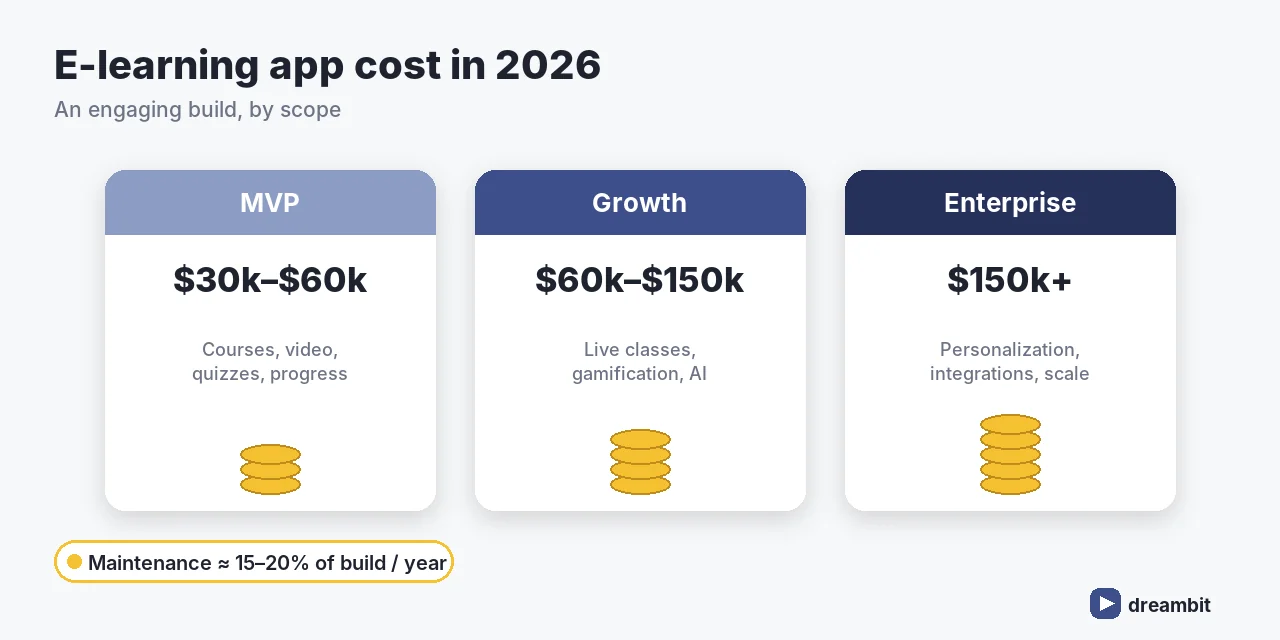
A realistic range for a custom e-learning app in 2026 is $30,000–$200,000+, depending on scope, content features, and platforms. A focused single-platform MVP lands at the lower end; a multi-platform product with live classes, gamification, and AI personalization sits higher.
An engaging e-learning MVP with courses, video lessons, quizzes, and progress tracking typically costs $30,000–$60,000 and reaches the app stores in 4–6 months — adding live classes or AI personalization pushes a build into the $60,000–$150,000 range (Dreambit project benchmarks, 2026).
The main cost drivers are video infrastructure, gamification depth, live/real-time features, AI personalization, and the number of platforms. For a fuller breakdown, see our guide to the cost of custom software development in 2026.
Must-have features for an e-learning app
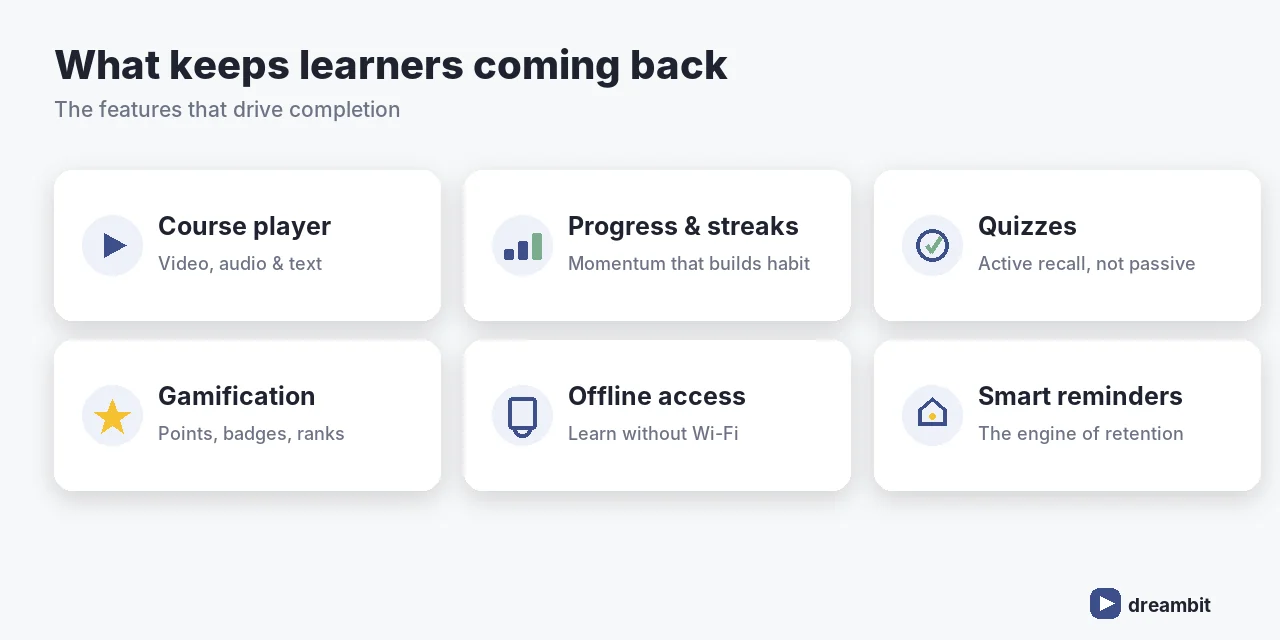
Engagement is the whole game. A credible e-learning app ships with a core built to keep learners coming back:
- Clean course player — video, audio, and text lessons that just work, online and off
- Progress tracking — visible streaks, completion, and next-step nudges
- Quizzes & assessments — active recall, not passive watching
- Gamification — points, badges, leaderboards, streaks that drive habit
- Offline access — learning continues without Wi-Fi
- Notifications & reminders — the quiet engine of daily retention
Retention is where most learning apps fail. We wrote about predicting and preventing drop-off in how we predict user churn and bring users back.
AI in e-learning apps
AI is now a baseline expectation, not a novelty. The highest-value uses we see:
- Personalized learning paths — content adapts to each learner’s pace and gaps
- AI tutoring & feedback — instant, patient help on demand
- Content generation — quizzes, summaries, and flashcards from existing material
- Smart recommendations — the next lesson a learner is most likely to finish
How to monetize an e-learning app
The model shapes the product, so decide it early:
- Subscription — predictable revenue; best for ongoing learning
- Freemium — free core, paid advanced content or features
- Course sales — one-off purchases or bundles
- B2B licensing — sell to companies for employee training (often the highest margin)
The right tech stack for an e-learning app
After 60+ MVPs, our default is a cross-platform front end with a scalable, media-ready back end:
- Frontend: Flutter or React Native — one codebase, 30–40% lower build cost. See why we use Flutter and Firebase for MVPs.
- Backend: Node.js or Python (Django) for content APIs and analytics.
- Media: a video CDN/streaming service for smooth playback at scale.
- Cloud: AWS or Firebase, with analytics wired in from day one.
Our e-learning app development process
- Discovery (1–2 weeks) — audience, content model, success metrics.
- UX/UI design (2–4 weeks) — engagement-first flows and prototypes.
- Development (8–16 weeks) — iterative sprints, analytics instrumented.
- QA & launch — tested across devices, then to the stores.
- Iterate on data — improve the flows that drive completion.
Not sure an app is the right move yet? Start with our checklist on whether your business needs a mobile app.
Common e-learning app development mistakes to avoid
- Building a content dump. More courses don’t help if no one finishes one.
- Ignoring retention from day one. Streaks, reminders, and nudges aren’t “later” features.
- Over-investing in live before validating recorded. Live classes are expensive; prove demand first.
- Skipping offline. Learners use commutes and gaps — meet them there.
- No analytics. If you can’t see where learners drop, you can’t fix it.
Key Takeaways
- Custom e-learning app development in 2026 typically costs $30,000–$200,000+; an engaging MVP is $30,000–$60,000.
- Engagement > features — progress, gamification, reminders, and offline drive completion.
- AI personalization and tutoring are now baseline expectations.
- Pick a monetization model early; B2B licensing is often the highest margin.
- Instrument analytics from day one and iterate on completion, not downloads.
Frequently Asked Questions
Custom e-learning app development typically costs $30,000–$200,000+ in 2026. An engaging MVP with courses, video, quizzes and progress tracking is usually $30,000–$60,000; adding live classes, gamification, or AI personalization pushes it to $60,000–$150,000. Maintenance runs about 15–20% of the build per year.
A focused, engaging e-learning MVP usually takes 4–6 months from discovery to app-store launch. Live classes, deep gamification, or AI personalization add time. The fastest path is to ship a strong recorded-course experience first, then expand based on real completion data.
Engagement features, not sheer content volume: a clean course player with offline access, visible progress and streaks, quizzes for active recall, gamification, and smart reminders. These drive course completion — the metric that actually matters — far more than the number of courses available.
Retention is designed in from day one: streaks and progress create momentum, reminders bring learners back, gamification rewards consistency, and AI personalization keeps content at the right level. We also instrument analytics to see exactly where learners drop and fix those flows.
Common models are subscriptions (predictable revenue for ongoing learning), freemium (free core, paid advanced content), one-off course sales, and B2B licensing to companies for employee training — often the highest-margin route. Pick the model early, because it shapes the product.
AI is only worth it when it solves a real problem. We don’t bolt “AI” onto a product to put it on a slide — we build features that earn their place: faster workflows, lower costs, things that simply weren’t possible before. Here’s what our AI integration services look like in practice.
AI integration services in your product
We embed AI where it creates real value for your users, not where it looks impressive in a demo.
- Assistants & chatbots — conversational interfaces that actually understand your domain, not generic bots
- RAG over your data — answers grounded in your documents, knowledge base, and policies, with sources — not the model making things up
- Smart search — natural-language search across content that used to be impossible to navigate
Example: for a B2B SaaS client we built a support assistant grounded in their docs that cut average first-response time by ~40% and deflected around 30% of routine tickets.
LLM-powered features
The building blocks that quietly make a product smarter:
- Summarization — long documents, threads, calls turned into the part that matters
- Classification & routing — tagging, triage, and sorting at scale, automatically
- Extraction — pulling structured data out of messy, unstructured input
- Generation — drafting content, replies, and reports inside your workflow
Example: an extraction pipeline for a logistics client that replaced roughly 15 hours of manual data entry per week.
AI agents & automation
Beyond single calls — systems that carry out multi-step work on their own.
- Workflow automation — agents that handle routine operational processes end to end
- Tool-connected agents — AI that acts across your stack (databases, APIs, internal tools) instead of just talking
- Human-in-the-loop where it matters — automation with the right checkpoints, not a black box
Example: an agent that automates invoice processing end to end, freeing the team from about 8 hours of manual reconciliation a week.
AI consulting & discovery
Sometimes the most valuable thing we do is tell you where not to use AI.
- Opportunity discovery — we map where AI will genuinely move the needle for your business, and where it would just burn budget
- Feasibility & architecture — a realistic plan: what’s possible now, what it costs, what the risks are
- From idea to prototype — a working proof, fast, so decisions are made on evidence not hype

How we build it — and why it holds up
The difference between an AI demo and an AI product is everything that happens after the demo. We build with the same discipline we apply to all our work:
- Spec-driven — we define correct behavior before we build, so the AI’s output is predictable
- Tested & verified — full coverage on real behavior, plus an AI verification layer; nothing ships unchecked
- Secure by default — your code and data aren’t used to train models; sensitive work runs under a separate access regime.
- Built to scale — we design around AI’s real limits, so it holds up in production, not just in the pitch
Why clients work with us
- We build AI every day, on our own work — so our advice comes from practitioners, not theory
- We’re honest about where AI fits and where it doesn’t
- You get a battle-tested system, not an experiment — shipped 2–3× faster, at the same level of quality
Frequently Asked Questions
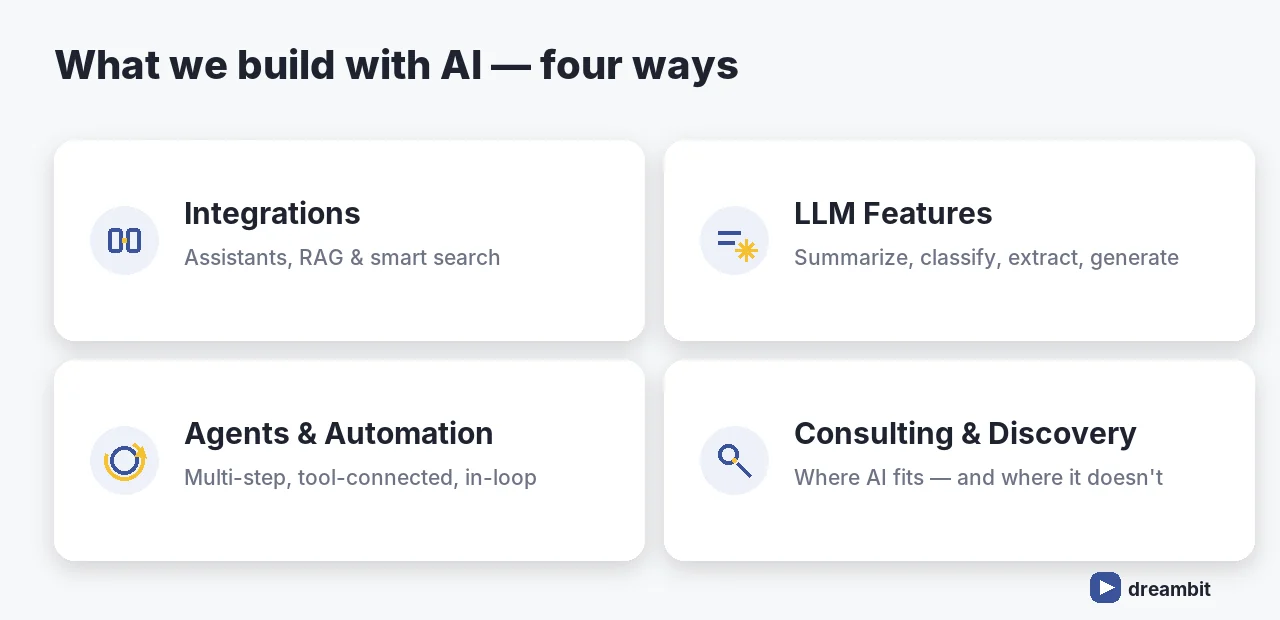
Dreambit’s AI integration services cover four areas: AI integrations in your product (assistants, RAG, smart search), LLM-powered features (summarization, classification, extraction, generation), AI agents and automation, and AI consulting and discovery — all built into real products, not demos.
Retrieval-Augmented Generation grounds AI answers in your own documents, knowledge base, and policies, and cites sources — instead of the model making things up. It’s how we make assistants and smart search reliable enough to put in front of your users.
Your code and data aren’t used to train models, and sensitive work runs under a separate access regime. Generated code goes through the same reviews and checks as human code, plus a dedicated AI vulnerability pass — AI gets no bypass.
Yes. We build tool-connected agents that act across your stack — databases, APIs, and internal tools — to carry out multi-step work end to end, with human-in-the-loop checkpoints where the cost of error is high, not a black box.
That’s what our AI consulting and discovery is for. We map where AI will genuinely move the needle versus where it would just burn budget, give a realistic feasibility and architecture plan, and build a fast prototype so decisions are made on evidence, not hype.
Not “we use AI.” An engineering system where AI is a full participant in the process — bounded by our rules, and verified by our own controls — through Spec-Driven Development.
Why this isn’t another AI article
Every other studio today says “we do AI.” The only thing that matters is whether there’s engineering discipline behind it, or just marketing. Here’s how it actually works for us — with specifics, not slogans.
The core: Spec-Driven Development
We build through Spec-Driven Development (SDD). This isn’t a detail — it’s the reason AI gives us predictable results instead of guesswork.
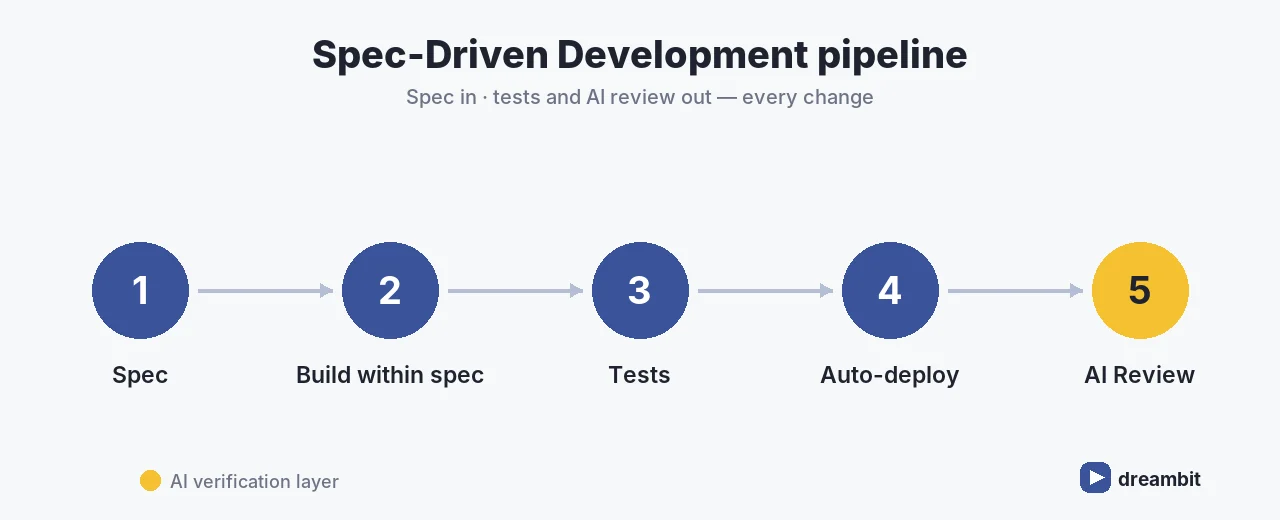
The model never works from a vague “build this feature.” First comes a clear specification that becomes a contract for both the human and the AI:
- Spec first — we define expected behavior before any code is written
- Implementation within the spec — the engineer drives the AI along the contract, not the other way around
- Full test coverage — tests confirm conformance to the spec, not abstract coverage numbers
- Automatic deployment — passes the pipeline → it ships, no manual busywork
- AI verification of the result — a separate verification layer on top of the tests
The point: AI is never left unchecked. Spec on the way in, tests and AI review on the way out. That’s why speed never costs us quality.
A real task, in numbers
To avoid speaking in abstractions. Take a typical feature — integrating a payment provider into a B2B product:
- Before: ~10 working days — ramp-up, implementation, tests, review, fixes
- Now: ~2.5 days at the same level of coverage and quality
- Where the time was saved: ramping up on the API and docs — hours instead of days; initial implementation and tests in parallel; first-pass review — AI catches the obvious before a human does
- What did NOT change: the final call on architecture and edge cases stays with the engineer (the spirit of CTO-as-a-service)
This isn’t “AI did everything.” AI removed the rote work, and our people reinvested that time where they’re irreplaceable.
What practice taught us (not tutorials)
The real value isn’t the tools — it’s knowing their limits. A few lessons that show we genuinely live in this:
- Coverage ≠ test quality. AI will happily generate tests that hit 90% coverage and verify nothing meaningful. We’ve learned to demand behavior- and edge-case tests, not line-chasing.
- More context ≠ better output. Dumping the whole codebase on the model is worse than handing it a precise slice. Curated context wins. At scale, that’s the difference between a working solution and mush.
- AI is confidently wrong. The most dangerous output is plausible-but-incorrect code. That’s exactly why everything goes through spec + tests + verification, not “looks fine → merge.”
The full set of our processes, skills, and templates is our intellectual property. But the depth at which we can talk about it is the proof that it exists.
How we keep quality and security with AI
Speaking directly to what a CTO worries about:
- Code security. Generated code goes through the same reviews and checks as human code — plus a dedicated AI pass for vulnerabilities. AI gets no bypass.
- Client data & IP. We work in environments where client code and data are not used to train models; sensitive projects run under a separate access regime.
- Maintainability. SDD ties code to a specification and tests — anyone on the team can maintain it, not just the original author.
- Hallucination control. Spec + tests + AI verification are three independent filters. A plausible error doesn’t survive to production.
Tooling: the right model for the task
Our approach is pragmatic, not religious. It doesn’t matter which IDE an engineer uses — Cursor, Copilot, Figma AI, and others are all in play. What does matter: on critical work, we don’t cut corners on model quality. We match the model to the context — the strongest where the cost of error is high, and we don’t burn resources where the task is simple.
The team: a standard, not individual chaos
- Documented processes and constraints for working with AI — the same for everyone
- Onboarding and training — new people are brought into the methodology, not left to figure it out alone
- A strong team — knowledge circulates, there’s always someone to ask; the bar doesn’t depend on “getting lucky with an AI enthusiast”
The result
3–5× faster at the same level of quality.
No compromise — the speed came from methodology, not cut corners. Scale, flexibility, security — proven in practice, not in theory. You get a battle-tested system, not an experiment.
Frequently Asked Questions
Spec-Driven Development is an approach where a clear specification is written before any code, becoming a contract for both the engineer and the AI. The model implements within the spec, tests confirm conformance, and a separate AI review verifies the result. It is how we get predictable output from AI instead of guesswork.
Generated code goes through the same reviews and checks as human-written code, plus a dedicated AI pass for vulnerabilities — AI gets no bypass. Combined with the spec and tests, that gives three independent filters, so a plausible-but-wrong change does not reach production.
Not the way we work. Speed comes from methodology, not cut corners. Spec-driven development ties every change to a specification and tests, so any team member can maintain it — not just the original author. Coverage alone is not enough; we demand behaviour and edge-case tests.
The most dangerous output is plausible-but-incorrect code, so we never merge on “looks fine.” Spec, tests, and AI verification act as three independent filters, so a confident-but-wrong result is caught before it ships.
On a typical feature — integrating a payment provider into a B2B product — we went from about 10 working days to roughly 2.5 at the same quality: 3–5× faster overall. The speed came from methodology, not from lowering the bar.